Hot take: Dining scenes are overdone.
No pun intended.
In all seriousness, it’s time we examine the utility of dining scenes. You know the type: a bunch of characters have been assembled so you can Share the Important Information to everyone all in one go. Whether it’s breakfast, lunch, or dinner, these moments are everywhere, and oftentimes, they’re a hallmark of lazy writing. Dining scenes are like putting your characters on an elevator to get from floor one to floor fifty: they’re in close proximity, which provides tension; leaving early causes a problem; and there are likely spectators, people whose presence complicates conversation.
The thing is, these types of scenes are a crutch. They’re an easy way to get a group of characters together in a setting that’s dramatic to leave. How many scenes have you read where someone angrily storms away from a dining table? Or take another example, the family dinner where The Announcement is made (“we’re moving,” “I’m pregnant,” “we’re getting married”). And let’s not forget the proposal dinner. Dining scenes signal to the reader what’s about to happen, which makes that reveal so much less meaningful.
I always encourage fellow writers to make their work unique, whether it’s setting, characters, phrasing, etc. But like beginning a scene with a character waking up, there’s nothing unique about a dinner. Everybody has to eat. So ask yourself, is there another setting I can use that is specific to my story? Maybe your characters are musicians and you can stick them into a practice room. Maybe they’re feuding royals and they end up on a hunting trip together. Maybe they’re space explorers and they get stuck cleaning the escape pod. Whatever it is, pick something that will set your setting apart and make it meaningful. Just please, get away from the dinner table.

Showing posts with label setting. Show all posts
Showing posts with label setting. Show all posts
Tuesday, February 11, 2020


Thursday, August 31, 2017
THE WRITERS' BLOCK: Exercises for Overcoming a Creative Slump (#1: Setting the Scene)
In this new series, Operation Awesome is providing exercises to help you break out of writer's block, or a creative slump. Too often, we get stuck with writer's block because we believe when the words don't flow organically, or when the sentences don't come out perfectly structured, or when the plot has holes, we've failed. Usually, it just means you're having an off day, and forcing yourself to write on these days can perpetuate the feeling of being stuck. It can really help to take a day off from writing, but that doesn't mean taking a day off from working on your book. These exercises will help you work on your book when you're not actually writing.
So, none of our exercises involve narrative writing, per se. Instead, they require you to think, daydream, talk to your characters, and CREATE. You can jot down notes as you go, or you can record yourself talking through the exercises, or you can keep everything in your head.
For Exercise #1, we're going to focus on SETTING. A great setting engages all the readers' senses, and more. It's of course important to create a rich visual setting, but don't forget all the other senses while you're at it. And go the next step: think about the emotional (and sometimes even physical) impact the setting has on your characters.
Close your eyes, or go into a dark, quiet room, and put yourself into the setting of your story world, or any given scene from your novel. Can you describe your story world in terms of all five senses, along with the emotional impact on your characters?
VISION: What colors permeate your world? What objects are situated around the landscape? Are you outdoors or indoors? Are there natural or manmade structures? Are there plants, animals, other people? What do the other people look like? What kinds of clothes do they wear? Does your main character find the land beautiful, the people attractive, or the opposite?
HEARING: Setting aside the characters' voices, what other sounds exist in your world? Birds chirping, leaves fluttering, typewriters clacking, bedsheets rustling, TVs droning, machines whirring? Sometimes, authors get so caught up with visual description, they neglect to show the auditory richness of their story. Close your eyes and listen to your world.
TOUCH: Is the setting cold, hot, rainy, snowy, or a combination? Is the air thick with humidity, or does the wind move your characters' hair? If your character runs her fingers through the grass, are the blades stiff, pliant, wet, or sticky? When your character kisses his love interest for the first time, do their lips feel soft, slick, chapped, or dry? We are incredibly tactile creatures, so don't forget to take advantage of that when imagining your world.
SMELL: Odors can be very powerful, both the delicious ones and the disgusting ones. Bread baking, freshly-mown grass, and burning incense can all evoke positive thoughts and emotions. Smells like garbage, dead animals, and spoiled milk can all do the opposite. Play with what your world smells like.
TASTE: This is probably the least utilized sense in writing, but it can work for you. When your character bites into a steak, how is that taste different from biting into a chocolate bar? What about your character tasting her first-ever alcoholic drink - remember what that tasted like? What about a vile, disgusting taste - spoiled food, or something like Marmite that many people don't enjoy?
EMOTION: Does the setting evoke memories? Sense memories (such as hearing an old song, smelling bread baking, etc.) can be powerfully evocative. Does some aspect of the setting evoke strong emotions in your characters, whether it's anger, sadness, happiness, etc.? Does it drive them to action?
How'd it go? Were you able to better actualize your story setting?
So, none of our exercises involve narrative writing, per se. Instead, they require you to think, daydream, talk to your characters, and CREATE. You can jot down notes as you go, or you can record yourself talking through the exercises, or you can keep everything in your head.
For Exercise #1, we're going to focus on SETTING. A great setting engages all the readers' senses, and more. It's of course important to create a rich visual setting, but don't forget all the other senses while you're at it. And go the next step: think about the emotional (and sometimes even physical) impact the setting has on your characters.
Close your eyes, or go into a dark, quiet room, and put yourself into the setting of your story world, or any given scene from your novel. Can you describe your story world in terms of all five senses, along with the emotional impact on your characters?
VISION: What colors permeate your world? What objects are situated around the landscape? Are you outdoors or indoors? Are there natural or manmade structures? Are there plants, animals, other people? What do the other people look like? What kinds of clothes do they wear? Does your main character find the land beautiful, the people attractive, or the opposite?
HEARING: Setting aside the characters' voices, what other sounds exist in your world? Birds chirping, leaves fluttering, typewriters clacking, bedsheets rustling, TVs droning, machines whirring? Sometimes, authors get so caught up with visual description, they neglect to show the auditory richness of their story. Close your eyes and listen to your world.
TOUCH: Is the setting cold, hot, rainy, snowy, or a combination? Is the air thick with humidity, or does the wind move your characters' hair? If your character runs her fingers through the grass, are the blades stiff, pliant, wet, or sticky? When your character kisses his love interest for the first time, do their lips feel soft, slick, chapped, or dry? We are incredibly tactile creatures, so don't forget to take advantage of that when imagining your world.
SMELL: Odors can be very powerful, both the delicious ones and the disgusting ones. Bread baking, freshly-mown grass, and burning incense can all evoke positive thoughts and emotions. Smells like garbage, dead animals, and spoiled milk can all do the opposite. Play with what your world smells like.
TASTE: This is probably the least utilized sense in writing, but it can work for you. When your character bites into a steak, how is that taste different from biting into a chocolate bar? What about your character tasting her first-ever alcoholic drink - remember what that tasted like? What about a vile, disgusting taste - spoiled food, or something like Marmite that many people don't enjoy?
EMOTION: Does the setting evoke memories? Sense memories (such as hearing an old song, smelling bread baking, etc.) can be powerfully evocative. Does some aspect of the setting evoke strong emotions in your characters, whether it's anger, sadness, happiness, etc.? Does it drive them to action?
How'd it go? Were you able to better actualize your story setting?
Monday, March 6, 2017
Teen Writers' Workshop
In mid-March, I’ll be teaching a writers’ workshop for teens ages 14-19.
Everywhere I’ve taken my books, I’ve encountered young people who love to
write. When I was that age, the writing bug had already bitten me too, though in a
different form than what infects me now. I loved writing for my school yearbook and
newspaper and hoped, one day, to be a journalist. Fast forward a couple of
decades, and I found my true love—writing young adult fiction.

With a strong desire to share what I’ve learned with young
writers, I composed a six-part workshop that will cover everything from
plot to setting to sentence structure to editing to publishing. Because I believe
it’s so important to writers’ careers that they learn to network, I’ve also
invited other authors to make guest appearances. In addition, students will have the
opportunity to learn how to give constructive critique and receive critique on
their work in progress. My publisher, Rebelight Publishing, was excited to work together to bring this course to the teens in my community.

I hope that by
giving the next generation of writers information and inspiration, they’ll have a good foundation for
their writing careers and avoid some common pitfalls.
If you live in Winnipeg or surrounding areas, spread the
word. I’m really looking forward to meeting, teaching, and encouraging Manitoba's young
writers. Register online: Teen Writers' Workshop
*******
Melinda Marshall Friesen writes sci-fi/dystopian novels for teens and adults. Her most recent release, The High-Maintenance Ladies of the Zombie Apocalypse is equal parts suspence, gore, and humor. Check out her books here: Books by Melinda Marshall Friesen
Monday, January 19, 2015
Crow's Rest Book Trailer, and the Making Of
But first--the book trailer! And make sure you have the volume on; you won't want to miss the soundtrack.
Hope the trailer entertained and intrigued you! You can find pre-order and Goodreads info on Crow's Rest here.
These are all my images, by the way, which saved me a tremendous amount of licensing fees. I did end up buying a program to give the whistling of my original song a little reverb, and then bought some stock audio of the crows, so the entire trailer cost me $3.89!
First off, once I had the script finalized, I knew I wanted to set the mood and place the story into its setting. To open the trailer, I used a few photos set in the Sierra foothills town that inspired Crow's Rest--and its haunted Castle. Here's another look in case they went by too quickly:
 |
| This is taken from the town cemetery, looking towards the Castle |
 |
| This is an interior shot of the haunted Castle--which was abandoned for years after it did its duty as a boys' reformatory--and the perfect shot to accompany "Rumors that strange happenings are on the rise" |
 |
| The exterior of the Castle, with one of the turrets that helped earn it its nickname (it was more properly called the Preston School of Industry when it opened in the 19th century) |
 |
| Uncle Tam is the caretaker for an historic cemetery, so Avery and Daniel spend a lot of time hanging around tombstones |

The corbin picture is actually of a rook in Ireland--we definitely don't get these birds around here! But the crows that flock around my garden won't hold still for pictures, and I loved this ones's soulful expression.
 |
| For the trailer, I added a little violet to his eye color and cropped in tight on his face |

And the next one is the ruins of Kilcatherine church, which date back to the 7th century

That cheeky raven pic is from a trip to Bryce Canyon, but this post is already rather long so I'll skip adding that one! I just wanted to give you all an idea of what you can do with images that might already be in your photo collections, and that you don't need to spend a lot. For the links on the Power Point tutorials that helped me create this book trailer, see my post from November 24 here on Operation Awesome.
Sunday, September 7, 2014
Reasons for Requesting: Setting
As mentioned the last time I posted, I went to Alaska this summer on a cruise with my family. It was truly a beautiful, breathtaking landscape. The kind that gets you inspired to write epic fantasy with huge, sweeping landscapes. Mostly because it almost doesn't seem real. Below are some pictures from the trip, including some sleepy sea lions :)


The weather was amazing to match the scenery. A picture is worth a thousand words, they say. So it can be hard to make an image come to life with only a few paragraphs.
One of the great powers of writers is to make places that exist only in words come to life in the readers mind. Its a hard task and definitely one I struggle most with as a writer. Dialogue flows easily. Plot and characters? One of my strong suits. But imagery of any kind, particularly setting? I struggle big time with that.
So when a see a writer who can nail that setting? GIMME! The setting is as much a character as anyone else in your story. It should be a fully integrated element of the story. A most recent example I've come across of pitch perfect setting is The Shadow of the Wind by Carlos Ruiz Zafon. Spain is a huge part of the story and this book makes me want to visit.
In the end, that's really what your setting should do. Make us want to BE there. Make us want to hop onto the nearest train to Spain, Italy, Alaska or any number of fantastical locations. There are a lot of important elements that go into fleshing out a world, but setting is one of the most important.
Helpful tip for setting if you're bad at it like I am: Practice with describing places. It doesn't matter if its your local coffee shop or the glaciers of Alaska. Practice setting the scene to help it become more natural. And use all five senses when you do. Practice makes perfect right? And it might just land you an agent!
Sunday, August 3, 2014
Setting is more than just scenery
Setting isn't the coolest aspect of writing. Maybe because many of us associate it with a long passages of scenic description or town history and backstory that we associate with 19th century novels -- you know, the sort of thing we call infodump and edit out immediately.
But a realistic or contemporary novel can have a specific sense of place. "World-building" is associated with fantasy, but every novel builds its own world, whether it's one that's familiar or foreign, a meticulous recreation or the author's invention.
When I wrote Deadwood, I wanted to create a specificity of place -- the outer Philadelphia neighborhoods of Mount Airy and Andorra, the inner suburbs of the Mainline and Delaware County, the leafy urban parks where I've spent. I decided to do this because it's too common to think of some places as non-places -- places without regional character, places where nothing happens. But there are stories everywhere if you find them or write them.
Setting is specificity of place, accent, culture, geography, history, and architecture. In Deadwood, aspects of setting were almost a character -- Deadwood Park, the geographical and emotional center of the story. I had a very clear map in my head about where everything was. I didn't draw it out, but next time, maybe I will.
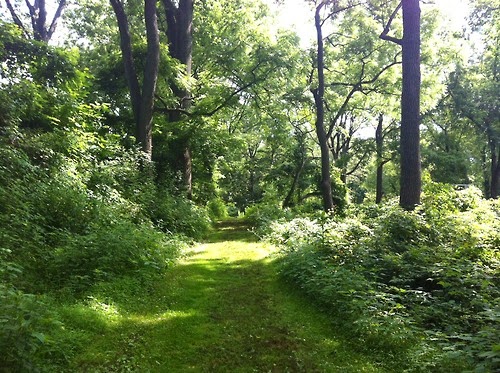 Brynwood Valley Park is based on few places: Wynnewood Valley Park in Wynnewood, Powder Mill Park, Haverford Heritage Trail, and Cobbs Creek in Haverford Township, and Wissahickon Valley Park and Carpenter’s Woods in Philadelphia.
 I love gatehouses, and I based Jenna Blitzer’s house on a couple near me. Most of them are right near the main roads, but the estate that they guarded are gone – knocked down for development.
 I based the high school/municipal complex on the layout of Upper Dublin, where I went to high school. The district rebuilt the school a few years ago, but I was describing the old layout. I walked around the new school about a month ago, and it was such a strange feeling. I felt like I could see the ghost of the old school in the new one.
 The geography of Hannah’s neighborhood is based on Manayunk, a neighborhood in Philadelphia with rowhouses and twins on super steep streets. Manayunk was originally a milltown, like Lower Brynwood.
Does a sense of place matter in the stories you write? Do you try to be universal or specfic when it comes to regionality? Do you prefer to write the exotic or the everyday?
And for another perspective, read this excellent guest post by PK Herzo:
Settings that Pop
About Kell Andrews: Kell Andrews writes picture books and middle grade novels. Deadwood, her middle-grade contemporary fantasy about a cursed tree, is out now from Spencer Hill Middle Grade.
But a realistic or contemporary novel can have a specific sense of place. "World-building" is associated with fantasy, but every novel builds its own world, whether it's one that's familiar or foreign, a meticulous recreation or the author's invention.
When I wrote Deadwood, I wanted to create a specificity of place -- the outer Philadelphia neighborhoods of Mount Airy and Andorra, the inner suburbs of the Mainline and Delaware County, the leafy urban parks where I've spent. I decided to do this because it's too common to think of some places as non-places -- places without regional character, places where nothing happens. But there are stories everywhere if you find them or write them.
Setting is specificity of place, accent, culture, geography, history, and architecture. In Deadwood, aspects of setting were almost a character -- Deadwood Park, the geographical and emotional center of the story. I had a very clear map in my head about where everything was. I didn't draw it out, but next time, maybe I will.
Top 5 places in Deadwood that are based on places in real life.
Does a sense of place matter in the stories you write? Do you try to be universal or specfic when it comes to regionality? Do you prefer to write the exotic or the everyday?
And for another perspective, read this excellent guest post by PK Herzo:
Settings that Pop
About Kell Andrews: Kell Andrews writes picture books and middle grade novels. Deadwood, her middle-grade contemporary fantasy about a cursed tree, is out now from Spencer Hill Middle Grade.
Subscribe to:
Posts (Atom)