It was a big day for me when I started writing for Operation Awesome nearly five years ago.
I felt unnecessary. There were a lot of bloggers out there, a lot of more accomplished writers with more to say about writing craft.
I felt exposed. For the first time, I was standing up in public and saying that I am a writer.
In the past five years, the industry has changed so much, and so have I. I lost my agent, published a book. Gained an agent, lost my publisher. Published a book again, sold another one. That's the short version. The long version happened day by day, word by word. It happened in my real life, and and a lot of happened here, with the writers and readers of Operation Awesome.
And now, as I'm stepping down as a blogger here, it's another big day.
I feel necessary. There are always more writers, always more books. I hope what I write matters to readers, but I can't control that part. Regardless, what I write matters to ME.
I feel exposed. This part is fine -- it's how a writer should feel. When you feel exposed, there are real emotions on the page. You have to open yourself if you want your words to matter.
And that's why I feel like I belong. Being part of Operation Awesome meant I was part of the community of writers. This community is large. It's diverse, inclusive, factional, and argumentative at times. It has big communal rooms, dark corners, murder holes, and secret passage ways. It's a magic castle and a home at the same time.
I'm leaving Operation Awesome, but Operation Awesome brought me into the writers' community. I'm grateful for all the posters and bloggers, and especially for the original group who dragged me along into blogging. I'm grateful for the people who I met here.
I'll see you all in other corners of the community we built together and that we all share.

Showing posts with label kell andrews. Show all posts
Showing posts with label kell andrews. Show all posts
Sunday, April 26, 2015


Sunday, December 7, 2014
LIst Season
Santa's making a list and checking it twice. Kids have lists of what the toys and gifts they're wishing for. Grownups have their shopping lists and long tallies of "to do."
And every critic, blogger, and publication has a year-end list of the books that are best, most notable, most this that or other.
I'm not on those lists.
It's hard not to look at the names on the "best of" and wish I saw my book there. It's hard not to regret a little, to be a little jealous, even complain a little.
But that's OK. It's List Season, and I have lists of my own.
The books I've read.
The words I've written.
The stories I've sold.
The readers I've reached.
The agent, editors, and publicist who have stood by me.
The writers and bloggers who have supported my writing.
The librarians, reviewers, and booksellers who have supported my book.
The friends and family who have supported my everything.
The people I love.
Hey look! I just made another list. If I start feeling left out, I'll read that one again instead.
Thanks to all the friends of Operation Awesome for another wonderful year on the blog -- I'd list you too but it would be too long.
And every critic, blogger, and publication has a year-end list of the books that are best, most notable, most this that or other.
I'm not on those lists.
It's hard not to look at the names on the "best of" and wish I saw my book there. It's hard not to regret a little, to be a little jealous, even complain a little.
But that's OK. It's List Season, and I have lists of my own.
The books I've read.
The words I've written.
The stories I've sold.
The readers I've reached.
The agent, editors, and publicist who have stood by me.
The writers and bloggers who have supported my writing.
The librarians, reviewers, and booksellers who have supported my book.
The friends and family who have supported my everything.
The people I love.
Hey look! I just made another list. If I start feeling left out, I'll read that one again instead.
Thanks to all the friends of Operation Awesome for another wonderful year on the blog -- I'd list you too but it would be too long.
Sunday, November 9, 2014
Celebrating Picture Book Month
Many writers think of November as National Novel Writing Month, but there's another literary event going on, and it's much easier to celebrate: Picture Book Month. While it's hard to cram in 40,000 words of writing amid holiday celebrations, it's easy to honor and enjoy illustrated books yourself or with children.
Read them.
Read by yourself or with a child. Browse a bookstore or a library.
Talk about them.

Join the conversation at SCBWI events, online at the Blueboards, or on Twitter at #picturebookmonth.
Brainstorm them.
Participate in Picture Book Idea Month. Started by picture book writer Tara Lazar, write down an idea a day to kickstart your creative process and get your mind thinking in the weird and wild ways that inspire new stories.
Write them.
Shape off your best idea into a story. Sign up for picture book writer Julie Hedlund's 2015 12 x 12 Challenge and write a picture book manuscript per month.
Picture books are a child's first introduction to literature, but there's no need to outgrow them. Picture books are the beginning of the story of a reader, not the end.
Read them.
Read by yourself or with a child. Browse a bookstore or a library.
Talk about them.
Join the conversation at SCBWI events, online at the Blueboards, or on Twitter at #picturebookmonth.
Brainstorm them.
Participate in Picture Book Idea Month. Started by picture book writer Tara Lazar, write down an idea a day to kickstart your creative process and get your mind thinking in the weird and wild ways that inspire new stories.
Write them.
Shape off your best idea into a story. Sign up for picture book writer Julie Hedlund's 2015 12 x 12 Challenge and write a picture book manuscript per month.
Picture books are a child's first introduction to literature, but there's no need to outgrow them. Picture books are the beginning of the story of a reader, not the end.
Sunday, October 26, 2014
Two Reactions When You Tell Non-Writers You Have a Book Out
The other day, a friend was feeling insecure because of the reaction she got when she told people her book was self-published. It's the same reaction I get when I tell people about my own book, out from a newer medium-sized press. It's the same reaction I've heard directed at Big-Five published authors.
So I realized there are two main reactions anyone gets when they tell non-writers they have a book (or books) out:
1) They are impressed because I've written and published a book, and the details don't matter.
2) They are not impressed and could never be impressed, because they've never heard of me, my book or my publisher, my genre is wrong, my method of publishing is wrong, my book is published in the wrong format, their cousin got published much younger than I am, there's no movie of my book, their next-door-neighbor has a Pulitzer, National Book Award, Newbery, and Caldecott for a string of New York Times bestsellers, and they are absolutely sure they'd do better if they tried it themselves.
When I get Reaction Number One, my tendency is to downplay what I've done. After all, when you hang out with writers, it seems like everyone writes books! But it's not that way for non-writers, so now I try to just take the compliment. Writing books is hard! I know it. You know it. Everyone I know who writes books knows it. And people who don't write books know it too. It's an accomplishment.
Reaction Number Two is the one that undermines confidence, and no writer is immune because there are always writers who are more successful, or who others perceive as producing books that matter more.
But the reaction that really matters isn't from people at cocktail parties or the line at the post office, but people who actually read my book. If I amuse, touch, provoke, or create a reaction, that's what really matters. I write for readers and myself, not for a conversational starter.
And while I don't know how everyone I meet has a cousin who won a Nobel Prize for Literature at the age of 22, it seems to happen. So I try to take the intent of speaker not as showupmanship, but as a conversational convention, like when you find out somebody is from the same hometown as your college roommate and you are compelled to ask if they know her.
Non-writers are just looking for common ground, same as me -- something to say. And guess what? I'm impressed by their cousin, because it IS an accomplishment, and I love any opening to talk about books, writing, the business of publishing, and people we know in common. Odds are, someone who isn't impressed knows -- or thinks they know -- about books and publishing, and there are a lot of directions that conversation can go. I want interaction, not accolades.
So bring on Reaction Number Two.
So I realized there are two main reactions anyone gets when they tell non-writers they have a book (or books) out:
 |
| Not impressed. |
2) They are not impressed and could never be impressed, because they've never heard of me, my book or my publisher, my genre is wrong, my method of publishing is wrong, my book is published in the wrong format, their cousin got published much younger than I am, there's no movie of my book, their next-door-neighbor has a Pulitzer, National Book Award, Newbery, and Caldecott for a string of New York Times bestsellers, and they are absolutely sure they'd do better if they tried it themselves.
When I get Reaction Number One, my tendency is to downplay what I've done. After all, when you hang out with writers, it seems like everyone writes books! But it's not that way for non-writers, so now I try to just take the compliment. Writing books is hard! I know it. You know it. Everyone I know who writes books knows it. And people who don't write books know it too. It's an accomplishment.
Reaction Number Two is the one that undermines confidence, and no writer is immune because there are always writers who are more successful, or who others perceive as producing books that matter more.
But the reaction that really matters isn't from people at cocktail parties or the line at the post office, but people who actually read my book. If I amuse, touch, provoke, or create a reaction, that's what really matters. I write for readers and myself, not for a conversational starter.
And while I don't know how everyone I meet has a cousin who won a Nobel Prize for Literature at the age of 22, it seems to happen. So I try to take the intent of speaker not as showupmanship, but as a conversational convention, like when you find out somebody is from the same hometown as your college roommate and you are compelled to ask if they know her.
Non-writers are just looking for common ground, same as me -- something to say. And guess what? I'm impressed by their cousin, because it IS an accomplishment, and I love any opening to talk about books, writing, the business of publishing, and people we know in common. Odds are, someone who isn't impressed knows -- or thinks they know -- about books and publishing, and there are a lot of directions that conversation can go. I want interaction, not accolades.
So bring on Reaction Number Two.
Sunday, August 31, 2014
Excerpts and the Art of Ellipsis: Dot dot dot vs. yadda yadda yadda
Now that my middle-grade debut Deadwood is out, I have industry and blog reviews. Some writers won't read their reviews, but I do. At the very least, a review shows that your book exists! Someone read it and thought enough to write about it. I'm very grateful for each one and include review excerpts on my site.
And that's where the art of ellipsis comes in. Dot dot dot. What do you include, and what do you ellide?
Some reviews rings so many happy bells I'd love to include the whole thing, but I can't -- the copyright for the review is owned by the writer, and fair use doctrine means I have to choose an excerpt. Tough decisions!
Most reviews have phrases I love and others that I'd rather not put on a book jacket, and that makes it easier to decide what to include. Easier, but less straightforward.
There are Generally Accepted Excerpt Best Practices, which actually may not be generally accepted or well known. Here are the three biggies (reference Kirkus):
1) Do not add words to reviews (including change cases/tense)
2) Use ellipses to indicate when words are omitted.
3) Do not alter the integrity of the review.
Number one seems clear. Number two also sounds clear, but that's where things get fuzzy. If misused, your ellipses push you into number three, where the review is manipulated so that it appears to mean something it does not. For example, if a reviewer writes, "This is a great book for people with terrible taste," you can't just include "This is a great book..." because you are altering the reviewer's meaning (and why wouldn't you include the whole thing? The full pull quote makes the book sound fun!)
But experienced reviewers take pains not to include phrases that can be easily misconstrued, just as many of them purposefully include pull quotes that can be easily excerpted. Other times, you get a pretty good review with not a decent pull quote to be found -- every positive is snuggling up tight with a negative turn of phrase. And that's where it's tempting to elide, slice, and dice your way into number three territory.
The Guiding Principle:
Right:
OK:
That's not incorrect, but it's a little awkward. While the writer might just be pressed for space, a reader might wonder what is missing and suspect it's something bad.
How about this?
Questionable:
Wrong:
This one crosses the line into number three. In this case, I'm changing the whole object of the sentence! The part that's missing is crucial to the meaning. In my example, it doesn't truly change the sense, but the elided phrase could as easily be "...the reader's impatience, finally spiraling into general silliness and..." This is where the dot dot dot is the review equivalent of yadda yadda yadda in an old Seinfeld episode.
Every review is individual, and every excerpt has to be included on case-by-case basis, considering the content and character count where the excerpt is to be placed. Now if only we could use ellipses in our everyday life! I'd replace every "but" with a dot dot dot.
And that's where the art of ellipsis comes in. Dot dot dot. What do you include, and what do you ellide?
Some reviews rings so many happy bells I'd love to include the whole thing, but I can't -- the copyright for the review is owned by the writer, and fair use doctrine means I have to choose an excerpt. Tough decisions!
Most reviews have phrases I love and others that I'd rather not put on a book jacket, and that makes it easier to decide what to include. Easier, but less straightforward.
Excerpt Best Practices
There are Generally Accepted Excerpt Best Practices, which actually may not be generally accepted or well known. Here are the three biggies (reference Kirkus):
1) Do not add words to reviews (including change cases/tense)
2) Use ellipses to indicate when words are omitted.
3) Do not alter the integrity of the review.
Number one seems clear. Number two also sounds clear, but that's where things get fuzzy. If misused, your ellipses push you into number three, where the review is manipulated so that it appears to mean something it does not. For example, if a reviewer writes, "This is a great book for people with terrible taste," you can't just include "This is a great book..." because you are altering the reviewer's meaning (and why wouldn't you include the whole thing? The full pull quote makes the book sound fun!)
But experienced reviewers take pains not to include phrases that can be easily misconstrued, just as many of them purposefully include pull quotes that can be easily excerpted. Other times, you get a pretty good review with not a decent pull quote to be found -- every positive is snuggling up tight with a negative turn of phrase. And that's where it's tempting to elide, slice, and dice your way into number three territory.
The Guiding Principle:
Use the reviewer's words and intent
as your guide, not what you wish the reviewer would have said and meant.
As an example of what works and what doesn't, I'm including a short excerpt from my review from Foreword Magazine here, and different ways to elide it that are right, ok, questionable, and wrong.
Right:
“Danger lurks around every corner, but these two strong characters — both of them sporty and clever, with diverse backgrounds — can hold their own. Short chapters amp up the pace and hold attention, bolstering the story’s wild suspense.” —Foreword MagazineLove the whole thing! Yay. Now, what if I excerpted it like this?
OK:
"Danger lurks around every corner, but these two strong characters ... can hold their own."
That's not incorrect, but it's a little awkward. While the writer might just be pressed for space, a reader might wonder what is missing and suspect it's something bad.
How about this?
Questionable:
“Danger lurks around every corner, but these two ... characters ... can hold their own"Definitely awkward, misleading, and bowdlerized into vagueness. The reader might play MadLibs with the missing modifier, and it may not be flattering: "annoyingly peppy," "Marysue-like," "Completely unbelievable."
Wrong:
"Short chapters amp up the ....wild suspense.”
This one crosses the line into number three. In this case, I'm changing the whole object of the sentence! The part that's missing is crucial to the meaning. In my example, it doesn't truly change the sense, but the elided phrase could as easily be "...the reader's impatience, finally spiraling into general silliness and..." This is where the dot dot dot is the review equivalent of yadda yadda yadda in an old Seinfeld episode.
Every review is individual, and every excerpt has to be included on case-by-case basis, considering the content and character count where the excerpt is to be placed. Now if only we could use ellipses in our everyday life! I'd replace every "but" with a dot dot dot.
Your work on that project was really sound but...
You're a great girl and I've enjoyed the time we've spent together but...
Your child has been working hard to improve his behavior but...
I appreciate your insight on ellipses but....
Sunday, August 3, 2014
Setting is more than just scenery
Setting isn't the coolest aspect of writing. Maybe because many of us associate it with a long passages of scenic description or town history and backstory that we associate with 19th century novels -- you know, the sort of thing we call infodump and edit out immediately.
But a realistic or contemporary novel can have a specific sense of place. "World-building" is associated with fantasy, but every novel builds its own world, whether it's one that's familiar or foreign, a meticulous recreation or the author's invention.
When I wrote Deadwood, I wanted to create a specificity of place -- the outer Philadelphia neighborhoods of Mount Airy and Andorra, the inner suburbs of the Mainline and Delaware County, the leafy urban parks where I've spent. I decided to do this because it's too common to think of some places as non-places -- places without regional character, places where nothing happens. But there are stories everywhere if you find them or write them.
Setting is specificity of place, accent, culture, geography, history, and architecture. In Deadwood, aspects of setting were almost a character -- Deadwood Park, the geographical and emotional center of the story. I had a very clear map in my head about where everything was. I didn't draw it out, but next time, maybe I will.
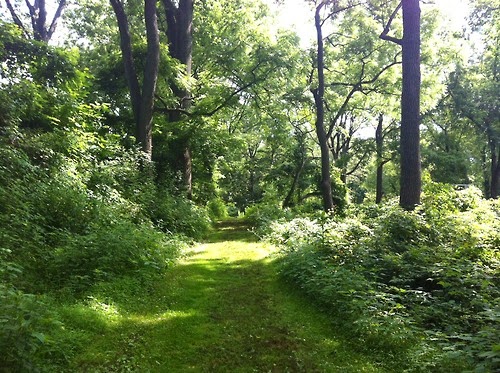 Brynwood Valley Park is based on few places: Wynnewood Valley Park in Wynnewood, Powder Mill Park, Haverford Heritage Trail, and Cobbs Creek in Haverford Township, and Wissahickon Valley Park and Carpenter’s Woods in Philadelphia.
 I love gatehouses, and I based Jenna Blitzer’s house on a couple near me. Most of them are right near the main roads, but the estate that they guarded are gone – knocked down for development.
 I based the high school/municipal complex on the layout of Upper Dublin, where I went to high school. The district rebuilt the school a few years ago, but I was describing the old layout. I walked around the new school about a month ago, and it was such a strange feeling. I felt like I could see the ghost of the old school in the new one.
 The geography of Hannah’s neighborhood is based on Manayunk, a neighborhood in Philadelphia with rowhouses and twins on super steep streets. Manayunk was originally a milltown, like Lower Brynwood.
Does a sense of place matter in the stories you write? Do you try to be universal or specfic when it comes to regionality? Do you prefer to write the exotic or the everyday?
And for another perspective, read this excellent guest post by PK Herzo:
Settings that Pop
About Kell Andrews: Kell Andrews writes picture books and middle grade novels. Deadwood, her middle-grade contemporary fantasy about a cursed tree, is out now from Spencer Hill Middle Grade.
But a realistic or contemporary novel can have a specific sense of place. "World-building" is associated with fantasy, but every novel builds its own world, whether it's one that's familiar or foreign, a meticulous recreation or the author's invention.
When I wrote Deadwood, I wanted to create a specificity of place -- the outer Philadelphia neighborhoods of Mount Airy and Andorra, the inner suburbs of the Mainline and Delaware County, the leafy urban parks where I've spent. I decided to do this because it's too common to think of some places as non-places -- places without regional character, places where nothing happens. But there are stories everywhere if you find them or write them.
Setting is specificity of place, accent, culture, geography, history, and architecture. In Deadwood, aspects of setting were almost a character -- Deadwood Park, the geographical and emotional center of the story. I had a very clear map in my head about where everything was. I didn't draw it out, but next time, maybe I will.
Top 5 places in Deadwood that are based on places in real life.
Does a sense of place matter in the stories you write? Do you try to be universal or specfic when it comes to regionality? Do you prefer to write the exotic or the everyday?
And for another perspective, read this excellent guest post by PK Herzo:
Settings that Pop
About Kell Andrews: Kell Andrews writes picture books and middle grade novels. Deadwood, her middle-grade contemporary fantasy about a cursed tree, is out now from Spencer Hill Middle Grade.
Sunday, July 6, 2014
Celebrating Deadwood Release With an Operation Awesome Appreciation giveaway
Deadwood, my middle-grade mystery fantasy debut, is out from
Spencer Hill Press at long last.
This is the second go-round for me, and believe me, I know how fragile the dream of writing is. My kids’ contemporary fantasy was first released by a small press which went out of business, and now it's out in a beautiful new edition from Spencer Hill Press. There have been a lot of twists, bumps, and flat tires on this road.
I've been telling my story here on the Operation Awesome blog for four years now, and I'm so grateful for the support this community has shown me. I might not still be writing if I hadn't been forced to have something to say by the bloggers, friends, and readers of OA. In my first blog post in 2010, I wrote, "It's hard to put myself out to the world as a writer, to suggest to others in the literary community that I have something worth saying. As an unpublished writer, the hardest part is to expose my dreams to family, friends, and not-so-friends before those dreams have been fulfilled."
That's still true as a published writer -- my dreams still feel exposed. But it's worth it, and I want to thank you for being here for me during the high and low points. Today is a high one -- thank you for celebrating.
I want to get Deadwood into your hands, and I'm giving away two copies. Just comment, and you're entered. If you win, you can choose paperback or ebook. Giveway winners picked July 13.

This is the second go-round for me, and believe me, I know how fragile the dream of writing is. My kids’ contemporary fantasy was first released by a small press which went out of business, and now it's out in a beautiful new edition from Spencer Hill Press. There have been a lot of twists, bumps, and flat tires on this road.
I've been telling my story here on the Operation Awesome blog for four years now, and I'm so grateful for the support this community has shown me. I might not still be writing if I hadn't been forced to have something to say by the bloggers, friends, and readers of OA. In my first blog post in 2010, I wrote, "It's hard to put myself out to the world as a writer, to suggest to others in the literary community that I have something worth saying. As an unpublished writer, the hardest part is to expose my dreams to family, friends, and not-so-friends before those dreams have been fulfilled."
That's still true as a published writer -- my dreams still feel exposed. But it's worth it, and I want to thank you for being here for me during the high and low points. Today is a high one -- thank you for celebrating.
I want to get Deadwood into your hands, and I'm giving away two copies. Just comment, and you're entered. If you win, you can choose paperback or ebook. Giveway winners picked July 13.
Deadwood by Kell Andrews
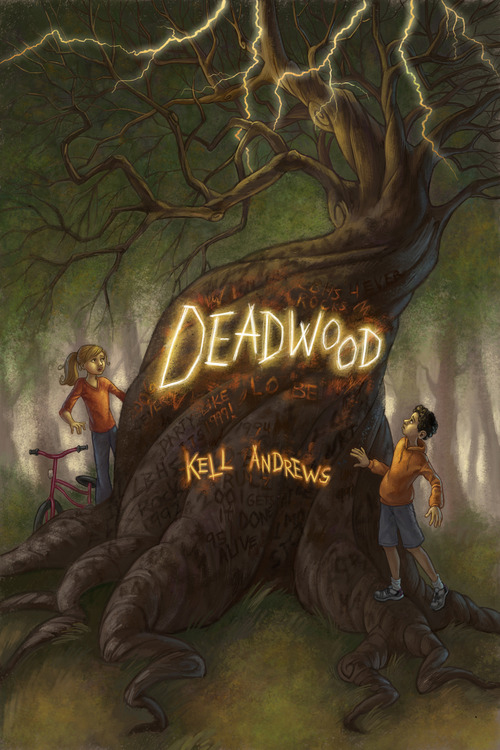
Martin gets a message from a tree saying that it’s cursed, and
so is Martin. He teams up with know-it-all soccer star Hannah, and if they
can't break the curse, their whole town will end up with a permanent case of
bad luck. Ages 10–14.
“Deadwood blends supernatural elements with an ecological message and some pretty typical middle school issues that most readers will identify with, like not being totally sure of who you are and how you fit in with the world around you … A fun book with just enough creepiness to be exciting.” —Amanda Valentine, Reads4Tweens
“A nice mix of heart and humor. … Give this one to middle grade readers who enjoy magical realism, or to anyone for whom the idea of talking with an ancient, enormous tree is irresistible.” —Jen Robinson, Jen’s Book Page
“A fast-paced, enjoyable, contemporary fantasy that upper middle graders will truly enjoy … The perfect blend of relatable contemporary, supernatural elements, mystery and environmental awareness — an amazing middle grade book for all ages to read!” —Bumbles and Fairy TalesOrder on Amazon, Barnes and Noble, BAM, Powell’s, or from your favorite independent bookstore.
Sunday, June 22, 2014
Who Tells the Story?
On Wednesday, I took my daughters to see Maleficent. We're going to see Wicked on
Broadway today with Girl Scouts, which makes this Misunderstood Women Week.
Yesterday my older daughter mentioned Morgan La Fey, who she knows mostly from the Magic Tree
House and Sisters Grimm series. I said the character she was really from King
Arthur and that in that story, she wasn't a good guy. Her eyes widened and she said,
"Morgan La Fey is a bad guy?"
And of course my answer was, "It depends who is telling the story."
Jane Eyre was one of my favorite books as teen, and then in a college course on postcolonial novels came another favorite, Wide Sargasso Sea. Jean Rhys's retelling of Jane Eyre from the point of view of Antoinette Cosway -- Rochester's wife -- showed me that the mad woman in the attic may not be at all, but simply not able to tell her own story.
Retellings of classic tales from other points of view is a favorite form of YA and MG, and the viewpoint of the villain makes a story immediately fresh. There's a reason little girls (and big ones) related better to conflicted Elsa in Frozen than open-hearted Anna. We all feel misunderstood at times, told to hide what makes us special, cast as the villain in narratives told about us.
Its frequently said that everyone is the hero in their own story. Every villain has motivations that could make them just as interesting as a main character -- or more interesting.
When I read Wide Sargasso Sea, it was both a revelation and an immediate, but it didn't replace Jane Eyre for me. I could love them both -- both novels, both Jane and Antoinette.
Similarly, there's room for both sides of the story, even in a novel with a single point of view.
What's your favorite retelling from an antagonist point of view? Do you consider and write your own stories with the antagonist viewpoint in mind?
About Kell Andrews: Kell Andrews writes picture books and middle grade novels. Deadwood, her middle-grade contemporary fantasy about a cursed tree, comes out from Spencer Hill Press, June 24, 2014.
Yesterday my older daughter mentioned Morgan La Fey, who she knows mostly from the Magic Tree
 | |
| Deadwood releases on Tuesday, June 24, 2014! Order your copy from your favorite indie bookstore or online retailer ! |
And of course my answer was, "It depends who is telling the story."
Sympathy for the Devil
Jane Eyre was one of my favorite books as teen, and then in a college course on postcolonial novels came another favorite, Wide Sargasso Sea. Jean Rhys's retelling of Jane Eyre from the point of view of Antoinette Cosway -- Rochester's wife -- showed me that the mad woman in the attic may not be at all, but simply not able to tell her own story.
Retellings of classic tales from other points of view is a favorite form of YA and MG, and the viewpoint of the villain makes a story immediately fresh. There's a reason little girls (and big ones) related better to conflicted Elsa in Frozen than open-hearted Anna. We all feel misunderstood at times, told to hide what makes us special, cast as the villain in narratives told about us.
Its frequently said that everyone is the hero in their own story. Every villain has motivations that could make them just as interesting as a main character -- or more interesting.
Room for Both Sides of the Story
When I read Wide Sargasso Sea, it was both a revelation and an immediate, but it didn't replace Jane Eyre for me. I could love them both -- both novels, both Jane and Antoinette.
Similarly, there's room for both sides of the story, even in a novel with a single point of view.
- Before you write, ask yourself, whose story is this?
- How would it change from another point of view?
- How would your antagonist tell it?
What's your favorite retelling from an antagonist point of view? Do you consider and write your own stories with the antagonist viewpoint in mind?
About Kell Andrews: Kell Andrews writes picture books and middle grade novels. Deadwood, her middle-grade contemporary fantasy about a cursed tree, comes out from Spencer Hill Press, June 24, 2014.
Sunday, June 8, 2014
Childish Things
This week there was another controversy where a columnist criticized adult readers of YA, believing that they should feel ashamed for reading books marketed to teens.
So what would she think of me? I write and read middle-grade novels and picture books.
The answer is that I don't care. Someone more brilliant has said what I think:
Then I read it too.

That was a doorway for me back to middle-grade books, which is what I began to write. It was also the doorway to fantasy novels -- middle-grade, YA, and adult -- that I had never read before.
And fantasy was something I'd been missing since I was ten. And yes, it's escapist. I read Harry Potter because it helped me escape a troubling time -- I could retell the stories to myself during the Hour of the Wolf, when I used to lie awake, toss, turn, and worry. At last I could sleep and dream of a life that wasn't mine.
But now fantasy reading is not just escapist. It teaches me about my life and those of others. Without conforming to the physics of the known world, it teaches me about it. If that level of the metaphysical isn't something that literary fiction readers can handle, maybe they should try more fantasy.
Then if they don't like it, that's OK. The writer of that think piece should read what she likes and loves, and so will I.
No shame in reading.
About Kell Andrews: Kell Andrews writes picture books and middle grade novels. Deadwood, her middle-grade contemporary fantasy about a cursed tree, comes out from Spencer Hill Middle Grade June 24, 2014.
So what would she think of me? I write and read middle-grade novels and picture books.
The answer is that I don't care. Someone more brilliant has said what I think:
This isn't exactly true of me. When I was ten, I read fairy tales and I wasn't ashamed. But when I was thirty, I saw adults reading Harry Potter, and I thought they should be.
“When I was ten, I read fairy tales in secret and would have been ashamed if I had been found doing so. Now that I am fifty, I read them openly. When I became a man I put away childish things, including the fear of childishness and the desire to be very grown up.”
― C.S. Lewis
Then I read it too.
That was a doorway for me back to middle-grade books, which is what I began to write. It was also the doorway to fantasy novels -- middle-grade, YA, and adult -- that I had never read before.
And fantasy was something I'd been missing since I was ten. And yes, it's escapist. I read Harry Potter because it helped me escape a troubling time -- I could retell the stories to myself during the Hour of the Wolf, when I used to lie awake, toss, turn, and worry. At last I could sleep and dream of a life that wasn't mine.
But now fantasy reading is not just escapist. It teaches me about my life and those of others. Without conforming to the physics of the known world, it teaches me about it. If that level of the metaphysical isn't something that literary fiction readers can handle, maybe they should try more fantasy.
Then if they don't like it, that's OK. The writer of that think piece should read what she likes and loves, and so will I.
No shame in reading.
About Kell Andrews: Kell Andrews writes picture books and middle grade novels. Deadwood, her middle-grade contemporary fantasy about a cursed tree, comes out from Spencer Hill Middle Grade June 24, 2014.
Sunday, May 11, 2014
On Writing a Sequel
When I wrote Deadwood, it was a standalone. The story was resolved at the end, and I didn’t see how it could continue.
Some readers asked if there would be a sequel, and the answer was no.
Then I found another story for Martin and Hannah. I had other projects before it came to the surface, and it simmered for a long time (nearly burning dry and setting off the fire alarm along the way).
But now, with the Spencer Hill Middle Grade release of my debut approaching June 24, my thoughts have turned back to the world of Deadwood and my 12-year-old characters. I want to be in their heads again, and at last my Deadwood sequel moving off my story-ideas list and into a work in progress. and not just another item on my story-ideas list.
It's a new mystery, not a part two, a duology, a trilogy, or a series. It's fun to be in the world of Deadwood again, and so familiar seeing it through the eyes of Martin and Hannah. But I'm finding a new set of challenges.
I went looking for some sequel wisdom, and here are four rules I found.
Miss Literati - How to Write a Sequel the Right Way - "Though some can get away with creating a sequel at the last-minute, it may be a better idea to plan ahead of time." Oh well. Too late for that. Hopefully I can keep my threads straight.
Caragh M. O'Brien, Writing the Second Book: Not Any Easier - Caragh O'Brien, author of the brilliant Birthmarked trilogy and upcoming The Vault of Dreamers, didn't started planning her trilogy while editing book one, so she was able to avoid writing into a box -- but she still had a lot of work to do in creating new challenges for book two. Guts were mandatory for everyone too: "In fact, my earliest draft was such a mess that it frightened my editor, Nancy Mercado." The published book, however, improved on the first.
3. Don't let "back story and infodumping take center stage."
Lydia Sharp, On Writing Sequels - Lydia Sharp (Twin Sense) talks about writing and reading sequels -- specifically, the sssue of backstory and infodumping. How much do you need? How do you remind both readers of the first of what has happened without beating them over the head? I've decided that while drafting, I'll backstory and infodump my heart out. I'll include it all now, then edit out what isn't necessary. Easier to delete some things than not write them at all...
Nathan Bransford, All About Sequels - Nathan Bransford, former agent and middle-grade author of the Jacob Wonderbar books, says that Acute sequelitis means being too attached to your characters and world so that you write a sequel to a book when no oide dreams of a massively long series when the first book in the series doesn't work out."
As a writer approaching release of my first book, point number four is a little touchy, so I'm going back to number two -- Caragh's advice. Now that I think about it, I'm one for four on this list.
Guts may be mandatory, but nothing else in writing is.
About Kell Andrews: Kell Andrews writes picture books and middle grade novels. Deadwood, her middle-grade contemporary fantasy about a cursed tree, comes out from Spencer Hill Middle Grade in June 2014.
 |
| Martin Cruz, from Deadwood (Credit: Shawna Tenney) |
It's a new mystery, not a part two, a duology, a trilogy, or a series. It's fun to be in the world of Deadwood again, and so familiar seeing it through the eyes of Martin and Hannah. But I'm finding a new set of challenges.
I went looking for some sequel wisdom, and here are four rules I found.
1. "Plan ahead of time."
Miss Literati - How to Write a Sequel the Right Way - "Though some can get away with creating a sequel at the last-minute, it may be a better idea to plan ahead of time." Oh well. Too late for that. Hopefully I can keep my threads straight.
2. "Guts are mandatory."
Caragh M. O'Brien, Writing the Second Book: Not Any Easier - Caragh O'Brien, author of the brilliant Birthmarked trilogy and upcoming The Vault of Dreamers, didn't started planning her trilogy while editing book one, so she was able to avoid writing into a box -- but she still had a lot of work to do in creating new challenges for book two. Guts were mandatory for everyone too: "In fact, my earliest draft was such a mess that it frightened my editor, Nancy Mercado." The published book, however, improved on the first.
 |
| Hannah Vaughan, from Deadwood (credit: Shawna Tenney) |
4. "Don't let acute sequelitis happen to you."
Nathan Bransford, All About Sequels - Nathan Bransford, former agent and middle-grade author of the Jacob Wonderbar books, says that Acute sequelitis means being too attached to your characters and world so that you write a sequel to a book when no oide dreams of a massively long series when the first book in the series doesn't work out."
As a writer approaching release of my first book, point number four is a little touchy, so I'm going back to number two -- Caragh's advice. Now that I think about it, I'm one for four on this list.
Guts may be mandatory, but nothing else in writing is.
From reading or writing sequels, what advice do you have? I could use it...
About Kell Andrews: Kell Andrews writes picture books and middle grade novels. Deadwood, her middle-grade contemporary fantasy about a cursed tree, comes out from Spencer Hill Middle Grade in June 2014.
Sunday, April 27, 2014
Democracy of Storytelling
A lot of things said on Twitter are inscrutable or inane, but sometimes it feels as if someone is talking right to you, whether they are @messaging you or not.
Like this:
As a writer, I often feel slighted, whether a bookstore or library won't carry my book or a reviewer won't look at it -- sometimes something as simple as a writer I admire won't follow me back on twitter. I know I'm not a king or queen.
So it's nice to be reminded that no one is. This is a democracy of storytellers.
We all have stories to write and share. We represent ourselves when we write, and when we publish or choose not to. One writer, one vote.
We represent ourselves when we read -- one reader, one vote every time we pick up a book.
Sure, democracies have power shifts, tiers, and factions of their own. The comparison doesn't hold up to heavy scrutiny.
This may be a multicultural republic, but representation on the shelves, lists, and award rosters doesn't match the citizens who are writing and reading. Everyone can write, but not everyone has not have equal platform to be heard. There may room for everyone, but most of that room is on the bottom.
But at the moment when I write a story and when a reader reads it, the relationship between us is the same. One story, one reader, one vote with every book.
About Kell Andrews: Kell Andrews writes picture books and middle grade novels. Deadwood, her middle-grade contemporary fantasy about a cursed tree, comes out from Spencer Hill Middle Grade in June 2014.
Like this:
It's a matter of philosophy. I don't see YA as a kingdom w/ reigning kings & queens. I see it as multi-cultural republic, room for everybody
— Patrick Ness (@Patrick_Ness) April 23, 2014
Earlier tweet was because I keep bumping into folks who think they are YA royalty or who refer to others as. Nah, Democracy of Storytellers.
— Patrick Ness (@Patrick_Ness) April 23, 2014
It often feels that publishing is a tiered system. At the top are the kings and queens -- the bestsellers, award winners, and A-listed. The tiers below are multiply layered and hard to define -- lead title, published or unpublished, published by big 5, published by major press, hardcover, paperback or ebook, carried in bookstores, self-published, agented, unagented, genre or literary, adult or children's. As a writer, I often feel slighted, whether a bookstore or library won't carry my book or a reviewer won't look at it -- sometimes something as simple as a writer I admire won't follow me back on twitter. I know I'm not a king or queen.
So it's nice to be reminded that no one is. This is a democracy of storytellers.
We all have stories to write and share. We represent ourselves when we write, and when we publish or choose not to. One writer, one vote.
We represent ourselves when we read -- one reader, one vote every time we pick up a book.
Sure, democracies have power shifts, tiers, and factions of their own. The comparison doesn't hold up to heavy scrutiny.
This may be a multicultural republic, but representation on the shelves, lists, and award rosters doesn't match the citizens who are writing and reading. Everyone can write, but not everyone has not have equal platform to be heard. There may room for everyone, but most of that room is on the bottom.
But at the moment when I write a story and when a reader reads it, the relationship between us is the same. One story, one reader, one vote with every book.
About Kell Andrews: Kell Andrews writes picture books and middle grade novels. Deadwood, her middle-grade contemporary fantasy about a cursed tree, comes out from Spencer Hill Middle Grade in June 2014.
Sunday, April 13, 2014
Lunchbox Lit: The Stories We Carry
The other day my daughter asked if she could take my old thermos in her lunch. And when I say old, I mean old -- I got it in first grade. Here it is:

And this is what I carried it in:

So what does my lunch kit say about me? I like to mix genre. I write about everyday childhood, with an imaginative twist. And I still can't resist a princess or a happy ending.
Who was on your lunchbox? What does it say about you then and now? What stories did you carry?
About Kell Andrews: Kell Andrews writes picture books and middle grade novels. Deadwood, her middle-grade contemporary fantasy about a cursed tree, comes out from Spencer Hill Middle Grade in June 2014.
And this is what I carried it in:
I posted the pics on Facebook, and some friends commented on what THEY carried -- Star Trek, Emergency, Scooby Doy, Hardy Boys. It occurred to me that the lunchboxes they carried held more than lunch -- they carried stories that those kids chose then, and that the writers were still carrying in the stories they wrote and read. Maybe that's a stretch, but we're all the sum of our influences.
Who was on your lunchbox? What does it say about you then and now? What stories did you carry?
About Kell Andrews: Kell Andrews writes picture books and middle grade novels. Deadwood, her middle-grade contemporary fantasy about a cursed tree, comes out from Spencer Hill Middle Grade in June 2014.
Sunday, January 5, 2014
Create Happiness
I've been reading both personal resolutions and writing goals, and I've decided to combine mine into a single guiding principle:
Create happiness.
Creating happiness means:
I will make the things that makes me happy. It may be a novel, a picture book, a short story, or a drawing -- if I am expressing something, that is enough.
I will make things to make others happy. Writing what I want does not mean I'm talking to myself. I can't guarantee that everything will be published -- no one can! -- but I'll think of what a reader or viewer would like and write for them.
I will try to make other people happy. First is my family -- I won't let my goals and struggles get in the way. I will aim to make them happy, and I will also reach out more to others as well and grow the circle of the people in my life.
I will create happiness in myself. I can't make problems or sadness disappear but I will strive to appreciate the good that I have and live in the moments I have been given.
How much clearer it would be to post a word count goal! Reach it or fall short, words end up the page either way. But creating happiness is only a principle, and it's ambiguous by design.
The worlds we write carry over into the real world, for ourselves and our readers. I aim to increase my creative output this year without shutting the door. Mine will not be a refuge or flight from real life, and I will not let writing be a struggle that wears me down. I hope to find flow, joy, and peace in the creative process and create greater happiness in myself and others.
About Kell Andrews: Kell Andrews writes picture books and middle grade novels. Deadwood, her middle-grade contemporary fantasy about a cursed tree, comes out from Spencer Hill Middle Grade in June 2014.
Create happiness.
Creating happiness means:
I will make the things that makes me happy. It may be a novel, a picture book, a short story, or a drawing -- if I am expressing something, that is enough.
I will make things to make others happy. Writing what I want does not mean I'm talking to myself. I can't guarantee that everything will be published -- no one can! -- but I'll think of what a reader or viewer would like and write for them.
I will try to make other people happy. First is my family -- I won't let my goals and struggles get in the way. I will aim to make them happy, and I will also reach out more to others as well and grow the circle of the people in my life.
I will create happiness in myself. I can't make problems or sadness disappear but I will strive to appreciate the good that I have and live in the moments I have been given.
How much clearer it would be to post a word count goal! Reach it or fall short, words end up the page either way. But creating happiness is only a principle, and it's ambiguous by design.
The worlds we write carry over into the real world, for ourselves and our readers. I aim to increase my creative output this year without shutting the door. Mine will not be a refuge or flight from real life, and I will not let writing be a struggle that wears me down. I hope to find flow, joy, and peace in the creative process and create greater happiness in myself and others.
About Kell Andrews: Kell Andrews writes picture books and middle grade novels. Deadwood, her middle-grade contemporary fantasy about a cursed tree, comes out from Spencer Hill Middle Grade in June 2014.
Friday, November 29, 2013
You found ANOTHER LITTLE PIECE OF MY HEART!
 |
| Buy Another Little Piece of My Heart |
But more importantly, read the book, which is irresistibly sweet, bitter, and true.
Here's what Another Little Piece of My Heart is about:
What if your devastating break-up became this summer’s hit single? In this rock-and-roll retelling of Jane Austen’s Persuasion, music can either bring you together or tear you apart.
At her dying mother’s request, Claire dumps Jared, the only boy she’s ever loved. Left with a broken family and a broken heart, Claire is furious when she discovers that her biggest regret became Jared’s big break. While Jared is catapulted into rock-star status, another piece of Claire’s heart crumbles every time his song plays on the radio.
The summer after her senior year, it’s been months since the big break-up, and Claire is just trying to keep her head down and make it through a tense trip to the beach with her family. But when Jared shows up, and old feelings reignite, can Claire and Jared let go of the past? Or will they be stuck singing the same old refrain.
Here are the scavenger hunt directions:
In my post, you’ll notice
that I’ve linked to one song from the Another
Little Piece of My Heart Claire’s Summer Survival Playlist. There are 12
songs on the playlist in total, and therefore 12 stops on the scavenger hunt (posting from November 29 – December 1). Find them
all, and discover 12 chances to win great Harlequin TEEN books and Another Little Piece of My Heart swag.But there’s more! One grand-prize winner will be randomly drawn to receive a $25 iTunes gift card in addition to books and swag! To enter for the grand prize, send the complete, 12-song playlist, along with your contact information (including the address where you’d like to receive your prize) to the author by using this contact form: http://tracey-martin.com/contact/. The winner will be notified by email after the contest ends on December 5th.
Rules: Open internationally, anyone below the age of 18 should have a parent or guardian’s permission to enter. To be eligible for the grand prize, you must submit the playlist using the contact form above by December 5th at noon Eastern Time. Entries sent without the correct playlist or without contact information will not be considered.
Here's what I think about Another Little Piece of My Heart:
I first read this book as a
beta reader, and I was in love. As an underestimated middle sister, I've
always had an affinity for Anne Elliott out of all Jane Austen
heroines. But what if Anne didn't fade away after disappointed love, but
dyed her hair bright orange, moved to a beach town, and joined a band?
That's Claire. She's funny, outspoken, and smart. And so is Jared -- her one-time musical match, but now an international rockstar, out of her league -- and her life, unless they can stop being outspoken and just say what they really want.
Martin is a great writer, and Claire is a likeable, realistic character, one whose head I like to be in.
Here's the scavenger hunt song:
Song #3 in Claire’s Summer Survival Playlist
Tom Petty and The Heartbreakers, “Running Down a Dream”
iTunes link: https://itunes.apple.com/us/album/runnin-down-a-dream/id359171619?i=359171994&uo=4
Here's how to enter the Operation Awesome contest:
Comment here by December 5 to enter the Operation Awesome giveaway of three Harlequin TEEN backlist titles as well as ANOTHER LITTLE PIECE OF MY HEART buttons and bookmarks. Easy!
Sunday, November 24, 2013
Another Spin of the Wheel
Many blog posts have come and gone while I have waited to share this news, and now I finally can. From Publishers Marketplace:
Woohoo! A new contract for my debut novel, DEADWOOD. But yes, DEADWOOD was contracted before. As one of my friends quipped, it's a book so nice I sold it twice.
I wrote about the story on my blog here -- how I took a chance on a new small press, and how even though the publisher folded, the chance still worked out for the best. My wonderful editor Jennifer Carson offered me a new contract at Spencer Hill Press, where she is now senior editor.
I took a good chance. But you know what? It was a good chance even before I got the new contract. I'm really proud that I put my book through a small press, even thought I knew it was a risk.
Certainly all small presses aren’t the same. There is a wide range in the category — new and old, tiny and mid-size, traditional, e-only, and POD. Some offer advances, and some don’t. Some are genre specialists, and others are literary fiction vanguards. Some are open to unagented submissions, and some are closed. Some have great bookstore distribution, and others sell chiefly online. There is a range of quality in acquisitions, editing, marketing, and covers, from the highest standards to strictly amateur. Inevitably, some will grow into the big presses of the future (look at Spencer Hill!), and others will disappear. Yep, a lot of them will disappear.
So I did my research. I had realistic expectations. And most importantly, I had a fair contract and I was working with people I trusted.
And lucky me -- I still am. I get work with Jenn again, and my middle-grade contemporary fantasy will reach new readers when the new edition is re-released by Spencer Hill, a fast-growing, dynamic publisher with greater reach and distribution than before.
Ready for another spin of the wheel...
Kell Andrews’s DEADWOOD, when an ancient tree sends a message through carvings in its bark, seventh graders must break a code and a curse to save their doomed town…because the message isn’t just about the tree, to Jennifer Carson at Spencer Hill Press, by Kathleen Rushall at Marsal Lyon Literary Agency.
Woohoo! A new contract for my debut novel, DEADWOOD. But yes, DEADWOOD was contracted before. As one of my friends quipped, it's a book so nice I sold it twice.
I wrote about the story on my blog here -- how I took a chance on a new small press, and how even though the publisher folded, the chance still worked out for the best. My wonderful editor Jennifer Carson offered me a new contract at Spencer Hill Press, where she is now senior editor.
I took a good chance. But you know what? It was a good chance even before I got the new contract. I'm really proud that I put my book through a small press, even thought I knew it was a risk.
Certainly all small presses aren’t the same. There is a wide range in the category — new and old, tiny and mid-size, traditional, e-only, and POD. Some offer advances, and some don’t. Some are genre specialists, and others are literary fiction vanguards. Some are open to unagented submissions, and some are closed. Some have great bookstore distribution, and others sell chiefly online. There is a range of quality in acquisitions, editing, marketing, and covers, from the highest standards to strictly amateur. Inevitably, some will grow into the big presses of the future (look at Spencer Hill!), and others will disappear. Yep, a lot of them will disappear.
So I did my research. I had realistic expectations. And most importantly, I had a fair contract and I was working with people I trusted.
And lucky me -- I still am. I get work with Jenn again, and my middle-grade contemporary fantasy will reach new readers when the new edition is re-released by Spencer Hill, a fast-growing, dynamic publisher with greater reach and distribution than before.
Ready for another spin of the wheel...
Sunday, November 10, 2013
Celebrating Unwanted Milestones

The other day a friend mentioned that she'd gotten her first bad review. I offered sympathy, but she
said no hugs were required -- it's a milestone for every writer.
So it is. There are many milestones that show we're writers -- finishing a first novel draft, getting that first agent. Those are worth celebrating.
But so are the milestones we don't want. Often writers get excited for their first query rejection -- they are real writers, with the rejection to prove it. We should celebrate those too with battle decorations of kind. They show we keep going.
So let's all celebrate all those unwanted milestones that prove we're really trying.
First terrible critique
First query rejection
100th query rejection
First trunked novel
Fifth trunked novel
First ex-agent
First bad review
First snarky GIF review
First Internet kerfuffle
First royalty statement with unearned royalties
First royalty statement where returns exceed sales
First remaindered book
First time rights returned for lack of sales
It keeps going. But that's because WE KEEP GOING.
Sunday, October 13, 2013
Giving Up
The other day I had a writing setback. Not a huge one, but the timing of it made me add up all my rejections for the past few years, and... well, it was a big number.
Amid them, I've had a handful of acceptances, but so far, it's all come to ... well, nothing.
One thought brought me comfort: the thought of giving up.
I could just give up! I didn't have to do this any longer. I didn't have to work toward publishing my fiction. I didn't even have to write fiction.
Give up.
It was possible. I could stop for a little while, or forever.
I could give up.
Why was the comforting? Because it's a choice. As long as I can give up, I am free. The corollary is that as long as I pursue this path, it means that I am choosing it.
So I'm choosing it for now.
Here's a little theme song for those of us who need the option to quit so that we keep going. There's no glory in compulsion -- I choose this of my own free will.
Amid them, I've had a handful of acceptances, but so far, it's all come to ... well, nothing.
One thought brought me comfort: the thought of giving up.
I could just give up! I didn't have to do this any longer. I didn't have to work toward publishing my fiction. I didn't even have to write fiction.
Give up.
It was possible. I could stop for a little while, or forever.
I could give up.
Why was the comforting? Because it's a choice. As long as I can give up, I am free. The corollary is that as long as I pursue this path, it means that I am choosing it.
So I'm choosing it for now.
Here's a little theme song for those of us who need the option to quit so that we keep going. There's no glory in compulsion -- I choose this of my own free will.
Sunday, September 15, 2013
You Can't Live a Dream
Being a writer has always been my dream. Guess what? I am a writer. I write nonfiction for my day job, and I write middle-grade fiction as a passion. I've even been published.
So why doesn't it feel like a dream come true?
Because you can't live a dream. You can only live real life.
There are dream-like moments -- getting an offer from an agent, a contract, an award, a bestseller (some of those remains dreams) -- but reality is much more mundane. Big contracts come with pressure and deadlines. So do small ones. So does self-publishing, only the people cracking the whip are readers who demand more.
Agents and editors and readers often don't have the same ideas as you do. They don't always like your latest work. There are reviews, returns, and unearned royalties along the way. There are disappointing sales and dropped contracts. There are empty book signings, readings that fall flat, endless blog posts, and internet controversies. Hopefully there is plenty of writing and more books along the way too.
Writing can be a good job or bad one. Well paid, poorly paid, or unpaid. It can be a very good life, and I'm grateful for the one I have. But it's always work.
So what about the other part of my dream -- a pot of dark-brewed coffee and a thousand words, a long walk on a crisp sunny fall day, another thousand words?
That's not real life. That's a writer's retreat.
So why doesn't it feel like a dream come true?
Because you can't live a dream. You can only live real life.
There are dream-like moments -- getting an offer from an agent, a contract, an award, a bestseller (some of those remains dreams) -- but reality is much more mundane. Big contracts come with pressure and deadlines. So do small ones. So does self-publishing, only the people cracking the whip are readers who demand more.
Agents and editors and readers often don't have the same ideas as you do. They don't always like your latest work. There are reviews, returns, and unearned royalties along the way. There are disappointing sales and dropped contracts. There are empty book signings, readings that fall flat, endless blog posts, and internet controversies. Hopefully there is plenty of writing and more books along the way too.
Writing can be a good job or bad one. Well paid, poorly paid, or unpaid. It can be a very good life, and I'm grateful for the one I have. But it's always work.
So what about the other part of my dream -- a pot of dark-brewed coffee and a thousand words, a long walk on a crisp sunny fall day, another thousand words?
That's not real life. That's a writer's retreat.
Sunday, August 4, 2013
Freedom, Deadlines, Contracts, and Obligations
I was asked to submit to a project, and boy, I love having an assignment. I love having parameters. I love working within limitations.
I'm not under contract -- I'm still writing under spec and my piece may not be chosen. But it's lovely to begin with a set of requirements instead of a blank page. I work best with a deadline -- I always have. That's when I stop dithering and get to work. Self-motivation is not my middle name.
That's why for many, projects like National Novel Writing Month work so well. If you need a deadline, give yourself one, in a very public way with plenty of support and accountability. A critique group can serve the same purpose.
On the other hand, I've never tried to draft a novel under contract, and from observing my friends, that's a whole other beast. Some of them get into the flow and manage to productivity that amazes me. Others find their creativity withering under the obligation. Plot holes loom. Words stick. It feels like typing underwater.
I've also had friends succeed at writing work for hire and development projects, while others turn it down. Writing work for hire can be tremendously creative, satisfying work for someone who thrives on frameworks and deadlines, while it can seem like drudgery for those who need to work in the open. They burst with shiny new ideas that must shine in the corner, unattended. They long for the freedom to write whatever they want.
Do you work best with freedom or limits? How does your creative process differ when you're self-motivated, versus writing under contract or deadline? How do you create accountability that motivates you to keep going?
I'm not under contract -- I'm still writing under spec and my piece may not be chosen. But it's lovely to begin with a set of requirements instead of a blank page. I work best with a deadline -- I always have. That's when I stop dithering and get to work. Self-motivation is not my middle name.
That's why for many, projects like National Novel Writing Month work so well. If you need a deadline, give yourself one, in a very public way with plenty of support and accountability. A critique group can serve the same purpose.
On the other hand, I've never tried to draft a novel under contract, and from observing my friends, that's a whole other beast. Some of them get into the flow and manage to productivity that amazes me. Others find their creativity withering under the obligation. Plot holes loom. Words stick. It feels like typing underwater.
I've also had friends succeed at writing work for hire and development projects, while others turn it down. Writing work for hire can be tremendously creative, satisfying work for someone who thrives on frameworks and deadlines, while it can seem like drudgery for those who need to work in the open. They burst with shiny new ideas that must shine in the corner, unattended. They long for the freedom to write whatever they want.
Do you work best with freedom or limits? How does your creative process differ when you're self-motivated, versus writing under contract or deadline? How do you create accountability that motivates you to keep going?
Sunday, July 21, 2013
When You Need a New Hobby
Writing used to be a hobby. Now I've realized I need a new one.
Not that I mean to stop writing -- I don't. But writing fiction has changed for me. It's not something I do as a form of escapism from real life, or something that relieves stress and angst. It IS my real life. And it's often a source of stress and angst. I don't think the change came from being published -- it comes from focusing on becoming (and staying) published.
I don't make a living from writing fiction -- not by a long shot. Still, I have acknowledged myself as a writer and it's part of my public persona, but more importantly, it's too big a part of my private identity. It's no longer a no-stakes endeavor. The emotional stakes are high.
So now I need a hobby as relief from my hobby. Before I had children, I used to garden and still do, but my schedule doesn't give me free time during prime gardening hours. It's hard to prune roses at 9:30 p.m.
So I've returned to childhood pursuit that fell by the wayside -- drawing. I was a serious art student in high school, but now I find myself shockingly rusty. Still, it's fun for now. I'm actually trying my hand at illustrating my own stories, just pencil, ink, and brush pen. I'm strictly unprofessional and hope to stay that way -- if I start angsting about developing an illustration career, I'll be back scrambling for another hobby.
Is writing a hobby for you, or is it more? When did it change? What other personal pursuits do you have, and how do they interact with your writing?
Not that I mean to stop writing -- I don't. But writing fiction has changed for me. It's not something I do as a form of escapism from real life, or something that relieves stress and angst. It IS my real life. And it's often a source of stress and angst. I don't think the change came from being published -- it comes from focusing on becoming (and staying) published.
I don't make a living from writing fiction -- not by a long shot. Still, I have acknowledged myself as a writer and it's part of my public persona, but more importantly, it's too big a part of my private identity. It's no longer a no-stakes endeavor. The emotional stakes are high.
So now I need a hobby as relief from my hobby. Before I had children, I used to garden and still do, but my schedule doesn't give me free time during prime gardening hours. It's hard to prune roses at 9:30 p.m.
So I've returned to childhood pursuit that fell by the wayside -- drawing. I was a serious art student in high school, but now I find myself shockingly rusty. Still, it's fun for now. I'm actually trying my hand at illustrating my own stories, just pencil, ink, and brush pen. I'm strictly unprofessional and hope to stay that way -- if I start angsting about developing an illustration career, I'll be back scrambling for another hobby.
Is writing a hobby for you, or is it more? When did it change? What other personal pursuits do you have, and how do they interact with your writing?
Subscribe to:
Posts (Atom)