Showing posts with label picture books. Show all posts

Sunday, November 9, 2014

Celebrating Picture Book Month

Many writers think of November as National Novel Writing Month, but there's another literary event going on, and it's much easier to celebrate: Picture Book Month. While it's hard to cram in 40,000 words of writing amid holiday celebrations, it's easy to honor and enjoy illustrated books yourself or with children.

Read them. 
Read by yourself or with a child. Browse a bookstore or a library.

Talk about them.

Join the conversation at SCBWI events, online at the Blueboards, or on Twitter at #picturebookmonth.

Brainstorm them.
Participate in Picture Book Idea Month. Started by picture book writer Tara Lazar, write down an idea a day to kickstart your creative process and get your mind thinking in the weird and wild ways that inspire new stories.

Write them.
Shape off your best idea into a story. Sign up for picture book writer Julie Hedlund's 2015 12 x 12 Challenge  and write a picture book manuscript per month.

Picture books are a child's first introduction to literature, but there's no need to outgrow them. Picture books are the beginning of the story of a reader, not the end.

Monday, November 4, 2013

PiBoIdMo: How to Catch Picture Book Ideas with Sticky Paper

This month, I’m taking on another kind of writing challenge. In case you didn’t know, November is also time for Tara Lazar’s annual Picture Book Idea Month or PiBoIdMo. The challenge is to generate 30 picture book ideas in 30 days. You don’t have to turn any of the ideas into actual manuscripts or share your ideas with anyone. You simply go to Tara’s blog: and sign up.

She always has an amazing line-up of guest bloggers to share their picture book idea generating tips and tricks. (Have you ever wondered where Jane Yolen gets all of her picture book ideas? She’ll be on Tara’s blog November 13th to share!) Registration for PiBoIdMo runs until November 7th. By registering, you are eligible for really cool prizes, including agent critiques and feedback.

This is my third year participating in PiBoIdMo. Over time, it has turned into more than a month of creativity, but an online creative community through an active Facebook page.

Like NaNoWriMo, PiBoIdMo is a way to turn on the faucet of creativity without judging your ideas. It’s a time to go for it and see what pours out. It’s also a time to keep your eyes and ears open for ideas zinging around the universe and catching them on the sticky paper of your choosing. I sat down with a stack of index cards yesterday, my preferred PiBoIdMo sticky paper, and reflected on things I heard from my kids over the past week in preparation for Halloween. By the end of a 60 minute brainstorming session, I jotted down about eight ideas. Mind you some of them are absolutely, positively blech. But there were three in my pile that made me feel like I could turn them into something worthwhile in December.

So, if you are interested in writing picture books but aren’t really sure where or how to start, consider signing up for PiBoIdMo. Because getting inspired is always a good way to get started. If you write picture books, how do you capture ideas zinging around the universe? Is anyone doing PiBoIdMo and what do you think of it so far?

-- Kellie DuBay Gillis

Monday, February 11, 2013

Kellie DuBay Gillis: Making an Entrance

Please excuse the glitter in my hair and the streamers stuck to my socks. I’m cleaning up from my daughter’s whirlwind birthday party weekend. She’s the one I alluded to in my lie for the Operation Awesome Mystery Blogger reveal. When I said that I single-handedly delivered a baby in less than 50 minutes in a bathroom, most of that was true. Five years ago, I did deliver my daughter in less than 50 minutes in our 2x3 powder room off the kitchen, but I had the help of five EMTs and one queasy husband. (The only thing I did single-handedly was dial 9-1-1.)

I always joke that the way my daughter burst onto the scene says a lot about how she approaches life. Her nature. Her character. And that got me thinking about our characters and how they make entrances and introductions in our stories. What does it say about them and how they approach their life on the page?

As a picture book writer, nothing makes me more giddy than having a dozen five year old girls come over for a party. These are the kids I write for and about. It’s a perfect opportunity to swim around in their kidness and absorb as much as possible. While I painted nails or led a party game, I watched and listened. You never know when something will spark a new idea or help spit-shine an old one.

But what I found really fascinating was how each girl made their entrance. Some bounded through the door oozing with confidence and excitement, ready to show off their party clothes and eat up whatever I was dishing out. Others were very reluctant to have the group flock to the door upon their arrival and wanted to slip into the party without a bunch of hoopla. Some didn’t want to see their parents leave and others ran in without saying good-bye. I thought I knew most of these girls pretty well, but how many of them made their entrance surprised me. And, like any good character, many of these girls had a transformation at the end of the two hour party. Some found their voice (literally on the karaoke machine), others helped put a new friend in the spotlight.

We are told that we should really know our characters and that they should have a life beyond the page. I’m taking this to heart as I strive to write interesting, multi-dimensional characters. So, if your main character was about to walk into a birthday party, what sort of entrance would he or she make? Consider this your MC’s formal party invitation and feel free to write a line or two from your MC’s POV in the comments about how they’d make their entrance. If you supply the guests, I’ll bring the cake. I have a lot left to share! Looking forward to posting every other Monday on the ups and downs of writing picture books and middle grade with the fans of Operation Awesome. Thanks for reading!

-- Kellie DuBay Gillis


Monday, February 4, 2013

Truths and A Lie with A Cautionary Tale

For my first post, I thought I'd help you all get to know me better by expanding on the truths and lies from my Mystery Blogger introduction.

Truths first:

  • On her very first time volunteering at a regional SCBWI conference, Mystery Blogger introduced Well-Respected Editor without any verbal stumbles. And then as MB exited the stage, she promptly tripped over Well-Respected Editor’s purse and nearly faceplanted. There's more to this story--after my near-pratfall, I tried to recover with a "Ta-da!" Which might have worked, except that apparently no one had noticed me trip. So instead, they were wondering why I was ta-da-ing while Well-Respected Editor was trying to talk. Memorable for all the wrong reasons!
  • The most cats that Mystery Blogger has ever had piled on her at one time is seven, distributed equally between her lap, feet, head, face, and shoulders. There were another five in the queue waiting for an opportunity. Or a fight to break out, which also clears the decks. I only have two cats (both reformed ferals and special needs) but I volunteer at a wonderful no-kill, cagefree cat sanctuary called Fat Kitty City.

There are over 100 cats, some adoptable but many permanent residents due to special needs. "Does this tie into writing at all, Angelica?" you may be asking. Yes, because last year I started up an online auction called Pens for Paws to raise money for FKC and it is chock full of critique opportunities for writers. If you're one of those, you might want to bid (starting March 12).

  • While recording a video pitch for a PitchFest, Mystery Blogger misspoke “sets a ship afire” with a bad word that rhymes with ship. And then couldn’t stop laughing for the next twenty takes. Now whenever she talks about that book, most of her brain cells are devoted to screaming, “make sure you say ship!” This works approximately none of the time.

  • Mystery Blogger once scared an agent on Twitter by trying to make a joke. Agent had tweeted something along the lines of “you don’t ever want to send me a query so bad it ends up on my Special List” and Mystery Blogger responded with “Challenge Accepted!” Agent tweeted back that the Special List was not meant to be aspired to and Mystery Blogger apologized profusely. They shared a laugh and became the best of friends. Yeah, I'm pretty sure I ended up on that list without even querying. So the moral of this cautionary tale is not to assume that agents can spot sarcasm in a 140-character tweet. Unless . . . she was being sarcastic and I've worried for nothing all this time???

On another note, in my "hello" paragraph I failed to mention exactly what kind of writing I do. I started out freelancing, with articles published on gardening, family travel, local history, natural history, pets, green living, and recipes for special diets. These days, I mostly write poetry, picture books, short stories, and young adult novels. So you can expect to see my future posts populated with any of the above subjects.

Thanks for reading, and I'll see you all back here in two weeks for my next post!

Sunday, October 7, 2012

Salina Yoon on the Difference Between Character-Driven and Concept Picture Books


This week Operation Awesome features the amazing author/illustrator Salina Yoon, who celebrated the release of her first character-driven picture book, PENGUIN AND PINECONE, A FRIENDSHIP STORY (Walker and Company) on October 2.

What's so amazing about Salina is that while this book is a milestone for her, she has actually illustrated, written, and designed nearly 200 interactive, novelty, and concept books for young children! I had the pleasure of reading a wonderful draft of one of Salina's upcoming books, and I was surprised to find that she considers herself a beginner at writing character-driven stories. Her devotion to learning craft inspired me in writing my own picture book manuscripts.

Still, I had to make her explain the difference between the books that made her name and wonderful stories like PENGUIN AND PINECONE, which is receiving rave reviews everywhere. Believe me, Salina is busy, so I'm so pleased she shared these answers with us.


You are celebrating the release of your first character-driven picture book, but you've worked on nearly 200 interactive and novelty books. I don't know if all readers know the difference between the two categories. So what is the definition of an interactive or novelty book?

Novelty and interactive books are books with interactive elements designed into the book, usually for our youngest audience (though there are novelty books for older children and adults as well). A novelty book may include lift-flaps, touch-and-feel elements (cloth or textures embedded into the book), sliding elements, tabs to pull, wheels to spin, special peek-a-boo die-cuts, sound buttons, and even pop-ups are in the category of "novelty." Almost any book that is different from your standard book format is considered novelty which opens the door to lots of creativity in this genre. I have done a few concept picture books (COUNT MY BLESSINGS 1 THROUGH 10, CHORES! CHORES! CHORES!, SUPER BABIES ON THE MOVE, all published by Penguin), but these are different from narratives.

How did you first get published? And how did you come to publish so many books . . . all without an agent?

I worked as a designer/art director for three years at Intervisual Books, a book packager/publisher that specializes in interactive and pop-up books. Best publishing education EVER! It is there that I learned about novelty books, and there that I fell in love with them.

My passion for them grew and grew, and the more I designed them, the more I wanted to illustrate them too. I was given the opportunity to illustrate a few books while employed there, as a freelance project. This gave me some credibility in the world of publishing, and later lead to Cindy Loh, editorial director of S&S at the time, to contact me about illustrating a novelty book written by another author. I was actually floored when she contacted me. Numb, and in shock.

This was the year I had left my job to relocate to San Diego to be with my fiancĂ©, now husband, and was freelancing, hoping for book deals with my former company. Intervisual acquired many novelty titles from me, but I hadn't even considered submitting my books to NY houses at the time.  I quickly jumped at the chance. Thankfully, Cindy was happy enough with the project to ask me to illustrate another novelty series. But this time, she asked me if I could write the text as well. I'd never written anything other than first-words books. But I also couldn't let this opportunity slip away, so I quickly told her yes. (See a pattern?) Cindy was kind enough to edit my clunky text and make it publishable. 

After the novelty series, I was ready to submit projects of my own. I asked if I could send her something, and she and Robin Corey (former S&S publisher) said yes. It was a project she immediately loved, but after 12 months, ultimately had to pass due to pricing issues. So I built a new dummy set and sent it to Penguin as an unsolicited submission. (Building dummies are time consuming, so I would only build one set and target one house at a time until I heard from them.) 

I had no agent, no connections at Penguin, just an address from my Children's Writer's and Illustrator's Market reference book. It took about six months before an intern called me on the phone to say they love it, and if an editor could call me to discuss a deal. It was an incredible eight-book deal. I remember this moment because I was pregnant with my first son (now 8 1/2 yrs old). I was also publishing lots of novelties with S&S at the time. Two years later, Penguin offered a 22-novelty book, two-year exclusive deal. This is how I came to publish so many books, especially with Penguin, and without an agent. Those two houses kept me busy. Robin Corey moved to Random House later. She acquired several titles while there. My Penguin editors moved to various houses which gave me new connections and new publishing opportunities. Cindy moved to Scholastic (who gave me my Cartwheel contact), then moved to Sterling, and now at Bloomsbury. This is all to say that my publishing contact list grew and grew over time simply because my editors moved. 

But now, I DO have an agent (Jamie Weiss Chilton at Andrea Brown Literary Agency), and I find our partnership to be INVALUABLE on so many levels. 
Salina Yoon has published a novelty book about every major holiday.

What is the creative process for interactive and novelty books? Do publishers come to you, or do you develop the ideas yourself?

Mostly, I create the projects myself and submit them traditionally. I create the entire book (design, illustrations, text and format) and build a book dummy to ship out (or digital book dummy that's emailed). But in a few cases, publishers have contacted me to create something specific for their list with general guidelines. But this does not guarantee an acquisition, however. It's more of a suggestion from the editor that I could choose to follow up on or not.

Creating a novelty book is really a unique process because there are three very distinct and important elements to a novelty, and each must work with the other seamlessly: the format, the concept and the art. The format is the physical design of the book, and the added interactive component.  The concept is the idea of the book, including text. And the illustrations must fit the audience AND the publishing imprint, which is why I work in several art styles.

Some of your books, including the gorgeous KALEIDOSCOPE, are highly engineered and/or involve complicated die-cuts and moving parts. What's the process for developing those? Can you think of any specific compromise or change you end up making?
Salina Yoon's KALEIDOSCOPE, so gorgeous it's sold in the MoMA gift shop
Novelty ideas like KALEIDOSCOPE often start off as little paper cut-outs. I snip away, glue things on, sketch loosely, and try to envision the format. The format is key for novelty. Once I nail the idea, I work on my computer to create the art and design the book. The last thing I do is write the text. But while I build the full-size dummy, it goes through some changes as I find ways to improve it. Changes often occur after acquisition as well, due to pricing, child-safety, or other manufacturing/production issues.

PENGUIN AND PINECONE: A FRIENDSHIP STORY is your first picture book. Why did you branch into picture books? Did the idea come first, or did you decide to write a picture book and brainstorm for ideas?

Picture books seem like a natural progression from novelty and board books, though the process in creating one is entirely different. I was obsessed with the idea of creating a picture book with a penguin character. I just love penguins. So cute! This lead to the first penguin-character picture book manuscript, "Three Little Penguins," a retelling of the Three Little Pigs. Unfortunately, this manuscript was rejected, but we did get a revision request. Passed again. After this experience, I questioned my ability to write a picture book. I took a break and went back to creating novelties. Eight months later, I still thought about Penguin. I decided he needed an entirely new story and a new art style to go with it. I bought a Wacom tablet to experiment with new art styles on Photoshop. (Before then, I'd only illustrated digitally with a mouse.) Penguin was born. And with this, a story emerged.

You've described yourself as a novice in picture books, but with so many published titles, that's surprising to me. How different is it to write a character-driven narrative? How have you worked on this craft? 

In writing a character-driven narrative, I have to really understand Penguin's motivations, his emotional range, his physical range, what inspires him, and his understanding of the world. Once I know this, many plausible story lines reveal itself... though they're not always good stories! 

I never had to delve into a character before for my novelties. My novelties often lack a central character since they were often concept books. It's an entirely different way of working for me, but I'm enjoying the new challenge!
Salina Yoon, photo credit Marlo Yoshimoto
The character of Penguin is so vivid, adorable, and quirky too. Will we be hearing

Thank you, and absolutely you will see more Penguin books in the future in 2013 and possibly beyond! Please look for PENGUIN ON VACATION next spring!


What other stories and books are you working on?

I am working on three picture books at the moment, two that are story-based and the other more concept driven. I still love creating novelties, but I will be dedicating the next few months with completing these... unless I'm hit with a great novelty idea that will derail my plan.
Can you describe your other books that have released in 2012?

KALEIDOSCOPE (Little, Brown) a poetic novelty with a prismatic lens for children and adults, (look for its sequel, PINWHEEL, in the spring) SPACE WALK and DEEP SEA (Sterling), a non-fiction lift-flap series, HUMPTY DUMPTY (S&S), an Easter-holiday board book, IN THE OCEAN (Macmillan), a first words board book with foil accents, JACK AND JILL (S&S), a Halloween board book, DO CROCS KISS? and DO COWS MEOW? (Sterling), a fun animal sounds book with large mouth-shaped lift-flaps, WHERE'S ELLIE? (Random House), a hide and seek board book, and last but not least, PENGUIN & PINECONE (Walker/Bloomsbury), a picture book, caps off 2012!

Thank you for inviting me to the Operation Awesome blog, Kelly! 

Thank you to Salina! Visit her at www.salinayoon.com and look for her books everywhere.

Sunday, September 30, 2012

Seeing Differently: Where Ideas Come From

Where do ideas come from? I'm getting ready for Picture Book Idea Month, which is about opening your mind to story ideas -- seeing the world as a story to be written. But to be a story, an idea isn't about just recording the world -- it's about seeing it differently and describing it in a way that's simultaneously fresh and recognizably true.

It's easy to see the difference in picture books. An anecdote is something cute or funny that you see your child do or that you remember from your own childhood. A story is that anecdote transformed -- bigger, neater, funnier, more universal, more specific, better. It's making that anecdote magical, even when you're writing contemporary realism.

Ideas for novels are more complicated. Sometimes they start as an original idea -- a blast of inspiration, even in a dream. Sometimes it's a twist on a trope. Sometimes it's a "what if" from looking at the ordinary world in a different way.

The story of DEADWOOD was inspired by one of those little "what ifs." I noticed how certain trees in the park were carved with messages and names, some of them really old. I didn't even know what kind of trees they were (beeches). I didn't know that the messages have an anthropological name (arborglyphs). But I wondered, "What if the messages were mystical? What if they were a channel for magic? What if the tree could use them to communicate?"

That idea isn't a story, and it certainly isn't a book. I need plot, character, setting, voice, dialogue, description -- but all those things came from seeing something ordinary and looking at it in a different way.

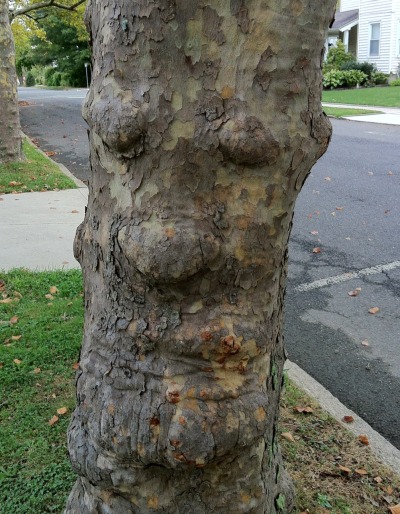
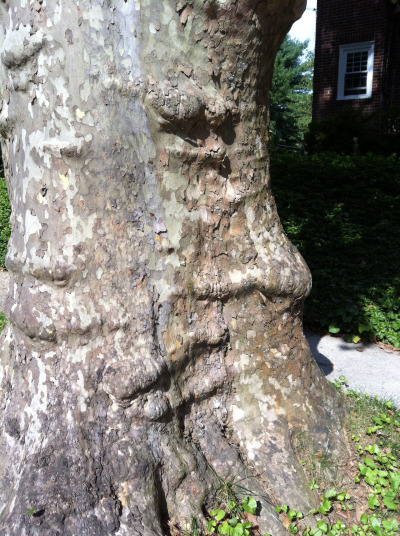
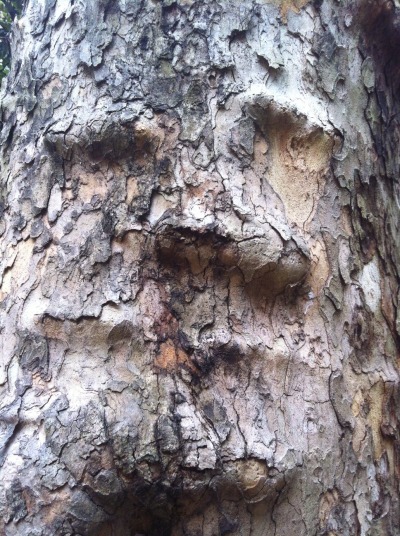
I'm sharing some photos from my tree blog as a fun example. I started taking pictures of arborglyphs, then I started noticing that a lot of trees (bumpy London planetrees especially) look a lot like people -- generally grumpy people. Here are a few of my favorites -- they might take a little imagination and squinting, but once I started looking, I started seeing them differently.

And that's what writers -- and photographers, and all kinds of artists -- do. The thing, person, or experience that washes over others can be a source of inspiration.

Contemplative tree, Belmar, Nj


Cartoon tree. Looks like Bart Simpson. Wynnewood, PA
Cubist tree. Eyes on same side of head. Wynnewood, PA


Skeptical tree. Philadelphia, PA


Sunday, September 23, 2012

Looking Ahead to November

While much of the U.S. is focusing on the next election cycle in November, many writers are preparing for our own grueling test: National Novel Writing Month (NaNo). I join another set of writers in a different challenge: Picture Book Idea Month (PiBoIdMo).

Picture book writer Tara Lazar (author of the upcoming THE MONSTORE,  I THOUGHT THIS WAS A BEAR BOOK, and LITTLE RED GLIDING HOOD) started PiBoIdMo on her own in 2008 and launched it publicly in 2009. Now involving more than 600 participants, the event includes an impressive slate of guest bloggers and a slew of prizes -- critiques, art, and more The challenge is the same: Generate 30 new picture book ideas in 30 days.

I took part last year, and although I fell short with only 14 ideas, I count it as the turning point for me in writing picture books. I had written two previously (one of which I'm happy will never see the light of day), and wanted to try more, but I had been waiting for ideas to hit me in the head. PiBoIdMo helped me realize that if I want ideas, I have to chase them down instead of waiting.

Idea generation is a muscle -- you have to use it, and once you do, you get stronger.

Only one of my ideas last year turned into a finished manuscript, but I have written several others from new ideas in that time.

I'm confident that I'll do better this year -- my goal is focused on higher concept, more commercial ideas. But getting ready for PiBoIdMo is a bit different than gearing up for NaNo -- with NaNo, it's all about the preparation. With PiBoIdMo, once you start thinking about it, the ideas themselves start flowing.

Are you getting ready for NaNo? Interested in trying PiBoIdMo? If you participated in the past, what results did you get -- ideas, a draft, a finished manuscript, a polished or published book?