Showing posts with label brainstorming. Show all posts

Tuesday, August 6, 2019

Camp NaNoWriMo, Procrastinator's Edition!

How did everyone’s Camp NaNoWriMo go? Personally, I forgot about it entirely, although what with moving halfway around the world, I probably wouldn’t have had time for it anyway.

Image result for camp nanowrimo

So…I’m doing Camp NaNoWriMo this month! My goal is to prepare for this year’s November NaNoWriMo by writing a page of brainstorming ideas every day for my YA historical fantasy I’m calling Project Julie. So far, I’ve got five pages of ideas. For the most part, it’s just “what if X” and “I like the idea of Y” because the general idea for Project Julie is so new. Keeping the manuscript on a low simmer on a back burner in my mind has been really helpful, and I keep coming up with little ideas here and there. Hopefully by the end of the month, I’ll have enough started to get me going in November!

Did this slip anyone else’s mind? If you were on the ball and got some work done last month, how did it go? Tell me about it in the comments!

Thursday, October 12, 2017

Preparing for NaNoWriMo: Choosing Your Project

November is National Novel Writing Month, otherwise known as NaNoWriMo. It's an entire month dedicated to writing, or, more specifically, to amassing fifty thousand words on an original novel. Last year, over 400,000 writers from around the world participated. The NaNo website helps you track your word count, provides regional support and chat boards, and allows you to "win" when you hit your 50,000-word goal. Every November, bookstores, coffee shops, and 24-hour diners fill up with writers - you can practically feel the creativity in the air! NaNo provides a great community, and it's a great motivation for starting or continuing a novel project. 2017 will be my seventh year tackling NaNo, and I can't wait to get started!

That said, there are a few ways to set yourself up in advance for NaNo success. We'll explore these each Thursday in October, so you'll be ready to hit the ground running on November 1st!

Today, let's talk about how to choose the novel project you'll be working on for NaNo. The NaNo rules specify that, to win, the 50,000 words must be on a brand-new novel. However, many people, self-described 'NaNo Rebels,' will do something different. They may write on a work-in-progress, or a non-fiction project, or revise 50,000 words on an existing draft. Assuming you choose the traditional route, and you don't have a story idea already in place, how do you decide on a concept that's going to hold your interest for an entire month and allow you to get 50,000 words written? Here's one idea:

1) Open a newspaper or click on an internet news site. Scroll past all the big news items, and look for the features, or local news, or interesting smaller stories. Let's say you find an article with a headline reading, "Local Woman Finds Alligator in Her Swimming Pool," and lets say you live in Wyoming. That raises a whole lot of interesting questions: How did the alligator get to Wyoming? What did the woman do when she discovered it? How did she remove it (or did she)? What did her neighbors do? What happened to the alligator afterwards? Write down as many questions you can think of that are raised by the article.

2) Next, ask yourself 'what if?' What if the woman just started living alone? What if her town's animal control didn't have a clue how to help her? What if the woman discovers she's one of five families who have discovered alligators in their swimming pools over the past year? What if the alligator starts talking to her? What if the alligator is pink? What if the town decides the alligator's arrival is a harbinger of the apocalypse? Ask yourself all the 'what if' questions you can think of - let your imagination go wild!

3) Write down the 'what if' questions that intrigue you the most. Maybe you decide on 'what if the alligator started talking?' Then, decide what kind of book this will be. A humorous, tongue-in-cheek sci-fi? A mystery? Fantasy? A children's book? A romance between the homeowner and the animal control officer?

4) Start brainstorming your protagonist, using a character questionnaire. Think about what other characters might fit into your story world. Flesh out your setting. Create an outline, or a list of ten scenes you know you want to see in your book.

5) Start writing on November 1st!

What techniques do you use for brainstorming story ideas?


Thursday, September 14, 2017

THE WRITERS' BLOCK: Exercises for Overcoming a Creative Slump (#3: Favorite Scenes)

In this new series, Operation Awesome is providing exercises to help you break out of writer's block, or a creative slump. Too often, we get stuck with writer's block because we believe when the words don't flow organically, or when the sentences don't come out perfectly structured, or when the plot has holes, we've failed. Usually, it just means you're having an off day, and forcing yourself to write on these days can perpetuate the feeling of being stuck. It can really help to take a day off from writing, but that doesn't mean taking a day off from working on your book. These exercises will help you work on your book when you're not actually writing.

So, none of our exercises involve narrative writing, per se. Instead, they require you to think, daydream, talk to your characters, and CREATE. You can jot down notes as you go, or you can record yourself talking through the exercises, or you can keep everything in your head.

For Exercise #3, we're going to focus on FAVORITE SCENES. You know how there are certain scenes in books and movies that you read/watch over and over? They're so beautifully portrayed, or tons of fun, or they evoke an emotional response, or all of the above. Creating great scenes that keep readers turning the pages is a big part of writing, one that can take years to perfect.

But The Writers' Block isn't about craft - it's about brainstorming. So take paper and a pen, or your computer, set a timer for 20-30 minutes, and brainstorm at least ten scenes you want to see in your book. You can use a basic outline you might already have for your novel, or you can start from scratch. The main rule for this exercise is to brainstorm big, colorful, significant scenes. Nothing is off-limits here... do you want to send your main character to the circus? Into outer space, even though it's a contemporary romance? Do you want a scene where your characters get locked in a mall? Go crazy, knowing that all these scenes might not make it into the book.

Once you have your list of scenes, and you've eliminated the ones that you might write for fun, but might not end up in your book, put them in the order that makes the most sense. That might be chronological, or if you're planning a non-linear narrative, it might be the order that makes the most sense for character development.

Then, start thinking about how to flesh out the details between the ordered scenes. You'll likely need some transitions, some additional scenes, and to explore how your characters are getting from Point A to Point B.

Then, when you're ready, pick a scene, either starting from the beginning or choosing the one that seems the most fun, and start writing! The scene list is a great way to structure a brand-new story idea, but it can also help kick-start a project that has stalled.


Did you enjoy creating a scene list? What scenes did you add to your list from this brainstorming session that you might have never considered before?

Wednesday, February 3, 2016

Re-imagining a Book Title

Novel titles are not my strong suit. Writing 80,000 words—no problem. Coming up with a couple words to encapsulate those 80,000 words—huge problem. Titles present a ton of pressure. The title must hook the reader, stand out, look good on a book cover and reflect the tone and themes inside those covers.

Think of your favourite books. The title is part of what makes them awesome. Would The Hunger Games have caught on if it had been called The Volunteer? Or if The Fault in our Stars had been called Augustus and Hazel’s European Vacation? Title are important. The pressure!

A couple years ago, I wrote a blog post about my novel-naming woes called, “No Name Novel.” I wish I could say that in those years I somehow mastered the art of titles, but it’s just as much of a struggle as ever.

So when my publisher approached me and asked to change the name of the second book in my One Bright Future series, I wasn’t surprised. The first book, originally titled The Enslavement of Rielle James, was trimmed down to Enslavement. I’d given the second book the working title of Captivity, which had grown on me as I worked through the edits.


A new title was suggested, but I wasn’t keen on it for a number of reasons. I did an Amazon search to see how many other books had that title or something similar. There were a lot! So, rather than coming back to my publisher and shooting down their idea, I decided to put together a list of titles I could live with. I brainstormed on my own, then with some writer friends. When I’m serious about brainstorming ideas I like to write them on my hand and wrist. Don’t ask me why.
So, with a list of about 15 titles scrawled on my skin, I narrowed it down to three. Writers are word people, so to me, each title word not only had a unique definition, but had nuances, undertones and a shape (dull, sharp, round, jagged) that played into my decision.


I presented my reasons for not wanting their suggestion along with the short-list of my suggestions to my publisher. After some back forth via email, we settled on the new title. It’s taken some getting used to and some habit breaking, but I’m thrilled with this new moniker. What did we agree upon? Book two in the One Bright Future series will be called Subversion. And it’s the perfect title for this book.

* * * * * *
Melinda Friesen writes novels for teens and short stories from her basement in Winnipeg, Manitoba Canada. Presently, she's trying to pretend there's something outside besides snow and ice.

Wednesday, September 30, 2015

Solving Story Problems Collaboratively

I’m a big advocate for writers’ groups. I figure that drawing on the wisdom of eight brains will certainly get me further than the limited wisdom of my single brain. 

One of the things we like to do in my writers’ group, The Anita Factor, is help each other brainstorm when we have a story problem.

I’d come up with a new concept for a novel. I was pretty jazzed about the idea, but I lacked one thing—a disaster. A major one. One that would level a huge portion of a town and result in the deaths of thousands. As you can tell, I’m all giggles and butterflies over here. I was stumped as to what that disaster should be. This is where novels can become trite, where authors choose something that’s been done hundreds of times. I needed a unique disaster.

I decided to take my problem to my writers’ group. I explained the main character and the premise of the story and, for the next 20 minutes, we brainstormed. I wrote down all of their ideas, no matter how silly, unusable or ridiculous. When we were done, I had 32 disastrous ideas. None of them stood out as, “the one,” but I had pages worth of material to ruminate on.

That night, when I went to my car, still thinking on all those potential disasters, I came up with idea number 33. It was THE idea! While my group may not have come up with it, I needed to go through all of their ideas to stumble upon mine. I also have the assurance of knowing that if these highly creative people didn’t come up with my idea, then there probably are not hundreds of novels out there structured around the same disaster.

Are you a part of a writers’ group? How do you help each other? Do you brainstorm with friends or beta readers when you’re stumped? Leave a comment.

Melinda Friesen writes middle grade, young adult and new adult fiction. Learn more about her and her novel, Enslavement, at www.melindafriesen.com

Monday, September 21, 2015

Major Rewrites: Revising in Layers or Moving Mountains One Stone at a Time, Pt. 2

Welcome to part 2 of Revising in Layers or Moving Mountains One Stone at a Time.

If you have major novel rewrite ahead, the task can seem overwhelming. My goal with these posts is to break the process down in order to make your revisions less daunting.

If you didn't read part 1, you can find it here. Last week I outlined the first four steps:

  1. Brainstorming
  2. Outling the existing manuscript
  3. Thinning
  4. Subplotting
After all your new characters and subplots are outlined as described in step 4, it's time to move on to step 5.

5. Integrating
This is where the layers come in. One subplot or character at a time, I add the subplot outlined items to my manuscript outline. For me, this is just a couple words with an arrow pointing to where I'll insert it. In this step, I can arrange and rearrange the new subplot points until I have them where they make the most sense.

When I'm pleased with my outline, I add the new writing to the manuscript. Depending on how extensive my new subplots and characters are, this can entail anything from a couple sentences to entirely new scenes.

I continue this process until each and every new character and subplot is added to the manuscript. During this process, I don't worry about whether or not it flows. I'm simply add the information I need.

By working in layers, I can concentrate on one subplot or character at a time which allows me to fully enrich each new item and add necessary depth.

6. Comprehensive Editing
I now view the manuscript as a rough draft, so it's time to do a thorough edit with a critical eye. I need to see how it flows, if the new plot points and characters ended up in a logical place, if there are any places I need to insert new information. I need to examine if the new characters are in all the scenes they need to be in, and to look for proper transitions, pace, tone, and appropriate shifts in existing text.

7. Polishing
After making the necessary changes, I always do a second edit to ensure it's ready for an editor's or beta readers' eyes.

8. Happy Dancing
This was a huge undertaking. You overcame the discouragement, dug in and got the job done. Everybody click here to do the dance!

The words, "major rewrite" are the last thing most writers want to hear, but I hope that by having the tools to conquer what can seem like an impossible task, you can approach the process with a can-do attitude. And that's what I'm here to tell you--you CAN do it! So, get offline and start brainstorming!

Melinda Friesen, author of Enslavement, writes novels for teens and people like her who love to read YA. In two weeks, her daughter is getting married, so her writing time is succumbing to wedding planning.


Tuesday, September 15, 2015

NaNoWriMo Prep: Brainstorming

Welcome back to our NaNoWriMo prep course! If you followed along last time, then I hope you found a writing craft book that you enjoyed. If you missed the first post in this series, check it out.

If you've never done NaNo before, mark my words: Writing 1,667 words a day is asking a lot of yourself. You will most likely need at least an hour set aside for the actual writing business. That doesn't include the coming-up-with-ideas part. Starting your brainstorming now will help save you time. What do you think of when you think about this newly blossoming story idea? Are you feeling a certain mood? Got a line of dialogue you just know you're going to use? Maybe you can see where the novel is set? Write these down somewhere! Review them frequently as you gear up to start writing.
With my 2012 project, I took 15 minutes at the end of each writing session to brainstorm what I would write the next day. That was the extent of my preparatory work. That's called pantsing. It works well for a lot of people. Whether you like to pants it or like to plot beforehand, here are some brainstorming tips to help you out:

1) Record your ideas
Whether you keep a notebook with you at all times, or e-mail ideas to yourself on your phone--make sure you are able to record even the tiniest of ideas at any time of day (or night!) What use is all this brainstorming if you can't remember what you come up with?

2) Daydream with a purpose
Everyone has idle brain time during the day. Use it wisely. Sitting in traffic? Think about your book. Wiping a toddler bum? Think about your book. Think about your characters. What would they do in your situation? Rage at the other cars? Hold back vomit? So many possibilities!

3) Set aside brainstorming time
More than just using your everyday idle time, you need to actually set aside time for thinking about your book. This will also get you in the habit of setting aside time for writing your book, which you will need in November.

I would love to see your brainstorming tips in the comments! And come back in two weeks for our next installment: using character interviews.

Friday, March 20, 2015

The New Project Starter Kit

TGIF, Operation Awesome!

As those of you who know me know well, I like to stay... busy, to put it mildly. Even now, as I am powering through revisions on my current project, I am already getting excited about my next idea in the queue. And I have good reason to be excited - usually the end of one project prompts a Battle Royale between fledgling ideas for premium space in my brain, so it's a lovely change of pace to have a fully-formed idea ready to go!

Sometimes, going into that new idea, I don't have a lot to work with until I get into the rhythm of it. Sometimes it takes a couple chapters to figure out what I'm doing. But even when I'm flying blind, I like to make a new project survival kit of sorts. Here's what I take with me when exploring the uncharted project wilderness:

A proper soundtrack. I work full time and have a long commute, so I have to use those long commutes to my advantage and get some serious brainstorming in. And when I need to drown out the loud-laughers and the cell phone-talkers and get lost in my thoughts, I need something to set the right mood. Sometimes that means a full-fledged, 50+ song playlist. Occasionally, that means two songs I will listen to on repeat for weeks upon weeks and will never want to hear again when the project is over. Either way, music, for me, is a serious plotting aid.

A protagonist character sheet. Other characters, I can figure out along the way, but if I can't get the voice right off the bat, it's hard to get going on the project. I shared my character sheet here - help yourself!

Basic plot touchstones. I have done my share of plotting AND pantsing, but I rarely know exactly where I'm going right from the start. Instead, I have key scenes in mind when I start, just to give me and idea and get me excited about the story. A full outline tends to emerge after the first quarter or so of the manuscript.

A pitch letter. Yes, I used to hate them, too. But much like those touchstones, it's great to start out knowing my hook. And it's also great to have something to share with my critique partners to get their early take on it. (And I kind of love getting a little early excitement going, too!)
 
Have fun, OA, and happy writing!

Friday, August 29, 2014

The Marriage of Exercise and Creative Thought

Did you know that exercising actually increases blood flow to the brain and helps a person to focus?

It's true. 

Brain research shows a correlation between physical activity and the development of brain connections. In 2010, the journal Pediatrics released a study showing that children with as little as 15 minutes of recess each day exhibited better behavior and attention spans than their peers who did not have recess. The Journal of Attention Disorders even states that walks outdoors that normally are associated with recess appear to improve attention and concentration scores of students with ADHD. -The Effect of Recess on Academics
 Not only does physical activity spur the development of brain connections, but it may result in clearer thinking and organizational ability, as research has shown an improvement in recall:

Recess provides a break that allows the brain to "regroup," and research has shown that recall is improved when learning is spaced out rather than condensed. After recess, children are more likely to learn because they are less tense and more invigorated. Even adults are given breaks during their work day, which allows for better production and clearer thinking.
Maybe you don't have time for "recess" in your busy day. Whether you're surrounded by kids or surrounded by other adults, it can be difficult to step out and get some physical exercise without somebody needing you. Yet we know that a break to watch TV and eat chocolate isn't going to have the same brain-clearing effects as physical exercise. It's worthwhile to carve out time in your day to exercise.

Personally, I get a lot of story ideas while running.

One of the scenic places I run by when I'm brainstorming


But I know some people prefer Zumba or UFCor even Spartan obstacle course racing. I have a crazy brother who does the latter and is a certified Spartan trainer. Someday I'll be that awesome. They jump over freakin' FIRE at the finish line!

Anyway, back to how exercise improves clarity of thought. How are you doing on your plotting? Characterization? Ever get stuck? A quick rise in blood flow to your brain might be just the thing...

Happy Friday, everyone! Enjoy your plotting, on and off the treadmill. 

Sunday, September 30, 2012

Seeing Differently: Where Ideas Come From

Where do ideas come from? I'm getting ready for Picture Book Idea Month, which is about opening your mind to story ideas -- seeing the world as a story to be written. But to be a story, an idea isn't about just recording the world -- it's about seeing it differently and describing it in a way that's simultaneously fresh and recognizably true.

It's easy to see the difference in picture books. An anecdote is something cute or funny that you see your child do or that you remember from your own childhood. A story is that anecdote transformed -- bigger, neater, funnier, more universal, more specific, better. It's making that anecdote magical, even when you're writing contemporary realism.

Ideas for novels are more complicated. Sometimes they start as an original idea -- a blast of inspiration, even in a dream. Sometimes it's a twist on a trope. Sometimes it's a "what if" from looking at the ordinary world in a different way.

The story of DEADWOOD was inspired by one of those little "what ifs." I noticed how certain trees in the park were carved with messages and names, some of them really old. I didn't even know what kind of trees they were (beeches). I didn't know that the messages have an anthropological name (arborglyphs). But I wondered, "What if the messages were mystical? What if they were a channel for magic? What if the tree could use them to communicate?"

That idea isn't a story, and it certainly isn't a book. I need plot, character, setting, voice, dialogue, description -- but all those things came from seeing something ordinary and looking at it in a different way.

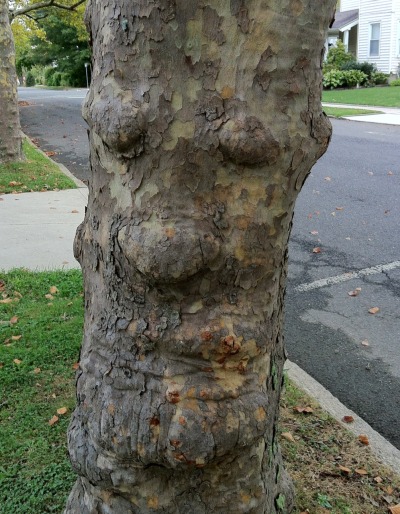
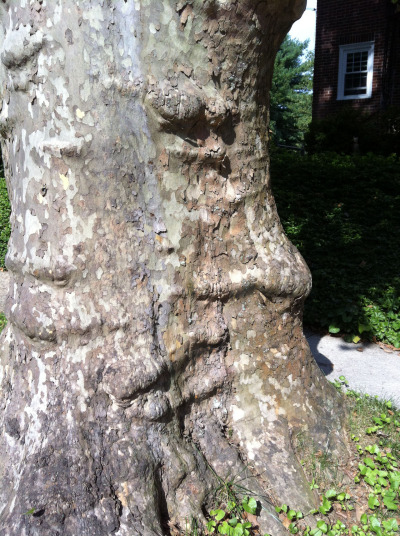
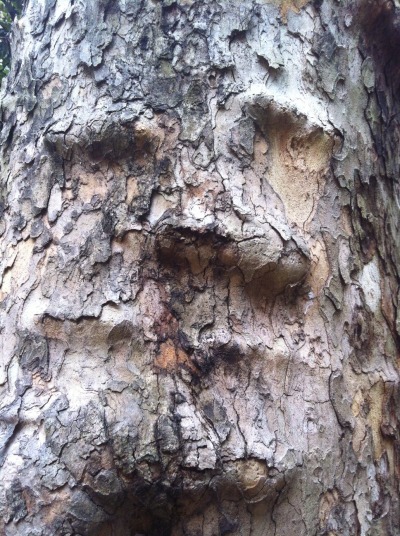
I'm sharing some photos from my tree blog as a fun example. I started taking pictures of arborglyphs, then I started noticing that a lot of trees (bumpy London planetrees especially) look a lot like people -- generally grumpy people. Here are a few of my favorites -- they might take a little imagination and squinting, but once I started looking, I started seeing them differently.

And that's what writers -- and photographers, and all kinds of artists -- do. The thing, person, or experience that washes over others can be a source of inspiration.

Contemplative tree, Belmar, Nj


Cartoon tree. Looks like Bart Simpson. Wynnewood, PA
Cubist tree. Eyes on same side of head. Wynnewood, PA


Skeptical tree. Philadelphia, PA