Showing posts with label editing. Show all posts

Thursday, December 15, 2022

 Dear O'Abby,

I noticed Times New Roman was trending on Twitter the other day and wondered why.  I ended up wading into a debate about which font is best and started wondering why agents and publishers almost all ask for manuscripts to be submitted in Times New Roman.  Personally, I prefer writing in Calibri, but always change the font before submitting.

Do you know why Times New Roman is the industry standard font?

Best,

Font-anelle

Dear Font-anelle,

Fonts are such a personal thing, aren't they?  I feel like different fonts almost have different personalities and reading the same text in different fonts can create different reading experiences.

Times New Roman was developed for the Times newspaper in England and quickly became popular because it is very readable at most point sizes and in itallics.  The spacing also makes reading easier and allows more text on the page because it is on the narrow side.

Until relatively recently Times New Roman was the default font for most devices including personal computers so was the one people tended to use.  It is probably because of this that it became the industry standard - everyone has access to this font and you can guarantee that your work will keep looking the way you want it to look on the page when using a font everyone has.

The downside of the font is that because it is a serif font, it is not as easy for dyslexics to read.  It is also now considered somewhat old-fashioned.  Your favorite, Calibri, is actually better for dyslexics as the spacing and the fact it is sans serif make it look less cluttered on the page.  Arial, another old favorite, is also easier for dyslexics.

Personally, I tend to use a font called Optima when I'm drafting, at 14pt.  In the editing stage, I like to change the font and the font size between drafts because changing these things helps me find mistakes.  Only when I'm at a final draft stage do I ever use Times New Roman because that's the font the final, submitted manuscript will be in.

Hopefully that answers your question?  You can use whatever font you like best when you're writing for yourself, but when submitting, to give yourself the best chance, and to look professional, use Times New Roman.  And don't go smaller than 12pt.

X O'Abby


Wednesday, June 8, 2022

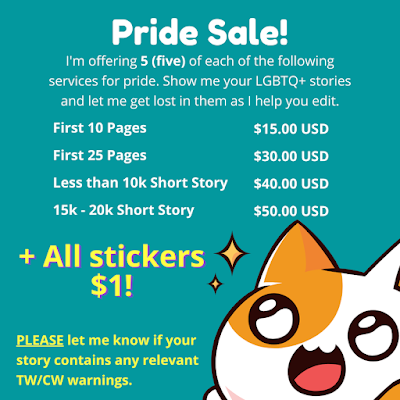
Editing Sale #Pride #LGBTQIA LGBTQ+

Pride editing sale

(Today's debut author canceled at the last minute due to unforeseen circumstances. Here is alternative content a friend passed along to me.)

O. R. Faulkner's Fantastical Features

#WritingCommunity Happy Pride! Sale until the end of June. Turn around time will be a few days to a week. 

Buy here: https://ko-fi.com/orfaulkner/shop


Pride Sale!

I'm offering 5 (five) of each of the following services for pride. Show me your LGBTQ+ stories and let me get lost in them as I help you edit.

First 10 Pages for $15.00 USD

First 25 Pages for $30.00 USD

Less than 10k Short Story for $40.00 USD

15k - 20k Short Story for $50.00 USD

Plus, all stickers are $1.00!

Please include relevant TW/CW

O. R. Faulkner's Fantastical Features

Thursday, August 19, 2021

Dear O'Abby: What do I do if my book is too long?

 Dear O'Abby,

I've been working on my first novel for about five years now, and finally got it to the point where I felt it was ready to show other people.  So I joined a critique group.  They seem like nice people and several of them have published more than one novel, so I'd hoped they would be helpful in getting my book into some kind of shape.

Well, they have, to a degree.  But all of them agree that my 146,000 word novel is too long.  I've already cut it down from over 200,000 words, so I'm not sure what else I need to do.  I feel like if I cut too much more, the book won't make sense.

Can you help?

Best,

Longwinded.


Dear Longwinded,

I'm afraid I'd have to agree with your group.  146,000 words is too long for a debut novel.  Around 100,000 is the upper limit for most adult novels with around 70,000 being standard for YA.  Fantasy can sometimes run a little higher because of the amount of world building required to set up a fantasy world, but if you're getting close to 120,000, you need to take a good hard look at what you've written.

There are a number of ways to start paring word count if you feel like you're too long.  I like to go through each chapter and remove all those pesky filtering words like just, believed, thought, quite, wondered etc.  You can usually cut a good chunk out just by doing this.

You can also search for redundant words and phrases.  Things like "she nodded her head."  I mean, what else would she nod?  And adverbs can often be redundant too.  If someone is walking quietly down the hall, see if you can find a verb that would better describe the action.  Maybe he's creeping down the hall, or shuffling, or tiptoeing.  All of these words convey something more than just moving quietly and can tell the reader something about the character and his intentions as well as describing the action.

Read through every scene and make sure what you're describing is relevant to the story and/or the characters.  If you have a paragraph describing the outside of a house, that house needs to be important.  What it looks like needs to mean something to the character looking at it.  If neither of these things are true, do you need to describe the outside of the house in that much detail?  Sometimes a broad description works just as well if the scenery is not critical to the plot or character.

You can do the same thing with your action scenes.  Are your characters doing mundane things like making tea or drawing a bath?  You can just say that's what they are doing.  You don't need to outline their actions as they do them unless the way they make tea or draw a bath is important to the plot or gives important information about the character.  

Read your dialogue passages closely.  While you want dialogue to sound natural, you can often cut a lot of dialogue out because people say a lot of stuff that doesn't mean anything.  Only keep the things people say that actually mean something.

Basically, every word of your novel needs to count either as something that drives the plot or something that colours your characters.  If you have stuff in there that does neither, it can go.

Hopefully that helps...  Best of luck with your novel!

X O'Abby

Thursday, February 13, 2020

Marketing and Publicty part 2

Following on from last week's post, I thought we'd continue with marketing and publicity since it's such a massive topic.

There are a huge number of services out there who will try to convince you that, for a fee, they will sell your book.  Most of these services are ridiculously expensive and don't offer value for money, so do your due diligence before making a commitment to spend.

This week I want to focus on some essential things you should have in order to successfully sell your book.

Firstly, you need your book to be well-edited and polished.  Readers are quick to find typos and grammatical errors and one really quick way to get a lot of negative reviews is to publish a book that isn't well edited.  This is especially important if you are self-publishing.  If you have a publisher working with you, you will work with an editor, but depending on the size of the press, the number of rounds of edits and the time you get to complete them may not be substantial.  Always do your own final pass before sending back to your editor or pressing publish on your e-book. And then, maybe do another one just in case... I find changing the font and the font size each time I do a pass helps me to find errors I may not have seen otherwise. 

Another essential is eye-catching cover art that suits your genre.  Make sure your title is in a readable font and that you can read it even if the cover is thumbnail-sized.  Some covers look amazing when you look at them on your computer monitor in full-screen, but are illegible when shrunk down to the size it's displayed on a website and looked at on a mobile phone.  Your cover is among your most important assets so it's worth paying for a good one if you're doing it yourself.  If you're working with a publisher, you may not get a lot of input into the design, but it's important you're happy with it.  You're going to be looking at it a lot!

The blurb for your book is also important even if you are planning only an e-book release.  Make sure it tells your readers what the book is about without giving away too much of the plot.  You want readers to be intrigued enough to want to read it.  I find that a good guide is to allow your blurb to tease only the first third of the book.  That way you're introducing the main characters, giving away the inciting incident and then teasing the reader with the possible consequences if the characters don't (or do) take action.  You may want to write a few different versions and try them out on different people to see which gets the most positive response from readers.

A website is also an important tool.  Make sure it's kept up-to-date and that there is a way for people to contact you.  Include the most important information about yourself and your book(s), including things like the blurb, all sales links (don't just direct people to Amazon) and an author photo.  You may also want to include a form so people can sign up to your newsletter (if you have one - and you should).

Social media is also a valuable tool for engaging with your readers and the wider writing community. Set up separate accounts for your author-self so your fans won't end up embroiled in the messy day-to-day stuff that happens on your personal social media pages.  Curate what you post on your author pages so what you post will be of interest to your readers.  And if you're not a keen social media user, pick whichever platform you like the most and only use that.  There's no point having multiple accounts with little to no activity; better to do one thing well.

An author newsletter is another thing you really should have, and bulking up the number of subscribers should be a priority.  To do this, you may want to offer something free to people who visit your website and sign up. A short story, maybe, set in the same world as your book, or something of that ilk.  Just make sure it's not something your readers can find elsewhere -  it needs to be exclusive to be enticing.

In terms of physical things you need, there aren't a lot that I would consider essential.  Bookmarks with your cover design, website and social media addresses are a nice-to-have and relatively cheap to get printed. You can hand these out at events and leave them inside library books of a similar genre at your local library.

And once again, I think that's all we have time for this week.  Next week, maybe we should talk a little about reviews and how to get them since reviews are pretty crucial for getting people to read your beautifully edited book with its gorgeous cover!


Tuesday, November 5, 2019

NaNoWriMo: Silencing Your Inner Editor

In my local NaNoWriMo group this week, someone asked, "How do I kill my inner editor?" After another writer recommended not to kill the inner editor but to send it on a month-long spa retreat instead, I let my mind drift to what my inner editor is up to this month. If I had to put an image to it, I'd have to say mine is tied up in a closet with duct tape on her mouth - and I know she's going to come out of the closet in an angry whirlwind the moment I open the door on December 1st.

Not revising as I go is always a struggle for me during NaNoWriMo. I don't have as hard a time with writing during the month as I do with not looking back - vomiting the words onto the paper and not saying to myself, "well, that sentence could use a little tweaking, what if I changed this phrasing around? Oh, but I used the same word in that other sentence, that one could use some work too..." and before I know it, I've spent an hour revising what I've already written and I have 137 fewer words than I did when I started. I mean, the other day I wrote this gem:
The metal melted at her touch, the soft metal weaving its way around her wrist into a series of interlinking cuffs with a pleasing sound of singing metal.
Gross. It's like it was a challenge to see how many times I could use the word "metal" in one sentence.

Over and over, like an inner mantra, I keep telling myself that NaNoWriMo is just about getting the words on the page. It's just about writing something with reckless abandon and not caring too much about the prose. One of my writer friends is struggling with prose that's too flowery. I've got clunky "telling" phrases everywhere you look, and I've seen no sign of that letting up anytime soon. One lucky friend is getting things pretty darn near perfect on the first try. (I swear she sold her soul or something.)

Allowing myself to write badly is hard. When I was growing up, every time I'd sit down to write, I'd start at the beginning of the manuscript and revise as I went until I got to where things left off. Of course, as the manuscript got longer, this meant I'd run out of time to put any new words in the document and I ended up revising the same first 50 pages over and over without having a good sense of where those 50 pages were going.

Fighting fifteen years of habit is hard, but this year, I think I've finally found a work-around. Every time I leave off writing, I leave a comment for myself about what just happened in the plot and where I see it going next. This keeps me from going back to read what I wrote yesterday and getting caught up with critiquing my writing. Refreshing the barest outline of yesterday's words is enough to get me going again, and I'm not tearing my hair out because my word count suddenly dropped. There are eleven months every year that aren't NaNoWriMo; I want to use this one for its intended purpose.

I hope all of your inner editors are on a warm, sandy beach somewhere far away from your works in progress, and I hope you'll be able to welcome them back without too much of a reality check when December gets here!

Thursday, August 1, 2019

Dear O'Abby: Do I Need to Pay a Beta Reader?

Dear O'Abby,

I've recently finished revising a novel based on feedback from a critique group and feel like I'm ready now to get another layer of feedback.  I've been looking for beta readers to get this, and was surprised when one of the people I reached out to asked to be paid for it.  Is this normal?  Should I expect to pay for a beta read?

Yours,

Strapped

Dear Strapped,

No. This is not normal.  Beta readers are usually fellow writers or people who like reading in your category and can articulate what they think the problems are with your book.  In my experience, beta reading is usually a reciprocal thing - I'll read your MS if you read mine - but it doesn't have to be.

Certainly, it's a nice gesture if you give a copy of the finished book to the person who beta read for you, and you can thank them in the acknowledgments section of the book. But I don't believe you should pay actual cash money.

That said, if you are wanting a significant amount of feedback, and perhaps some line editing as well, then there might be a case for paying someone to read your MS.  But in that case, I think the line between beta reading and editorial work is somewhat blurred.  You would definitely expect to pay an editor and often the differences between what a beta reader and an editor do are quite small.  I certainly do little line edits in manuscripts I beta read just because I can't help myself if I see a spelling, grammar or other minor error.

But I don't ask to be paid for the beta reading I do just because I will mention if you have a comma in the wrong place as well as telling you the MC needs to be more active in solving their own problems, or a secondary character is just annoying, not endearing, or that I feel like the whole of chapter 23 is completely redundant and slows the pacing.  I just hope that when my next MS is ready to be seen, you will do the same for me.

Hope that's helpful!  And good luck with your manuscript.

X O'Abby


Saturday, April 27, 2019

#AtoZchallenge Xesturgy


Yes, I know the dictionary defines xesturgy as polishing, as with stones, but in this case we’re looking at polishing your writing. Think of each word in your story as a stone, diamonds maybe, or rubies or opals, and imagine polishing each one until it shines.

Polishing is the last step for your manuscript before it’s ready to go out into the world. It’s also a very important step.

By the time you get to polishing, you should have already done the hard work, fixing plot holes, finding continuity errors, character inconsistencies and fixing any tense or grammar issues. Now it’s time to tighten things up to make them sing.

When I’m polishing, I like to look for overused words and replace or remove them where possible. Common culprits are words like ‘just’, ‘think’, ‘really’, ‘very’, ‘quite’, ‘that’, ‘as’, and ‘then’, but everyone has their own crutch words. Do your characters nod or shrug far more often than regular people? Change it up. Give them other actions.

Removing unnecessary adverbs will also strengthen your prose. If your characters are talking loudly or moving slowly, why not find stronger verbs to describe these things, like shouting or meandering? Also look for things that are obvious within the context. A character doesn’t need to sit down on the floor, just sit on the floor - the down is implied.

If you have a lot of dialogue in your text, check your dialogue tags. Said is the best tag because it tends to be virtually invisible to readers while words like ‘declared’ or ‘trumpeted’ draw attention to themselves. But even ‘said’ becomes noticeable when it’s overused, so if you have a lot of dialogue, try to get rid of some tags by using action to indicate who is speaking.

Eg. “My mother’s coming this weekend.” Jade rolled her eyes.

Dale returned the gesture. “I feel your pain.”

The other thing to check when polishing is your punctuation. Do you overuse certain things like exclamation marks, ellipses or semi-colons? Do you sprinkle commas liberally, but miss their proper placement every time? Reading aloud will help you find misplaced commas and other wonky punctuation because the rhythm will be off.

Reading aloud will also help you figure out if all your sentences tend to be of similar length and construction. To keep writing dynamic, you need sentences of differing lengths and styles. If you find you have a whole lot of really long ones, try chopping them up and making several shorter ones. This is especially useful in action scenes where shorter, punchier sentences create the feeling of action.

By the time you have done all these things, your manuscript should be shining like a diamond necklace.

What are your favourite tips for the xesturgy stage of your project?

#AtoZChallenge 2019 Tenth Anniversary badge

Thursday, April 25, 2019

#AtoZchallenge Vacation from Your Writing


#AtoZChallenge 2019 Tenth Anniversary blogging from A to Z challenge letter V


Vacation from Your Writing

Is it a good idea or a bad one to take a vacation from your writing? Some experts say that you should write every day. Even if it's just one line! That's not exactly what I'm talking about here.

Sometimes you're working on a manuscript. It seems done. Maybe. Maybe that scene in chapter five needs to be redone. Maybe that one character should be a different gender. Why do none of the characters have green hair? Is there enough diversity? That scar on the cheek, is it a cliché? 

That's when I suggest a vacation. Just back it up using two different methods and step away.

Go write a poem. Edit another project. Work on your social media following. Just go do something else for a month. Leave yourself post-it notes or .txt files if you must. But don't open that manuscript.

Once the 30 days have passed, then reread everything. Better yet, have someone read it to you. (Or use a text-to-speech like wordcounter.net.) You can take notes during the reading, but don't edit yet. Wait one more day. Get one more sleep cycle in. Let your brain process. Then make a copy of the manuscript and change the font to something drastically different. It is proven that you'll edit better with a different font.

Image Meme change font text for editing #writetip

Thanks to Addi Jones for finding this meme for me again.


Then resume working on it. It's the same with making big pieces of meat. Heat, rest, carve, then eat. You have to let them set before you cut into them. It's ruined otherwise. (For the vegetarians: it's as important as athletes taking a rest day between training sessions.)

#AtoZChallenge 2019 Tenth Anniversary badge

Wednesday, April 24, 2019

#AtoZChallenge Understanding #PassOrPages


#AtoZChallenge 2019 Tenth Anniversary blogging from A to Z challenge letter


Understanding #PassOrPages


#PassOrPages is Operation Awesome's query contest. The goal is to help writers get feedback on their query and first page, and possibly link them up with an agent who likes their work.

Three times a year, we choose a genre and age category and reach out to agents who might be interested in those manuscripts. Once we have our agent panel, we open up the contest to writers. Anyone can send in their query and first page, as long as they fit the genre and age category.

(Why only the first page? That could be as little as an agent reads, and we've even had agents stop after the first sentence. If they're not intrigued, they're not going to keep reading, so that first page is the most vital to the query package.)

Winners are randomly drawn and their work is sent to the agent panel. The participating agents give brief feedback on the entries and explain why they're passing on the work, or requesting pages. You can find our #PassOrPages archive with all our past contests here.

We began this contest because sometimes - okay, most of the time - the agenting process seems inscrutable. What do all those rejection letters mean when they say "I just didn't fall in love with it"? By asking agents specifically to critique the basic query package, we hope that all writers, not just those whose work is critiqued, will gain insight into what goes through an agent's mind when they read the query and first page. Here are some of the most common comments from the past three years of #PassOrPages, and how you can adjust your work accordingly:

  • Awkward phrasing. Read your query and first page aloud, or paste them into Google Translate and hit the "listen" button. Sometimes hearing things aloud sets off those problem spots that you don't catch when you're reading, especially when you've read that page a hundred times already. Keep in mind that the query should read like the inside of a book jacket.
  • Too many grammar/spelling mistakes. One grammar/spelling mistake is too many in your query package. Proofread, proofread, and proofread again. Have a friend, coworker, CP, beta, whoever, look at your pages before you send them.
  • Cut words/sentences. In your query and first page, keep prose tight and to the point. This isn't the time for flowery language, this is prime real estate! The first page is the time to show that your work is worth reading, not that you know how to write. Ask yourself, "Is this as concise as I can be?" Cut words like "just," "had," and instances of passive voice. If a sentence isn't advancing the plot, cut it.
  • Tone of the pages doesn't match tone of the query. This is a tough one. Try writing your query as if your main character wrote it - not necessarily as if they're telling their story, but write with their voice. 
  • Cut rhetorical question. Rhetorical questions are ALWAYS a bad idea. Whether it's a query, the opening line of your manuscript, or a Twitter pitch, rhetorical questions are not something agents want to see. They don't give you any new information or advance the plot in any way, and they're typically used as a crutch when writers don't know how to bring up the topic at hand. Just delete the question and dive straight in - you'll be surprised how well the story works without it.
  • Main character reads too old/too young for the age category. Maybe you've simply mis-categorized your work as MG when it should be YA. Maybe your character really doesn't act their age and you need to talk to some people that age to find out how they would act. I wish I had more advice to give about this one, but this is much more specific to a particular work. 
  • Keep similes and metaphor to a minimum. Most often, similes and metaphors aren't in the writer's own words (quiet as a mouse, all the world's a stage, etc.). One is enough for the first page, since you want to keep the agent's focus on your words.

The first #PassOrPages of 2019 is coming up next month. Keep an eye out for our genre reveal on April 30!


#AtoZChallenge 2019 Tenth Anniversary badge

Friday, April 5, 2019

#AtoZchallenge Eight Pages or Less - Synopsis writing


Synopses.... I know. The thing most authors dread above all else. And why not? You spend months or years crafting a novel that is exciting, vibrant, full of fascinating and realistic characters with flaws and failings, a plot that urges readers to keep reading right until the final page of beautifully realised prose.

And then you have to try and distill all that into a document that’s less than eight pages. In some cases, even into a single page. No wonder synopses have writers tearing out their hair!

But don’t stress too much. While it’s important that a synposis is clear and well written, it’s not designed to show off your sparkling language and inventive turn-of-phrase. Agents and publishers ask for a synopsis as a means to ascertain if your story flows well, meets enough beats and has a satisfying ending. And yes... You do have to give away any plot twists or surprises at the ending.

So how to begin?

Firstly, some housekeeping. Synopses are always written in third person present tense, regardless on how you’ve chosen to write the actual novel. Character names should be in caps the first time they are mentioned, and it’s important not to mention too many characters by name. If they are not central to the story, try and call them by their role eg/English teacher or step-mother.

If you’re an outliner (and I’m not), it may be helpful to dig that out. Chances are you’ve changed a lot since writing it, but it could be a good starting place. If, like me, you’re not an outliner, take a look at your manuscript and try to distill what happens in each chapter down to a handful of sentences.

This probably won’t flow together very well, and the cause and effect of events may not be clear because you’ve basically just created a list of what happens in the book. So go through with an eye to the overall plot and make sure the reasons and reactions for and to every major event are clear.

Novels aren’t just plot though. The character journey or arc is equally important, so now it’s time to go through your nascent synopis to ensure who your characters are and how they move through your story is clear. Characters almost always change during the course of a novel, so it’s important that their arc is clear too.

By now you should have a pretty good overview of the book, but it is probably starting to run long. The length of synopsis required by agents and publishers varies widely, so I suggest having several different ones at hand if you’re querying. I like to have them at around five, three and one pages to cover all my bases, so this is the point at which I start editing.

When editing, the words you choose are very important. You have limited space, so make sure every word you use is pulling its weight, every sentence is as succint and full of meaning as it can be. It’s amazing how much more a well-crafted sentence can convey than a baggy, over-blown one.

Once you think you’ve nailed it, give your synopsis to someone who hasn’t read the book to take a look at. Ask them if it makes sense, if they understand the story and its arc. Sometimes as an author, you’re too close to the story and the characters to see where you’ve missed a crucial piece of information.

And then, barring more edits, you are done. Your synopsis is ready to send out into the world.

Good luck with it!


#AtoZChallenge 2019 Tenth Anniversary badge

Tuesday, February 12, 2019

Writing a Reverse Outline

Hello friends! I don't know about the rest of you, but it seems that every time I do NaNoWriMo, I burn out for a while afterwards. And this year/cycle/whatever you want to call it, I burned out for a solid two and a half months. I stopped querying my manuscript, I stopped reading for my critique partners even though I'd just taken on a new one, and in general I stayed in bed about 18 hours of the day and didn't really leave the house.

Yeah. It was bad.

Recently, though, my partner nagged me into being vertical for an extended period of time. I needed something to do, and I'd played way too many hours of video games. So I came to terms with the fact that it was Time.

It was Time to Revise My NaNoWriMo Manuscript.

Ughhhhh.

I started by dragging myself to my laptop rereading what I'd written. It wasn't terrible, and I was pretty pleased with some parts of it that I had thought were dumpster fires while I was writing them. But I just...didn't know where to go from there. I vented to one of my writing buddies that I knew what I wanted to change, but not how to change it. And, like the gorgeous font of amazing ideas and perfect advice that she is, she suggested I make a reverse outline.

A reverse outline?

What is this mysterious creature, you ask? Yeah, I hadn't heard of reverse outlines, either. The idea is that some people make outlines before they write their manuscripts with the major plot points or what needs to be revealed at what point, etc. With a reverse outline, you make an outline after the manuscript is completed. That way, you can get a better sense of where to insert the changes you want to make, and you don't have to be searching through the whole document for that one scene where I think the main character says this to her friend but then her friend is ambivalent, yeah, where'd that go?

Yes thank you I am very organized.

Anyway, if you're stuck in the revision trenches like I was, give this a shot. It might give you a better sense of the timing of your manuscript and just where you should be making edits. Make sure to get down not only the major plot points but also the things they influence, like character reactions that will be important later or information this plot point brings out. Then you can go through and note where you want to make revisions. It's also a good idea to note where you did a good job! It's like encouragement from your past self :)

And because I'd be remiss if I didn't include an example, here's an excerpt from my own reverse outline:

Excerpt from my reverse outline for my manuscript, tentatively titled GIRLS BREAK THINGS. The main bullet points are the major plot points, and the secondary ones are reactions to that plot point. I've also commented on the outline to make notes to myself about other things to consider that didn't appear in the manuscript.

Check out the Dear O'Abby post this Thursday for more information about revising!

Thursday, January 10, 2019

Dear O'Abby, Do I Really Need Critique Partners and Beta Readers?

Dear O'Abby,

I've just finished a novel and I've read that at this point I should be sending it to critique partners and beta readers for feedback.  I don't know anyone to do this, and I am a very thorough editor, so feel like the book is as polished as it's going to get.  Is this feedback period really crucial to making my book a success?  And if it is, where do I find these readers?

Regards,

Critical.

Dear Critical,

Personally I believe this is probably the most important step in getting your book ready.  As the author, you know everything about your story and your characters so are unlikely to see gaps in logic or places where information might be missing.  Getting fresh eyes on the book is crucial for you to find out if everything is working the way you intended it to.

Critique partners and beta readers also fulfill different purposes.  A critique partner might read the book chapter by chapter as you write it and offer feedback as you go.  Or they might read it when you have finished a first or second full draft.  Their notes will include grammar and syntax errors, punctuation and suggestions about plotting, pacing and character development.  Finding other writers to be critique partners is usually a good idea because they will understand these things and be able to offer the right kind of feedback at this stage.

Beta readers are readers who will read the full manuscript once you have completed the revisions your notes from critique partners threw up.  These readers won't give you the detailed notes your CPs did, but will be able to identify how the book reads as a whole.  They will let you know if they believe and empathize with the characters, if the plot is engaging and if they feel the pacing works.  They will also let you know if the book is an enjoyable read, and may be able to tell you other books they've read that are similar.

In terms of finding people to act as CPs and beta readers, there are numerous options.  Join a writing group, in person if there is one in your local area, or online if there isn't (there are some very active critique groups at writing.com).  Engage with other writers via their social media and blogs.  Whatever stage in your writing career you are at, there will be other writers out there at the same stage and many will be willing do a MS exchange.  Engage with readers who talk about books online and ask them to beta for you.  You won't always get a yes, but a lot of people are excited to read new books before they are published and will jump on the chance.


Good luck with the book!

X O'Abby

Tuesday, October 2, 2018

Sensitivity Readers

A couple weeks ago, I wrote about critique partners and beta readers. One further category of note that has become much more visible recently is sensitivity readers.

What does a sensitivity reader do?
A sensitivity reader's job is to help identify instances of bias in your writing, particularly if you are writing characters of a culture, race, or other group of people to which you do not belong. Even if you do your research, you may put internalized bias onto the page when you write outside of your own experience. The sensitivity reader role exists to find that bias and help you eliminate it.


Where should you look for sensitivity readers?
Unlike critique partners and beta readers, sensitivity reading is best left to professionals. They have been trained to seek out specific language and critically examine the way you as a writer have portrayed your story. There are databases available for searching for a sensitivity reader of a particular group, and many are on social media sites like Twitter and have their own websites. You will most likely have to pay for their services, either by the hour or a flat fee for the manuscript. Keep in mind, you will probably need more than one sensitivity reader, just as you will need more than one critique partner. One person's experience as, say, a Chinese-American woman is not the same as another's. Having multiple perspectives can only help your work.

If you choose to employ a sensitivity reader, be open to their feedback. Some prior sensitivity readers cite pushback from writers as the reason they left their jobs. Remember that their feedback is meant to help you. It's hard to turn over your work to someone who, it seems, is looking for flaws in your work. But that's just what everyone else looking at your manuscript is doing. Just as a critique partner seeks out the issues with your plot or worldbuilding, a good sensitivity reader looks for problematic language as well, just with a different goal in mind.


Isn't sensitivity reading the same as censorship?
Sensitivity reading is not censorship. Censorship is telling someone that they can't write something, point blank. Sensitivity readers aren't likely to come right out and say that you can't describe a character's physical characteristics in a certain way; they're more likely to ask if you've done your research, thought about the way your phrasing will affect the story and the perception of the character, explored other options to write the same thing in a way that isn't cliche or damaging. It's a role meant to help you be responsible with your words, not to stop you from writing them.

Now go forth and be prolific - but do your research.


Saturday, April 15, 2017

M is for 8 Misconceptions About Writing and Publishing #AtoZChallenge

Misconceptions about writing and publishing abound. Here are the eight I hear most often.

1.  You wrote a book? You’re going to be rich.
Yes, someone said this to me. It took a huge amount of self-control not to burst out laughing. A small percentage of authors can live off their writing. A much, much smaller percentage get rich from it. Most of us are lucky to get a month’s wages out of a year’s worth of writing income.


2.  Once you get one book published, it’s easy to get published after that.
While it is easier to get the second book published than the first, easy is a relative term. It’s still highly competitive and has to be what the publisher or agent happens to be looking for at the time. Unless you’re a household name, there are no free passes.

3.  If I quickly write a book and upload it to Kindle, the money will just start rolling in.
Kindle is home to millions of books. MILLIONS. The only way readers are going to find your book is if you put in the hard work of marketing to bring it to readers’ attention. About a decade ago, authors were making a bundle on ebooks, but that era has passed.

4.  I managed to get a literary agent, now I’ve got it made in the shade.
Finding an agent who is interested in representing you is a huge feat, and I don’t want to belittle that in any way. However, the agent has to pitch your book to publishers, and if there are no takers, you’re back where you started.

5.  I had a friend who is good with grammar edit my book, so it’s ready for publication.
Editing for grammar, spelling and punctuation is only one small part of the editing process. When people hear the word “edit”, they usually think of copy editing. Your book should undergo four levels of editing before it lands in the hands of readers—developmental, substantive, copy edit and proofread. There’s much more to making your book shine that setting commas in place.

6.  Publishers are crooks who take all the money and give authors a tiny share.
In reality, publishers end up with about the same share of the retail price of the book as authors.  Who takes the largest chunk of money from book sales? Retailers take between 40 and 55%. You must also figure in the costs of printing and distributing the book. The author and publisher end up with what’s left.

7.  I’ve written an awesome book, so I need to get it on the market fast.

Nope. Take your time. Make it the best it can be. You can’t predict trends and behaviors. The book that has the best chance in the marketplace is the book that’s well written, well planned, well edited and well designed and these things all take time. Publishing is a marathon, not a sprint.

8.  I keep getting rejections, so I must not be a very good writer.
Every writer faces this thought. Maybe your book could be better, so learn more about the writing craft, get some honest beta readers, attend a conference or take some classes. If you’ve done those things and the rejections continue to roll in, keep in mind that finding the right agent or publisher on the right day for the right project is all luck. Pure and simple. If you’ve honed your writing and haven’t found a home for your manuscript, keep trying. Eventually, your number will be up. It’s all about perseverance.

What were your misconceptions when you first started writing? Share them in the comments below.

*************

Melinda Marshall Friesen writes sci-fi novels and short stories for teens and adults, and she works as marketing director at Rebelight Publishing Inc. She lives in Winnipeg, Manitoba, Canada with her family.


#AtoZchallenge 2017 Operation Awesome M is for 8 Misconceptions About Writing and Publishing

Wednesday, April 12, 2017

#AtoZChallenge Jump Start your Editing

The #AtoZChallenge 2017 Theme at Operation Awesome is the Publishing Journey.


Are you ready to Jump start your editing? Here are some tips.

This is a flow chart I created.
Editing flowchart by @JLenniDorner


By the first one hundred words of your book, not only should the reader be hooked, but the genre also established.


Examples:
Words 100- 103 The Shining by Stephen King = "the local undertaker" (horror)
Words 96- 99 The War Of The Flowers by Tad Williams = "In the mortal world" (fantasy)
Words 28- 34 Friends and Lovers by C. Solet ="going out tonight was a good idea" (erotica)
Words 6- 22 Self-Help 101 or: How I Learned to Take Over the World Through Tolerating My Family by L.G. Keltner "I can assume you either want to take over the world and are looking for some pointers" (humor)


Here are some questions to think about while editing:


What is the key dramatic question that will take whole story to answer? How is that dramatic question addressed in each scene?
What in the opening scene has put the protagonist on an inevitable collision with the antagonist?
What consequence will transpire, and how soon, if hero fails?
What is the most memorable trait or visual oddity of one of your characters?
What emotions do you hope your book will evoke for the reader?
Which character has your favorite Personality Contradiction? (responsible and spontaneous, humorous but secretly abusive, sexy yet celibate)


Does each scene have at least four obstacles or obstructions in the way of the main character achieving a goal? (Internal obstacles are things like worry, fear, or lack of knowledge. External obstacles are things like people or terrain.)
What nouns and verbs best express the primary emotion of the scene? How do the details of the scene's setting reveal relevant information about the story?
How do reactions to the setting reveal information or details about the characters?
How many of each of the following sensory details are in each scene?
  • Touch/ Feel
  • Taste
  • Hearing/ Sound
  • Smell/ Scent
  • Visual

With which of the following does the scene end?
  • New information relevant to the story question or prevention of the consequence that will happen if the hero fails
  • New important character added
  • Conflict that tests the moral values of the protagonist
  • Another available choice, which has both good and bad consequences
  • The main problem is now more complicated
  • The current course of action is more hopeless


Try Grammarly for amazing proofreading.


What editing tips do you have to share? What's your biggest "someone should have fixed that" pet-peeve when reading?

#AtoZchallenge 2017 Operation Awesome Jump Start your Editing

Tuesday, March 21, 2017

Waiting to Process Feedback

I don't know about you, but often when I receive feedback on my writing I immediately want to jump in and start making revisions. I've heard that "you should always wait before making changes" or "give it time to really sink in," but I didn't realize the wisdom behind that advice until recently. I had a valuable learning experience with feedback that I thought I'd share with you all.

First of all, I believe that you should wait before processing or trying to implement feedback, but you should not wait a single second to thank the person who gave you the feedback. I often send emails to my CPs the minute I receive their feedback that look like this: "Thank you so much for getting back to me with your notes! I can't wait to dive in!"

If someone takes the time to read your work and try to help you improve it, you should thank them regardless of whether you agree with all, any, or none of their feedback. Full stop.

On to my experience. I had an agent reject me back in January with some feedback that I thought was valuable. I was working on a revision plan to address that feedback when I got a full request from another agent. Not wanting to make the 2nd agent wait an unreasonable amount of time, I let her know I'd need a week to make a revision. I quickly finished my plan, took scenes out, added new scenes in, and sent it to the agent. I also sent it to one of my CPs who hadn't read the book yet to see what she thought.

A few weeks later my CP got back to me, and the short version is: she did not think that the changes I made addressed the issues brought up by the 1st agent. I was devastated. I felt like I had ruined my book, and worse yet, that maybe it wasn't worth saving. I knew that I had rushed my revision plan, and not sent Agent 2 the best version of my book. Lesson 1: Don't rush the implementation of feedback.

Going back over my CP's notes a week later, however, I started to get excited about her ideas. Instead of feeling depressed at the amount of work I needed to do, I felt confident that I could make changes and improve the book. Lesson 2: If the feedback upsets you, give it some time, then come back to it. It's amazing how much difference even a week can make in your attitudes.

What lessons have you learned about receiving and using feedback?

Thursday, July 21, 2016

Collaborative Project: Rough Draft is Complete, So Now What?

Over the past few months, I've been working on a collaborative project with fellow author, Christine Steendam. We come from very different backgrounds in terms of our writing and styles--she writes western romances and historical novels, while I write speculative teen fiction.

We've now completed a rough draft of our top-secret project, a novella different from anything either of us has ever written. We did a little happy dance last week when the final chapter was completed on our rough draft.

But, now what? Do we go in and start editing each other's work? Both of us edit for others professionally, so we're on equal footing in that regards. But, as I stated, this is a rough draft. I really hate anyone seeing my rough drafts, which was probably the hardest part of this whole endeavor--knowing that she'll be reading that primordial ooze that passes for my rough draft.

After some discussion, we decided on our process:


  1. We will go through the document and work on a second draft of our own passages. 
  2. Once both of our passages are brought up to second draft status, we'll edit each other's work. 
  3. After revisions, we'll send it off to an outside editor.
  4. Once the editor's changes are employed, we will each take a turn doing a copy edit.
  5. When we feel it's ready, it'll go into format and from there each of us will do a proofread.

Because of the novella's genre and target audience, we plan to independently publish it, which will be a new venture for me as well.

So far, working collaboratively with another author has been a ton of fun and a great experience. Once the project is complete, I'll share what I've learned.

Have you ever co-written a novel? What sorts of challenges did you face? Do you have any great advice for me? I'd love to hear it.

************************

Melinda Friesen writes novels for teens and is the marketing director at Rebelight Publishing Inc. Her YA dystopian novel, Enslavement has been shortlisted for a Willow Award. Enslavement's sequel, Subversion, is slated for a September launch.


Thursday, February 18, 2016

Solving Story Flow Issues


My first novel had flow issues. Other novels I was reading at the time seemed to flow so easily from one idea to the next–like a slinky walking down the stairs, but mine was more like a dollar store slinky–it would make it to the second step and just roll the rest of the way down. I wanted that smooth flow for my book, but couldn’t put my finger on the problem or decipher what made those other books work.

A couple years ago, I took Advanced Fiction Writing with Steve Alcorn--which I highly recommend--and in one of the lessons he presented the Scene and Sequel technique. I doubted him. In fact, I told him how wrong he was and set out to prove it. But, I soon realized, much to my irritation, he was right. Scene and Sequel not only remedied my story flow issues, but has been the technique that has most transformed my manuscripts.

If I were naming this technique I would have called it "Action and Reaction." It’s a way of keeping
tension and action at a high level, while giving your character a chance to react to what’s going on. In every book there are hundreds of scene and sequel pairs and may be multiple pairs within each chapter.

An individual scene or sequel can be long or short depending on your genre and target audience. It can even be applied in dialogue.

Here’s how it works:

Scene:
  • Goal– What the character hopes to accomplish, big or small. 
  • Conflict– A point of tension in reaching the goal or conflict with the goal itself. 
  • Disaster– A setback, big or small, that increases tension. Can even be a reverse disaster, a too good to be true moment. 
After the disaster we give our character a chance to react, which brings us to the Sequel.

Sequel:

  • Emotion– Reveal how the character feels (remember to show not tell) 
  • Thought- What’s your character thinking at that moment? 
  • Decision– How will they handle the conflict? Remember that making no decision is still a decision 
  • Action– What course of action will they take as a result? 
This action will lead into the next scene.
Here’s a simple example:

Laura snatched her keys off the kitchen counter and ran for the front door. (Goal) A brisk arctic wind smacked her in the face when she stepped outside. She trudged through knee deep snow to her car, her nose already stinging from the cold. (Conflict) Out of the wind and tucked inside her car, she slid the key into the ignition and gave it a crank. Click. She turned the key again, pumped the gas. Nothing but clicks of automotive death and dim dashboard lights. (Disaster)

Laura pounded her fists on her steering wheel. (Emotion) Not today! She’d been waiting months for this interview. (Thought) She dropped her forehead against the steering wheel. She couldn’t give up, couldn’t let this beat her. (Decision) She grabbed her purse and ran for bus stop. (Action)

Take a piece of your own writing and give it a try. With repeated use, it becomes second nature--the logical way to organize a novel. Check out Crossing the Threshold for a deeper discussion of Scene and Sequel.

************************

Melinda Friesen writes novels for teens and short stories. You can find her first published novel, Enslavement, here. Unfortunately, she is all too familiar with automotive clicks of death.

Monday, February 8, 2016

Guest Post: Taryn Skipper: Using Text-To-Speech Programs to Develop Characters

Using Text-To-Speech programs to Develop Characters

I tend to talk to myself. Some people like to call it “thinking out loud” but I won’t deny it; myself and I have some great conversations, and sometimes I’m a really great sounding board. But not always. Sometimes I just wish I had someone else who was just as passionate about and interested in my developing manuscript as I am, and could answer me every time I asked something like, “Okay, how does this sound,” or “Does that really sound like something this character would say?” And sometimes I just need other-me to forget they’ve written anything, and read it with fresh eyes. I’m not ready for beta readers, but I need some new insight. How can I cleanse my palate a little bit and get a new perspective on my characters, or on my work as a whole?

Try online Text-To-Speech (TTS) readers. It’s a tactic I’ve found enlightening, not to mention pretty entertaining.  My main character is male, so I worry sometimes about whether or not he sounds masculine enough.   Running his lines through TTS programs have helped me realize which lines really work and which need tweaking.  When I can hear him speak his lines, I get a better feel for his personality, and how he might actually phrase his thoughts. 

Here are few helpful TTS exercises you might try:

-Run whatever chapter you’re working on in a UK accent (or an American accent if you’re from the UK). Hearing it so differently from what I hear in my head really puts a new spin on the words and helps me pick up on little things, working and non, that I normally skip over. Plus it just sounds so fancy. 

-Try lines for each character in different voices until you find one that is closest to how you think they probably sound. You may be surprised, and learn something something new about their personality.

-Create audio files for each line in a dialogue in each character’s voice, and play them back in order. You will actually hear your characters converse, which is amazing, but you’ll also be able to gauge whether each character is speaking as he or she would.

-If you’re a woman, have a man read your book out loud, and vice versa. It might help broaden your perspective to hear how it sounds to someone who isn’t you.

-Instead of reading a couple paragraphs back before you pick up writing or rewriting for the day, try playing those paragraphs out loud.  You never know what ideas might flare up.

Although TTS programs have come a long way since the MagicSpell wizard used to read your ICQ messages to you, keep in mind that a computer still doesn’t sound like a fully-produced audiobook. It will still sound somewhat robotic, with incorrect cadance and strange emphases. Do your best to listen past the weirdness!

Below are a few free online TTS readers to try out:

http://ttsreader.com/  No character limit, US English is female, and UK English is Male. I like the UK English, and I like this reader because it’s quick and responsive.

http://www.fromtexttospeech.com/ This is one where you have the option to download seperate files for each line.  Also no character limit, and several different voices, including an Indian accent. 

https://acapela-box.com/AcaBox/index.php This has the most choices and it’s wonderful for hearing lines from diverse characters! In US English you can hear children’s voices, a teenager (Scott), an old man, a Texan guy (Michah), a child with an Hispanic accent (Emilio), a child who sounds like she’s from France or something (Valeria), a sad guy, a super happy guy, and yes, even a Yoda voice, with which I may or may not have spent my evening playing. Warn you I must: get distracted, you will.  There are also several other choices under British, Scottish, Australian, and Indian English.  If your character is from another country, select any language (Russian, Dutch, German, Japanese, etc etc) and the voice will read your English text with a thick accent.  You can’t download for free from here, but you can listen online.


Do you have any readers you love, or any other methods for seeing your work with fresh eyes? I’d love to hear them!

**********
Check out Taryn's books:
The Bear, The Box and the Boy (also available in bilingual English/Spanish, Russian, or Chinese) http://amzn.com/1502493136 
 
The Girl Who Knew She Was a Princess http://amzn.com/1503321916

Follow her on Twitter: @Skipper_Bay

Monday, December 7, 2015

Revise and Resubmit

After sending out queries, we all wait for responses. Sometimes they don't come. Sometimes we
receive rejection letters. Sometime we get a hopeful, "Send me more," and then we wait again. We hope for a phone call and not a polite "no thank you" email. A yes, and we're flying. A no, and we're plummeting.

But what about that other response--the R&R. If you're new to the term, in the publishing world it does not mean rest and relaxation. In fact, it might mean just the opposite. The R&R we're talking about stands for revise and resubmit.

For today's post, I'm taking off my writer hat and replacing it with my publisher hat. I'm going to tell you why I ask for an R&R, what I hope you'll do, what I hope you won't do and about the negatives of R&R requests. 

Why I ask for an R&R: 
This is pretty simple. I really liked something about your manuscript. I saw something there that caught my interest, and not just a little. If I only liked it a little, I wouldn't bother with the R&R. I get this excited inner niggling when I come across something I really like--an intriguing premise, a strong character voice, a unique plot or setting. When I find this, I get excited. This excitement combined with well written sample chapters leads me to request a full manuscript. When the manuscript has problems, but I see great potential, I'll request an R&R.

What I hope you'll do:
I hope you'll take the advice I gave when I requested the R&R and dig into your manuscript, that you'll edit with new eyes. This is a second chance, so take full advantage of it. I hope you'll make global changes and then get new beta readers to supply feedback in light of what I've asked.

What I hope you won't do:
Simple--rush. If I ask for an R&R, it does not mean there are only minor tweaks to be made. If the
changes I wanted were minor, easy changes, I would've just proposed offering a contract and making those changes during the editing process. An R&R means the manuscript needs significant changes that exceed what Rebelight Publishing will undertake in the editing process. If you send the manuscript back to me within a week, I'm going to be pretty suspect of the quality of the revisions. As always, take your time and make your manuscript the very best it can be.

What are the negatives of R&R requests:
  • I move on. A week after I send you an R&R, I may find something that I like equally, but doesn't as much revision. We may sign that author and by the time you send me your revised manuscript, I may no longer be interested. All the more reason, to rush, right? No, because I may still be interested, and if you don't bring your manuscript to where it needs to be, you've just blown your second chance. I won't give a second R&R. I'll just assume you're unable to do what's been requested.
  • I may still decline the manuscript. Perhaps you did what was requested, but it went in a different direction than I'd hoped. This doesn't mean it was bad, just different and not something I felt fit with our publishing goals. However, with the manuscript newly revised, it may catch the attention of another agent or editor.
  • You may not want to make the changes I requested. I'm a strong advocate for authors telling the story they felt compelled to write. Whether or not you attempt the R&R is totally up to you. Take some time to think about it. If you don't feel comfortable taking your story in the direction I suggested, then don't do it. Keep searching for an editor or agent who gets your vision for the manuscript.

I encourage you to take full advantage of the R&R. Work hard to show the person who offered you the second chance that you're just the type of professional they'd like to work alongside. 

Have you ever had an R&R request? Tell me about it in the comments.