Dear O’Abby,
I’m a writer, or at least, I’m trying to be a writer. But I have a big problem. I’m a terrible speller. And when it comes to grammer and punctuation, I’m even worst. I wasn’t brought up speaking English and while I’m totally fluent in spoken English now, I think I’ve missed some important rules when it comes to written language.
I have written two novels and I would love them to be published, but I’m not confidence that my grasp of written English is good enough to get an agent or a publisher. Do you have any advice?
Yours,
Second Language
Dear Second Language,
Being bad at spelling, grammar or punctuation is not the barrier to being a published writer you might think it is. It just means you need to do a bit of extra work before you send your work out to any publishing professionals.
There are a huge number of online writing tools you can use to check your work on your own. This article gives some information about the different spelling and grammar correction software options available. If you are serious about writing, it is worth investing a little money in something like this if you’re not confident of your grasp of the rules.
Once you have run your MS through one of these tools, it will still probably need another look over because for all AI is great at picking up errors, it doesn’t always correct things in a way that suits your own writing style. So do a read-through and fix anything that doesn’t sound right for your character or doesn’t fit with your personal style.
Once you’ve done this, it’s time to get a fresh set of eyes across it. A critique partner who has a strong grasp of spelling, grammar and punctuation would be good. If you don’t have one of these, maybe try reaching out to an English teacher you might know. Or ask around in your online community to see if anyone might be available to help you with this specific area. If you have a budget, you could look at hiring a copy editor, but as they usually charge by the word, it can get expensive. Especially if you’re writing epic fantasy!
Once you have incorporated the feedback from all these sources, you should have a MS that is spelling and grammar error free! And that sounds like you’ve been writing English all your life. As long as you ensure the same care is put into your query and synopsis, your submission package shouldn’t stand out from the pack in all the wrong ways.
Good luck!
O’Abby

Showing posts with label grammar. Show all posts
Showing posts with label grammar. Show all posts
Thursday, December 12, 2019


Saturday, April 27, 2019
#AtoZchallenge Xesturgy


Yes, I know the dictionary defines xesturgy as polishing, as with stones, but in this case we’re looking at polishing your writing. Think of each word in your story as a stone, diamonds maybe, or rubies or opals, and imagine polishing each one until it shines.
Polishing is the last step for your manuscript before it’s ready to go out into the world. It’s also a very important step.
By the time you get to polishing, you should have already done the hard work, fixing plot holes, finding continuity errors, character inconsistencies and fixing any tense or grammar issues. Now it’s time to tighten things up to make them sing.
When I’m polishing, I like to look for overused words and replace or remove them where possible. Common culprits are words like ‘just’, ‘think’, ‘really’, ‘very’, ‘quite’, ‘that’, ‘as’, and ‘then’, but everyone has their own crutch words. Do your characters nod or shrug far more often than regular people? Change it up. Give them other actions.
Removing unnecessary adverbs will also strengthen your prose. If your characters are talking loudly or moving slowly, why not find stronger verbs to describe these things, like shouting or meandering? Also look for things that are obvious within the context. A character doesn’t need to sit down on the floor, just sit on the floor - the down is implied.
If you have a lot of dialogue in your text, check your dialogue tags. Said is the best tag because it tends to be virtually invisible to readers while words like ‘declared’ or ‘trumpeted’ draw attention to themselves. But even ‘said’ becomes noticeable when it’s overused, so if you have a lot of dialogue, try to get rid of some tags by using action to indicate who is speaking.
Eg. “My mother’s coming this weekend.” Jade rolled her eyes.
Dale returned the gesture. “I feel your pain.”
The other thing to check when polishing is your punctuation. Do you overuse certain things like exclamation marks, ellipses or semi-colons? Do you sprinkle commas liberally, but miss their proper placement every time? Reading aloud will help you find misplaced commas and other wonky punctuation because the rhythm will be off.
Reading aloud will also help you figure out if all your sentences tend to be of similar length and construction. To keep writing dynamic, you need sentences of differing lengths and styles. If you find you have a whole lot of really long ones, try chopping them up and making several shorter ones. This is especially useful in action scenes where shorter, punchier sentences create the feeling of action.
By the time you have done all these things, your manuscript should be shining like a diamond necklace.
What are your favourite tips for the xesturgy stage of your project?
Monday, August 21, 2017
Beware of the Overuse of This Type of Word
Beware. Beware. Beware! Of the overuse of the I-N-G verb.

The technical term for this type of verb is present
participle. For the sake of this blog post, I’m leaving out gerunds (ING
verbs that act as a noun) and limiting this discussion to the present
participle.
In many manuscripts, present participle use gets out of
hand. While one can still say the language is active, adding the ING is akin to
wrapping your trumpet in a towel—it muffles and muddies your once beautiful
verb. To be clear, they are useful, but as with most things in life, moderation
is key.
Consider the often-used dialogue tag modifier.
“That’s the ugliest sofa I’ve ever seen,” she said,
wrinkling her nose.
This is a fine sentence. There’s nothing grammatically wrong
with it. However, is there a better way to convey the same idea? As writers, we
must be in a constant quest to refine our craft. Consider the following:
She wrinkled her nose. “That’s the ugliest sofa I’ve ever
seen.”
Fewer words and we’ve conveyed the same idea but without the
ING parasitically attached to our beautiful verb.
How about this pair:
She spent every Saturday cleaning her apartment and running
errands.
Vs.
Every Saturday, she cleaned her apartment and ran errands.
Again, same idea, fewer words. So input “ing” into the search function in Microsoft Word, and see where you can strengthen your
manuscript by removing the present participle. You might be surprised by how
much you’ve overused them.
***************
Melinda Marshall Friesen writes fiction for young people and the young at heart. She lives in Winnipeg, Manitoba Canada with her family.
Tuesday, July 19, 2016
Using Punctuation Correctly
This spring, I went to Massachusetts for my sister's graduation (yes, the one featured in Tuesday Museday who got credit-carded). On the short drive from her house to the AirBnB rental where my family stayed, I saw this advertisement for ice cream:
Still... a FULL half-gallon!
The company was advertising that even though their ice cream containers were now shaped differently, consumers would get the same amount of ice cream as before.
Why they thought an ellipsis after the word "still'' was the way to go, I do not know.
A lot of people think that correct punctuation is unnecessary, insisting that the point of their message is still clear, regardless of grammar or punctuation or verb tense or whatever. And they are not necessarily wrong. I understood what the ice cream people were getting at with their message.
But as a writer, it still made me laugh. Because of the ellipsis, I read the word "still" with a wistful tone. I dragged the word out in my head. And then there was an exclamation point at the end! So my inner voice had to be slow, then excited! I wish you guys could hear what I "hear" inside my head when I read that sentence.
And maybe you can. That's the beauty of punctuation. When used correctly, it can convey to a reader exactly how a character is saying a sentence. Punctuation is a great tool to convey voice and tone. Know how to use it to your advantage, whether you've got a comma, ellipsis, or em dash.
And for the love of everything, use them correctly.
Tuesday, October 16, 2012
Blond vs. Blonde
So last night on twitter, one of the editors at my publisher tweeted about blond and blonde and how editors talk about that sort of thing. This, of course, sent me into a moment of saying "crap" and rushing off to my manuscript. You see, my manuscript is sitting in edits right now, and, knowing my luck, it was probably me who started this "blond" discussion. Well, at least I THOUGHT it might be me, so I went to check it out. I mean, in some of my earlier drafts, I had someone "lunching" with their sword, so it could be me, right?
Did I get it wrong?
Did I have a blond...er, I mean blonde...or, um...
Ok, let's call it a brunette moment, considering I do have brown hair.
So I looked up "blond vs. blonde" and found out some interesting stuff. I also discovered that I DID have a wrong blond in my manuscript. Go figure. No matter how many times I learn about grammar, there is always something else to learn, eh?
I wanted to share what I found out with you. :o)
The word "blond" comes from the French, where it has a feminine and a masculine form of the word. So, when you are using the word as a noun, it has two separate forms. When talking about a girl, you use BLONDE. A man would be BLOND.
Examples:
Now, if you use it as an adjective, use the form BLOND. As an adjective, it never has an "e".
****Addition****
I have also found reference that you can use blonde for a female adjective. There is some difference of opinion on that rule. If you would go with the French , where blond was derived from, the word "hair" is a masculine word. And so, in theory, you can safely use blond (without e) for describing hair. However, I don't think you'd get a lot of grief if you had used a girl's blonde hair either.
Now...your turn. :)
Did I get it wrong?
Did I have a blond...er, I mean blonde...or, um...
Ok, let's call it a brunette moment, considering I do have brown hair.
So I looked up "blond vs. blonde" and found out some interesting stuff. I also discovered that I DID have a wrong blond in my manuscript. Go figure. No matter how many times I learn about grammar, there is always something else to learn, eh?
I wanted to share what I found out with you. :o)
The word "blond" comes from the French, where it has a feminine and a masculine form of the word. So, when you are using the word as a noun, it has two separate forms. When talking about a girl, you use BLONDE. A man would be BLOND.
Examples:
The blonde walked by in her high heels.
The blond on the men's track team can run really fast.
Now, if you use it as an adjective, use the form BLOND. As an adjective, it never has an "e".
The blond woman has on a red dress.
The man with blond hair has a big nose.
****Addition****
I have also found reference that you can use blonde for a female adjective. There is some difference of opinion on that rule. If you would go with the French , where blond was derived from, the word "hair" is a masculine word. And so, in theory, you can safely use blond (without e) for describing hair. However, I don't think you'd get a lot of grief if you had used a girl's blonde hair either.
Now...your turn. :)
1. An attractive ________ wore a sequined dress.
2. The ________woman is quite short.
2. The playground was filled with _________ children.
3. That man peeing in the grass is a ________.
Friday, May 11, 2012
Stickler for Rules (with funky grammar contest)
Update: giveaway closed, winner notified by facebook message. :) Thanks, Ilima!
From now on, ending a sentence with a preposition is something up with which I shall not put.
-Winston Churchill
I was always one of those annoying kids who went around correcting other people's grammar. When I read Lynne Truss's Eats, Shoots & Leaves I thought I had met my other half. She just seemed to get me and my compulsion to fix (or at least point out) signs with the dreaded apostrophe in place of a plural.
But when I started writing seriously, I discovered that all those rules I absorbed about grammar don't matter half as much as I thought they did. I've since read dozens of published books filled with what child-me would point out as grammatical errors.
The thing is, though, that they aren't errors at all. These authors broke the rules on purpose to avoid sentences like Winston Churchill's up there.
When you write fiction, and especially when you write for young people, it seems a whole new list of rules takes the place of the old list. Some of these rules are easy to identify after reading half a dozen books in your chosen genre. Others are more abstract and require additional reading to absorb. But the one that reigns supreme is this:
Everyone can participate but only a U.S. entrant will win.
From now on, ending a sentence with a preposition is something up with which I shall not put.
-Winston Churchill
I was always one of those annoying kids who went around correcting other people's grammar. When I read Lynne Truss's Eats, Shoots & Leaves I thought I had met my other half. She just seemed to get me and my compulsion to fix (or at least point out) signs with the dreaded apostrophe in place of a plural.
 |
| *gasp* |
 |
| I love that someone actually DID fix this! |
But when I started writing seriously, I discovered that all those rules I absorbed about grammar don't matter half as much as I thought they did. I've since read dozens of published books filled with what child-me would point out as grammatical errors.
The thing is, though, that they aren't errors at all. These authors broke the rules on purpose to avoid sentences like Winston Churchill's up there.
When you write fiction, and especially when you write for young people, it seems a whole new list of rules takes the place of the old list. Some of these rules are easy to identify after reading half a dozen books in your chosen genre. Others are more abstract and require additional reading to absorb. But the one that reigns supreme is this:
- Keep it conversational - If you wouldn't say it in real life, don't make your character say it. That means letting him end sentences in prepositions when it feels natural. And while this is obvious in dialogue, it holds true for narration, too.
I'll pick the best sentence and whoever posted it gets this:
 |
| On amazon |
Tuesday, October 25, 2011
The Semicolon
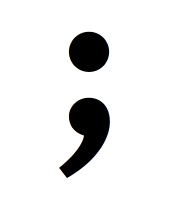
I thought I had.
I mentioned that I did indeed proofread. He commented that he thought not, considering I'd misused the semicolon 5 times on the first page. (And yes, I did use a lot of them in the early years). So at that point, I researched the proper usage of a semicolon. And considering that all the writers in my local writing group had no idea the proper usage (and one is a copy editor for a newspaper), I thought I'd post the rules of usage on here.
The most common use of a semicolon separates two complete sentences, closely related. Two independent clauses. Two sentences that could stand on their own. So basically, if you can't replace it with a period, you can't use a semicolon. There are some other usages, that I will share, but that is the primary one that I see misused with a lot of writers. Here is a pretty good description, taken from Wikipedia.
And if you still don't believe me, here are a few more links to convince you.
http://theoatmeal.com/comics/semicolon
http://owl.english.purdue.edu/owl/resource/607/04/
http://writing.wisc.edu/Handbook/Semicolons.html
http://grammar.quickanddirtytips.com/semicolons.aspx
Usage
Semicolons are followed by a lower case letter, unless that letter is the first letter of a proper noun. Modern style guides recommend no space before them, and one space after. Modern style guides also typically recommend placing semicolons outside of ending quotation marks—although this was not always the case. For example, the first edition of the Chicago Manual of Style (1906) recommended placing the semicolon inside ending quotation marks.[5] Applications of the semicolon in English include:- Between items in a series or listing containing internal punctuation, especially parenthetic commas, where the semicolons function as serial commas:
- She saw three men: Jamie, who came from New Zealand; John, the milkman's son; and George, a gaunt kind of man.
- Several fast food restaurants can be found within the cities: London, England; Paris, France; Dublin, Ireland; and Madrid, Spain.
- Examples of familiar sequences are: one, two, and three; a, b, and c; and first, second, and third.
- (Fig. 8; see also plates in Harley 1941, 1950; Schwab 1947).
- This is by far the most frequent use currently.[6]
- Between closely related independent clauses not conjoined with a coordinating conjunction
- I went to the basketball court; I was told it was closed for cleaning.
- I told Kate she's running for the hills; I wonder if she knew I was joking.
- Nothing is true; everything is permitted.
- A man chooses; a slave obeys.
- I told John that his shoe was untied; he looked.
- Between independent clauses and semi clauses linked with a transitional phrase or a conjunctive adverb
- Everyone knows he is guilty of committing the crime; of course, it will never be proven.[7]
- It can occur in both melodic and harmonic lines; however, it is subject to certain restraints.
- Of these patients, 6 were not enrolled; thus, the cohort was composed of 141 patients at baseline.
- This is the least common use, and is mostly confined to academic texts.[8]
Tuesday, March 8, 2011
Passive Voice: Misconceptions and Facts
Let me start off by saying one thing: I am not a grammar expert, by any means. I am merely a writer that wants to understand the words and structure of her craft.
I’ve come a long ways with grammar. When I first started my writing journey, I was ten years out of college. The most writing I’d done, at that point, was the term papers and small creative writing projects in high school…on a typewriter. Yes, my friends, THAT long ago. So after writing the opening pages of my first draft, I put up a sample on a well-known writing forum for review. Now, I thought I’d edited it to perfection. After some ripping apart by strangers, one of them stated, “Well, if you had edited it better before putting it up….”
“What? I edited it. A lot”
“Oh really? Well, I figured that you hadn’t since you used the semicolon improperly four times on the first page.”
My mouth dropped open. I quickly looked up the proper function of a semicolon. And the stranger was quite right about my error. I learned that I had a long ways to go in the grammar department.
Fast forward to several months back. I received a terrific critique marking my excessive use of passive voice. I had, in fact, used “was” too much. Instead of changing them all, I decided to do some research on passive voice. Passive voice is one of those things I’d never fully understood. And, like my semicolon days, I wanted not just to change it, but I wanted to understand it.
My research helped me to understand a couple of things.
- What passive voice is.
- What passive voice isn't.
Here is what my book, Nitty-Gritty Grammar, has to say about Active and Passive Voice.
Verbs can be active or passive. Active verbs put the person or thing doing the action in charge. With the passive voice, the subject receives the action.
So passive voice is not just what verb you use. Passive voice is sentence construction.
Here are some other definitions online of passive voice (I will include links at the bottom of this post).
- A passive construction occurs when you make the object of an action into the subject of a sentence. That is, whoever or whatever is performing the action is not the grammatical subject of the sentence.
- We call a verb passive when a writer uses a "to be" verb to place the focus on the object of the sentence, rather than on the subject.
- Passive voice is used when the focus is on the action. It is not important or not known, however, who or what is performing the action.
- Passive voice should not be confused with verb tense.
Verb tense is action + time. What happened and when.
Passive/active voice is the subject in relation to the action. Is the subject the doer or the recipient of the action
- A form of the verb “To be” is combined with a past participle to form the passive.
- In passive voice, the target of the action gets promoted to the subject position. Instead of saying, "Steve loves Amy," I would say, "Amy is loved by Steve." The subject of the sentence becomes Amy, but she isn't doing anything. Rather, she is just the recipient of Steve's love. The focus of the sentence has changed from Steve to Amy. If you wanted to make the title of the Marvin Gaye song passive, you would say “It was heard by me through the grapevine,” not such a catchy title anymore.
So I want to make this point very clear to all the writers out there who have a wrong concept of passive voice. Passive voice has to do with the construction of the sentence, not just on the use of “to be” verbs.
Was is NOT a passive verb.
Let me say that again.
Using WAS does not necessarily make the sentence passive.
Here are a few examples of passive and active sentences.
Active: The boy threw the ball.
Passive: The ball was thrown by the boy.
Active: I will invite Joe to the party.
Passive: Joe will be invited to the party by me.
There are tons of examples on the following links. I recommend reading them all, so we can veto this “was” misconception once and for all. These are only a few references to the truth of passive/active voice.
- http://www.englishpage.com/verbpage/activepassive.html
- http://www.amypadgett.com/2008/04/passive-voice.html
- http://grammar.ccc.commnet.edu/grammar/to_be.htm
- http://www.be-a-better-writer.com/passive-verbs.html
- http://www.sil.org/linguistics/GlossaryOfLinguisticTerms/WhatIsPassiveVoice.htm
- http://www.unc.edu/depts/wcweb/handouts/passivevoice.html
- http://www.ego4u.com/en/cram-up/grammar/passive
- http://grammar.quickanddirtytips.com/active-voice-versus-passive-voice.aspx
Now, before you all come at me with pitch forks and anti “was” signs, I do want to clarify that even though using the forms of “to be” doesn’t necessarily constitute passive voice, it can signify lazy writing. I highly recommend cutting out as many “was” words as you can, to make a more descriptive and unique passage.
However, I will say that I read a book recently, by one of my favorite authors. He/she is even on the NY Times bestseller list…multiple times. In the first four sentences, the author used “was” six times (none of them in a passive construction). It goes to prove that, even though cutting down on “to be” verbs are helpful, the most important thing to do in writing is to tell a damn good story.
Subscribe to:
Posts (Atom)