Thursday, August 17, 2023
Dear O'Abby: How do I come up with ideas?
Tuesday, December 7, 2021
Suzanna's Thoughts and Experiences - Where do you get your ideas?
I absolutely love this question! Collecting ideas is a hobby of mine. There is an energy and excitement when ideas are new.
1. I am really, really, lucky that vivid and colorful dreams run in my family, so I have awesome dreams that "sometimes" get a turn at the writing desk. Dream meanings are fascinating.
2. I collect stories, funny sayings, and other things that I encounter every day into a document I call the compost. Theodore Roethke had a similar collection of fragments in Straw for the Fire. Inspiration from Roethke? Yes please.
3. Read "On Writing: A memoir of the craft" by Stephen King. Basically, take two unrelated ideas and combine them. This helped me when I combined two short stories to create the graphic novel project I am working on today.
4. Find some awesome writing prompts, either online or in collections. Some of my favorites are "Steering the Craft: Exercises and Discussions on Story Writing for the Lone Navigator or the Mutinous Crew" by Ursula K. Le Guin and "The Writer's Book of Matches" by Fresh Boiled Peanuts.
5. Do some research. Do you love fencing? Dogs? Funerals? Read some books, nonfiction and fiction, interviews, watch a TV show or movie. Ask "what if" and "I wonder if" questions. Combine two unrelated things (see 3). You'll be amazed by what other writers have created. What will you create if you had similar ingredients? Go to the lab and find out.
Going from inspiration to publication is a different journey. Focus on gathering ideas. Have fun with the writing and see what happens on the page. Then have fun with the editing and publishing part of the journey, if you so desire. Good luck!
Monday, November 4, 2013
PiBoIdMo: How to Catch Picture Book Ideas with Sticky Paper
She always has an amazing line-up of guest bloggers to share their picture book idea generating tips and tricks. (Have you ever wondered where Jane Yolen gets all of her picture book ideas? She’ll be on Tara’s blog November 13th to share!) Registration for PiBoIdMo runs until November 7th. By registering, you are eligible for really cool prizes, including agent critiques and feedback.
This is my third year participating in PiBoIdMo. Over time, it has turned into more than a month of creativity, but an online creative community through an active Facebook page.
Like NaNoWriMo, PiBoIdMo is a way to turn on the faucet of creativity without judging your ideas. It’s a time to go for it and see what pours out. It’s also a time to keep your eyes and ears open for ideas zinging around the universe and catching them on the sticky paper of your choosing. I sat down with a stack of index cards yesterday, my preferred PiBoIdMo sticky paper, and reflected on things I heard from my kids over the past week in preparation for Halloween. By the end of a 60 minute brainstorming session, I jotted down about eight ideas. Mind you some of them are absolutely, positively blech. But there were three in my pile that made me feel like I could turn them into something worthwhile in December.
So, if you are interested in writing picture books but aren’t really sure where or how to start, consider signing up for PiBoIdMo. Because getting inspired is always a good way to get started. If you write picture books, how do you capture ideas zinging around the universe? Is anyone doing PiBoIdMo and what do you think of it so far?
-- Kellie DuBay Gillis
Sunday, September 30, 2012
Seeing Differently: Where Ideas Come From
It's easy to see the difference in picture books. An anecdote is something cute or funny that you see your child do or that you remember from your own childhood. A story is that anecdote transformed -- bigger, neater, funnier, more universal, more specific, better. It's making that anecdote magical, even when you're writing contemporary realism.
Ideas for novels are more complicated. Sometimes they start as an original idea -- a blast of inspiration, even in a dream. Sometimes it's a twist on a trope. Sometimes it's a "what if" from looking at the ordinary world in a different way.
The story of DEADWOOD was inspired by one of those little "what ifs." I noticed how certain trees in the park were carved with messages and names, some of them really old. I didn't even know what kind of trees they were (beeches). I didn't know that the messages have an anthropological name (arborglyphs). But I wondered, "What if the messages were mystical? What if they were a channel for magic? What if the tree could use them to communicate?"
That idea isn't a story, and it certainly isn't a book. I need plot, character, setting, voice, dialogue, description -- but all those things came from seeing something ordinary and looking at it in a different way.
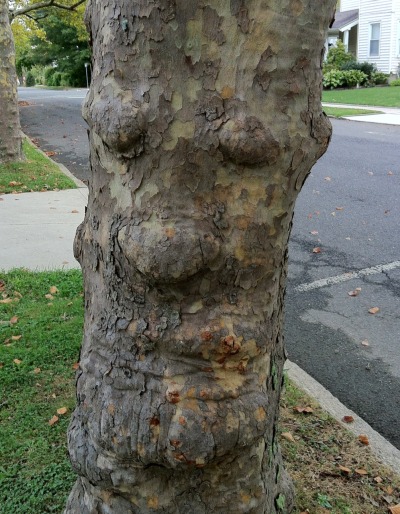
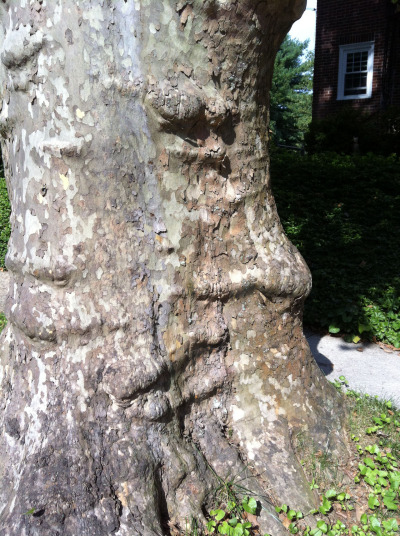
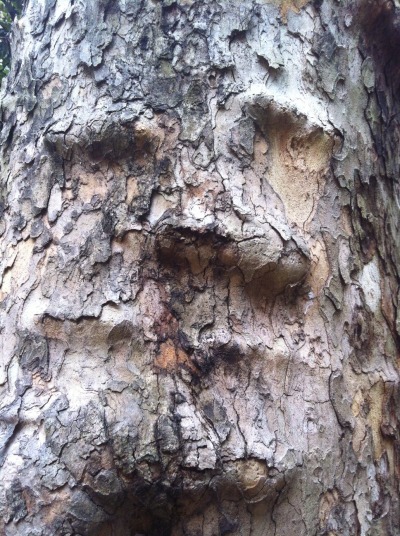
I'm sharing some photos from my tree blog as a fun example. I started taking pictures of arborglyphs, then I started noticing that a lot of trees (bumpy London planetrees especially) look a lot like people -- generally grumpy people. Here are a few of my favorites -- they might take a little imagination and squinting, but once I started looking, I started seeing them differently.
And that's what writers -- and photographers, and all kinds of artists -- do. The thing, person, or experience that washes over others can be a source of inspiration.
| Contemplative tree, Belmar, Nj |
| Cartoon tree. Looks like Bart Simpson. Wynnewood, PA |
| Cubist tree. Eyes on same side of head. Wynnewood, PA |
| Skeptical tree. Philadelphia, PA |
Sunday, July 29, 2012
Evaluating Ideas
I wish there were a better way to evaluate new ideas before writing a book. Lately I've watched some very talented writer friends query gorgeous novels that they'd carefully crafted over periods of years, only to meet utter thudding indifference at the query stage. If the pitch, premise, or query can't get an agent to request, the beauty of pages 11 through 400 does not matter. The novel is DOA. Yet agents and editors only consider completed novels -- the only way to get them to even consider the pitch is to write the whole dang thing.
Of course, established writers are able to test their ideas earlier, not only by running them past their agents, but by selling books on pitch or proposal. Of course, it seems a tremendous luxury to write a book that is sold, but that understates the pressure of writing a half dozen pitches before one hits with the acquisition team -- and then rushing to complete the contracted novel in six weeks.
So what should the rest of us do?
I've been thinking about a model for evaluating ideas used by Karl Ulrich, Vice Dean of Innovation at the Wharton School of the University of Pennsylvania. He teaches his courses on new product development in a tournament format. At the beginning of the course, students bring in their ideas. The class votes, knocking out the weak ideas at each stage and joining teams around the strongest projects. In the end, the most promising products emerge -- a cage match, if you will.
Ulrich hopes that the tournament teaches students that deciding not to pursue an idea should be considered a success, not a failure. It saves the resources that would have been spent on a doomed idea and redirects them towards a better one.
That's the principle behind sites like Authonomy, but those sites were devised more as a slushkiller to help publishers identify good stories, not for writers to find the most successful concepts in their own idea files. The site comes too late in the development cycle to help a writer gauge the appeal of his or her own ideas, and the judging system is questionable. And who wants to put their best ideas out in the public sphere before they've even written them?
One of the main problems in vetting ideas is that nobody really knows a book will sell until it does. Not even agents know, or they wouldn't have so many unsold client manuscripts gathering digital dust. Chasing trends only works if you're fast enough to catch them. Trying for high concept is no guarantee -- one of my friends had a manuscript rejected because it was "too commercial" to sell. Say again? We are still puzzling over that one.
So how do you identify which projects to work on? Do you think about the idea you're most passionate about, or do commercial considerations come into play?
Saturday, January 28, 2012
The Idea File

It's said that ideas are a dime a dozen. I disagree. No one's paying me for them, but my story ideas are gold to me. I treasure my idea file almost much as my novel drafts.
My idea file has a few forms. It includes three partly outlined novels, a few paragraph-length summaries, a line or two each in individual Word docs, one long list of story ideas, a few snippets, a paragraph here or there. A few years ago it had nothing. Then when I finally started writing a novel, I had more novel plots than I could write. Then a few years later, a wrote a picture book. Now, thanks to Tara Lazar's Picture Book Idea Month, I have a couple drafts and a lot more ideas.
Often I review my idea file before a walk or drive so I can turn a premise over in my mind, transforming an idea into a story. Almost everything in that file (well, except a couple make-weights from PiBoIdMo, if I'm honest) seems tantalizingly viable. I just need the time, skill, and creativity to do those ideas justice ... someday.
So a dime a dozen? No way. I insist on the traditional penny-per-thought rate. Unless you have a 20 percent off Groupon, and then a dime will do.
How do you keep track of your ideas? Are you a one-at-a-time writer, or do you have a vault full of SNIs?
And get your pitches ready -- New Mystery Agent contest beginning on Wednesday, February 1!
Need inspiration? Read the i swim for oceans interview with Operation Awesome's Angela J. Townsend, author of AMAROK, a unique, dark, thrilling paranormal coming soon from Spencer Hill Press.
Sunday, January 30, 2011
Strings Attached

REMINDER! New Mystery Agent contest coming February 1, with special surprises when Operation Awesome hits 300 followers! Now back to the blog:
My friend Tracey had another insightful post the other day, From the Heart or from the Head. As she pondered what book idea to pursue next, she wrote:
I've blogged before that “write what you love” is some of the worst advice given out in publishing. That loving what you write will only get you somewhere if what you love also happens to be popular.I’m grappling with the same issue. The next novel I want to write is a difficult, time-consuming historical that is not inherently commercial. Yes, it’s the kind of book I want to immerse myself in as a reader and writer, but it’s not necessarily one that will sell in this very challenging market. And for me, that matters almost as much as writing a story with personal and literary integrity.
So I suggest that instead of writing what you love, you have to love what you write.
Our books are like babies in many ways, but if you’re trying to write to get published, writers have no room for unconditional love. We should try to use our love to make our books good and publishable, not just cling to our words and ideas because they are ours. Loving what you write is hard work, and there are strings attached to this kind of love.
So I pulled out my indispensable copy of Writing the Breakout Novel by Donald Maass, and I think I found a way to make my beloved historical better – a little bigger, a little higher concept – before I start it. It may not be the next Hunger Games, but I’m hoping that I can execute it well, and if I do, that it will interest readers besides me, and hopefully earn a contract.
And you know what? I already love it.
Thursday, December 2, 2010
Kelly's Best of 2010
Laurie Halse Anderson, Forge. I was moved by Isabel’s story in Chains, and Curzon is an equally compelling narrator. I’m a Philadelphian who grew up in the Bicentennial area, so the history of Valley Forge and the Revolutionary War is part of my cultural DNA. Anderson brought it to life. Should I say now that I have another story of my own planned for this general historic period and setting? Well, I do. I haven’t read Anderson’s contemporary YA works, but her historical fiction is an inspiration.
Diana Wynne Jones, Howl’s Moving Castle. This was my first Jones book, probably because it was in the paperback section of my library and the hardcover selection included only middle volumes from various series. But boy, did I love this – creative, surprising, romantic. I also read Enchanted Glass this year, another marvelous book, grounded between the real world and faerie with a satirical edge.
M.M. Kaye, The Ordinary Princess. I’m a sucker for fairy tales, but I don’t like Shrek-like fractured fairy tales – I prefer my stories sincere and straight-up, no snarkiness please and – ugh – no anachronistic pop-culture references. Out of at least 10 books with the word “princess” in the title last year, this sweet, original story was the only one that captured my heart. The Ordinary Princess is illustrator M.M. Kaye’s only novel, published in 1981, a little late for me to have discovered it as child. But I would have loved it then, and I loved it now so much I read it twice in a row (not hard, because it’s so short) and then read it aloud to my daughter. I have a fairytale/fantasy story idea on my to-write list, and I have the very lofty goal of combining what I love about The Ordinary Princess and Howl’s Moving Castle. Aim high, right?
Robin McKinley, Chalice. I didn’t read McKinley when I was young (possibly Beauty – I read it this year and it was vaguely familiar) but I discovered her this year. I started with The Blue Sword and The Hero and the Crown, both widely loved and hugely influential books. I saw them all over Graceling and Fire, which I read this year as well. I greatly enjoyed and admired all four of those stories, but Chalice, which is not one of McKinley’s canonical works, moved me more. I enjoy a warrior-woman tale now and then, but I prefer heroines who are just as strong but also gentle, like Mirasol.
Grace Lin, Where the Mountain Meets the Moon. This utterly delightful, sincere, good-hearted book, inspired by Chinese fairy tales, made me smile throughout -- the clever, brave children, the sad dragon, the exquisite writing, and the wonderful structure of stories-within-the-story that all tie into a very happy ending. This is a masterful work – a true classic.
Rita Williams-Garcia, One Crazy Summer. I loved the intersection of the ordinary family plight of the three girls with important but difficult to understand historic events, bringing it to life so clearly. As a young child, I lived in the progressive enclave of Mt. Airy in Philadelphia, so the setting was both familiar and fresh to me, while the voice of the young MC was endearing and original.
What are your favorite reads of 2010? Which books inspired you most as a reader, person, and writer?