Showing posts with label creativity. Show all posts

Monday, July 30, 2018

A Depressed Writer: Taking Small Steps

When I first decided to write about being a depressed writer on this platform, all the way back in March, I didn't expect that it be more than four months before I wrote another installation in the series.

Yet here we are, the end of July, and I'm just now checking back in. That delay, in part, is of course due to the "creativity coma" that I talked about two weeks ago.

And now that I'm finally feeling better, creatively, in the sense that I want to write again, that I have ideas for writing again, I'm slamming into another wall: my depression.

The symptoms of my mental illness are something that I encounter, in some mutation, on pretty much a daily basis. Whether it's lethargy pushing me to hit the snooze for three hours; anxiety keeping me awake even though my eyes are so tired they burn; or a general sense of malaise, like the end of the world is nigh and my doom is imminent; on any given day, I am fighting off my depression and anxiety.

It's constant. And it's exhausting.

I feel like being, or at least pretending to be, "well" takes up so much of my energy. And the time! Between personal hygiene, and rest, and eating, and being social, and reading, and relaxing, and also spending 45 hours a week at work (plus commute!), what time is left to be creative?

And yet creativity, writing, is such an integral part of my mental wellbeing. It's how I express myself, yes; it's how I communicate with people, yes; it's how I hope to change the world, of course.

But in so many ways, writing is how I learn. About myself, and about others.

So often, when I sit down to write an article or a blog post, it's because I'm trying to explore an idea, an issue, a scenario.

It's the same with novels. They start as an image, or a certain feeling I want to explore.

An image: A girl standing in the midst of a crowd of people singing her praises, making eye contact with the one person who's always had the ability to make her doubt herself.

A feeling: A girl in her mid-20s, trying to achieve her dreams and have it all, wondering why her life doesn't look like the TV shows, wondering where her "Friends" are.

I write because it's how I process, and I write because it's how I survive.

Depression clouds that. It makes me forget that I even want to write, much less be able to do so well.

And so being a depressed writer is a combination of taking breaks and allowing yourself to rest, and then, eventually, just forcing yourself to do it. Because in the end, you know it's what's best. It's what you need to do. To survive. To come out, in any way, ahead.

And sometimes, "just doing it" means taking it slow. It means sitting down to write, scrounging out 500 or 1,000 words, and celebrating that fact with a slice of cake or, if you're me, an episode of Brooklyn Nine-Nine.

Taking it slow means relieving the pressure, the wildly fake pressure, that there is a timeline by which you need to "make it." And it means rethinking what "making it" looks like at all. It means diving into the fact that I'm 25, three years out of college, have completed four novels and don't have an agent yet. And here I thought I'd be signing my book deal before graduation...

The only way to survive as a depressed writer, I've found, is to acknowledge reality, including my limitations, and eventually embrace overcoming them. 

And sometimes, it means thinking ahead: I began writing this post on Thursday morning, knowing I wanted to publish it on Monday morning. I wrote it in chunks over the weekend. And here it is, ready for you, as scheduled. Because I knew if I waited until the last minute, something would come up — something always does.

You get better with time, at being a depressed writer. The more you get to know yourself and your depression, the more you can deal with it. But if you're overwhelmed — when you're overwhelmed — it's important to go back to the basics: small steps. One thing at a time.

You'll get through it. I believe in you. I believe in me. We've got this.

Monday, July 16, 2018

Resurfacing From Creativity Coma

I didn't realize my creative brain was asleep until it woke up.

It wasn't until about a week and a half ago that I had my first idea for an article...an essay...a blog post...got inspired to work on my YA contemporary novel...wanted to put words on a blank page and soak in the worlds they created, the images they painted.

And suddenly, I was on fire. Within about 24 hours, I'd compiled a list of four or five blog posts and essays I wanted to write. It was liberating, empowering, and it was intoxicating.

It's not actually the first time I've experienced something like that. Where for days — nay, weeks — on end, my thoughts were asleep. And I barely even realized it.

I told myself it wasn't happening; that I had ideas, just not the time to work on them; and that as soon as I was no longer stressed about my housing situation, my work situation, my everything-else situation, I would settle back into writing.

But isn't that how it always goes? We don't stop being creative because we want to, or because we've lost the creativity inside of us; we stop being creative because of life circumstances.

But that's actually not the purpose of this post. It doesn't really matter what causes a creativity slump; what matters is what we do after they're over. I won't say "to get over them," because honestly, sometimes you just have to wait it out as best you can, in my opinion. You can't force yourself into productivity, nor can you beat yourself up for not being productive if it's just. not. coming.

The key thing with a slump, a creativity coma, is how you recover from it.

I feel like I'm just now waking up from a long, deep sleep...which is hilarious, because on May 29 I was on a Slump-Busting panel at a blogging conference, and I thought I was recovering from a two-week slump.

Oh, how wrong I was.

Sure, I got back into reading at that point...but writing? Nope, that didn't come easy. Like I mentioned, it wasn't until about a week and a half ago that I even wanted to write again. That I even had an idea for anything to write. That I even believed I could write again.

But I have to take it slow. The other night, I almost freaked right on out because of how much I have to get started doing again — writing for this blog; writing for my own blog; writing for paid publications; writing my novel; reading friends' novels; reading ARCs and reviewing; I could go on. So much more to do!

And in that moment, thinking of fitting it all in on top of full-time work, sleeping, commuting, and trying to have a social life felt...impossible.

So I slowed myself down. I'm gonna take things one at a time. Make lists. Stick to them. Forgive myself if I don't hit everything on the list. Celebrate my accomplishments. Don't sign up for too much (aka don't overcommit). And more, and more, and more.

This blog post is...one of the first steps, actually. A small commitment that I made far enough in advance that I knew I could make it. And. Here. I. Am!

Hey, I'll check back in a few weeks from now and let y'all know how it's going! What do you do when you're in your own creativity coma?

This photo is unrelated. But yay, empty subway train!

Monday, August 15, 2016

Why a Day Off Can Make You a Better Writer

I once read an article about how the CEO of a large company takes a day just to think, maybe walk, do low-impact activities, but mostly think. There are many articles like this, and I think more creatives should follow the pattern.

As writers, our 'work' is more like play and it's a lot of fun, but it's also a lot of concentration, planning, brainstorming, and you know, work. Since I entered the online writing community, I kept hearing the same advice about how writers succeed. Write. Write everyday. Write on the toilet. Write in your sleep. Eat, sleep, and breathe writing. Only then will you become a good writer. But not all advice works for all writers, and not all writers can write everyday.

Whether you're in the 'write everyday' camp or the 'write when I can steal a moment' camp, we can all agree on one thing: we need downtime. You can't write every moment, and you shouldn't. You need time to recharge, to stir up those brilliant ideas that keep the words flowing. You need time to read other writers' books. Even your dream job can cause burn-out if it's all you do.

Vacations from writing are okay. Taking a few weeks to read, to paint, do pottery, travel, and do anything else is fine as long as you can spare the time. If you're on a deadline, you might only be able to afford a day or even a few hours, but you should take it. Make time for thought and reflection, for turning over those plot problems and looking at them from all angles.

Most of our writing problems aren't solved by writing. Considering a scene, talking out a character concept with a friend, and stepping away from the keyboard awhile can help us avoid a lot of pitfalls in our final draft. We need to grant ourselves 'free' days to gain perspective.

Schedule yourself so your free day feels like a treat. If all your days are free days it won't seem so special, and you'll waste it. (Writing days are not free days.)

During your free day, do fun things, relax, but be sure to think productively over what the rest of your week will be like. (Hudson's Productive Thinking model might help with that) Inspire yourself with art, books, music, and especially your own project. Get yourself motivated so when you go back to the keyboard, you're ready to work. It'll be easier when you do.

So, give yourself a day off. Relax, have fun, but most of all, think.

Monday, August 8, 2016

Motivation for Procrastinators


my actual motivational stones
I'm always on the lookout for motivational tools that I can get behind, something that can nudge me in the right direction without being a drill sergeant about it. I'd seen those pretty inspirational stones for sale before, but usually they cost more than I wanted to pay. So, when I found one at a thrift store for fifty cents (maybe even twenty-five) I picked it up. It was black and shiny and said "DREAM" in lovely white serif font. Now, I knew that a rock really couldn't inspire me that much... unless perhaps I kept it around my work area and looked at it all the time. So, I decided to set it in front of my keyboard and hope it would inspire me.

It was a lovely thought, but I didn't feel as inspired as I hoped I would. Eventually I realized a stone with the word "DREAM" on it, wasn't going to make me productive. I needed another word. I had to find another stone! I trolled Ebay (another wonderful way to spend a potentially-productive writing day) for such a stone, and eventually I found one. It was mottled white and said in no-nonsense depressed san-serif, "CREATE". This was it! I was sure that this stone, paired with my 'Dream' stone, would help me to finally see my goals through.

Guess what? It didn't. I still have those stones sitting in front of my keyboard, nudging at my conscious mind to DREAM and CREATE, but they mostly just make me feel guilty for not doing it.

This is a classic procrastination tactic, and I am a classic procrastinator. Did I really believe two stones would be all the catalyst I needed to launch into productive mode? No. Did I think it was more fun to search Ebay for more clutter I don't need than work on my current project? Yes. At least, at the time I did.

Procrastionation is an ugly, greedy, short-sighted mistress. It steals your time - time  you could be using to do the things you love. For me, the only way to beat procrastination is to remind myself on a regular basis what I really want and what I need to do to get there. The rest is about breaking down those To-Dos, and scheduling them, which I'm really bad at.

I seem to work best spontaneously. I spontaneously clean, spontaneously cook, spontaneously write. The key to getting myself to be productive a little more often is to psych myself up. Anything I want to do, when I think about it and how much I love it, or how great I'll feel after it's done, I become inspired to do it.

Here are the tips I've read that actually work for me:
  1. Encourage yourself. Remind yourself how fun whatever you want to accomplish is.
  2. Be passionate. If you aren't that into it, you're not going to want to do it. Find your passion for it, whatever it is. 
  3. Imagine the goal finished and how great it will look/feel/sound/taste. (good for chores)
  4. Break a big goal down into smaller tasks. Perspective makes all the difference.
  5. Give yourself a time limit/deadline. This helps especially when it's something you don't really want to do. If you know you only have to do it for _ hours, it's not so bad.
  6. Treat yourself. Give yourself an incentive to get the work done, and celebrate when you do. This might be going out with friends, writing a celebratory blog post, watching a tv show you love.
  7. Surround yourself with people who encourage you to accomplish your goal, or people trying to accomplish the same goal you are. This is the writing community, so you won't have to go far before you run into someone who's also writing a YA set in the civil war, or a contemporary romance set in a bakery.
  8. Dump the negativity. If someone - even a writer friend - makes you feel talentless, stupid, or doubtful of your skills, get away from that person. Accomplishing big goals is hard enough without naysayers trying to trip you up. 
  9. Start. Just do the thing. It isn't that big a deal. Really. 
  10. Repeat steps 1-8 and keep going. 

We are not stones, and the impulse of creativity/productivity is not inert. It is motion. It is fire, and it pulls and pushes and makes you very uncomfortable until you take action. So take action now. No amount of gentle, happy words telling you how great you are can beat that. Go to it!

Monday, November 24, 2014

Making a Book Trailer in Power Point

I've just spent the last week and a half or so making a book trailer for Crow's Rest, and I wanted to share a video that was really helpful. My first attempt at the trailer used my own video footage (which means it's free, and no rights and permissions to get hung up later) but I wasn't completely happy with that. It felt too disjointed, since some of the footage ended up being more metaphorical than actually illustrative of the script.

So I looked around for some tutorials on Power Point (I'd never used the program before) and found this video very helpful


It walks you through animation, transitions, and even adding narration, in an easy-to-understand tutorial. He also includes instructions on how to format your presentation so that when you export it as a video, you'll have an HD-quality YouTube video. Even if you are familiar with Power Point, you may find some tips and tricks in here that you didn't know.

I watched it once, and then dived into my own slide show, and referred back to this video a few times when I got stuck. The process wasn't nearly as intimidating as I thought it would be, and if not for my creative perfectionism that led me to endlessly tweak the script and image choices, it would likely have only taken me a few hours to create a book trailer using this method. And now that I'm more familiar with it, I could see using this technique to create some vlogs or videos for schools to use.

I also wanted to share another tool that I used to create an original soundtrack for the trailer; it's an app called LoopStack. There are other, similar apps out there, but this one was free to try on Android (you pay $1.99 to unlock more expanded features, but it's still a bargain) so I gave it a shot. Pretty easy to use, once you get the rhythm of it.


I encourage everyone to give a try on a trailer for their book--working on the script alone makes you look at your story in a completely different way. Even if you never share it with anyone (we'll be doing a reveal on mine soon), it will definitely help you visualize elements of your story and characters in a new media.

Monday, September 22, 2014

Lemonade from Lemons: Filling the creative well during rough periods

I really liked Abby's recent post, Evolution of a Snowman, because it gibes with how I've been feeling lately too. She's right in that it can be easy to feel negative when things get a little rougher than usual. And it's especially daunting when real life stuff gets in the way of creativity and writing.

With everything going on, I neglected my other blog, The Writer Librarian, until last week, when I posted this writing contest. Entries so far? 0. The problem, I think, was not only the long radio silence on my end, but also the time constraints resulting in a lack of publicity--I even forgot to put a Twitter post about it, which is my usual go-to for that sort of thing.

This has taught me that even when I don't get as much writing/editing/creative time that I like, every experience adds to my creative pool, whether I realize it or not. And not only can I tap into it later, it helps me grow, both as a writer, and as a person.

An even better example was a slightly bizarre library question I got through chat the other day. I didn't save the transcript, but the basic gist was this:

Library User: Hi, I'm looking for leadership skills used by domestic violence perpetrators.

Me (significant pause): You mean leadership skills used by domestic violence victims?

Library User: No, not victims. Perpetrators.

Me (incredulous): You mean abusers?

Library User: Sure, that will work.

Some time later after some significant searching and head scratching...

Me (unable to hide snark): Uhrm, I'm not finding anything. Do perpetrators actually have meetings now? I'm not familiar with your field.

Library User: It must not be that common. If you can find it, I'm also interested in the tools perpetrators might bring to meetings.

What I didn't say: What, like knives?

Me (what I said instead): The only articles I'm finding are ones that discuss leadership skills used by social workers and counselors. Is that what you're looking for?

Special Library User: Hmm. I guess that will work--I'm a social work major.

It's obvious my user thought "perpetrator" meant "counselor," and my only regret is that I didn't see the interaction with their instructor when they figured this out. Luckily, this will be going into my ever-growing file of weird library stories, and even though it was a challenge to deal with, it's something I can utilize later on.

So for those battling rougher terrain than usual (there seem to be a lot of us lately!) take heart. It's not all lemons, and you can use these things to your advantage later, whether in writing, or in life. So kick your feet up, drink that lemonade, and enjoy.


Thursday, June 26, 2014

Write What You Know

“Write what you know” is one of the phrases I've heard the most often in the writing world. When I began seriously writing, my first reaction to this bit of advice was, “Oh heck no. No one is going to tell me what to write!” I didn’t want to write what I knew. That would be boring. I wanted to explore new worlds and dive into old ones.

It didn’t make any sense to me because I was taking it very literally. I kept thinking, “Well, if writers only wrote what they knew, we’d have no fantasy or scifi or historical novels.” I mean, unless people were out there falling in love with vampires or having their home planets overrun by meat-eating aliens, it just wasn’t possible to always write what you know.

What I finally realized was that the best writers really do write what they know. Now, does that mean Stephenie Meyer ran into a family of vegetarian, sparkling vampires? Or that J.K. Rowling once stumbled upon a whole community of magical kids running around undetected by all the muggles somewhere in Britain? Of course not! (Well, not that I’m aware of in any case).

So how do writers write what they know?

They infuse their stories with all of the emotions, knowledge, and life that they’ve experienced and use all of it to build their characters and storyworlds into incredible books that suck their readers into a new reality. I’m willing to bet that Ms. Meyer has, at some point in her life, experienced fear and loss and that total exhilaration of first love. J.K. Rowling was certainly never a magical teenage boy fighting a weird, snake-looking wizard…but she probably knows what it feels like to be terrified, excited, helpless, alone…to find friends who love you, fight for something you want, and maybe have things turn out great in the end.

To write what you know, you need to write about something you care about, something that touches you. That connection you have to your subject will come through in your work. Novelist Kurt Vonnegut sums it up perfectly:
Find a subject you care about and which in your heart you feel others should care about. It is the genuine caring, and not your games with language, which will be the most compelling and seductive element in your style.
There is a more literal approach to the “write what you know” statement as well. It really is necessary to be familiar with your genre and the world of which you are writing. There are little quirks and “rules” to every genre – what works for a romance might not always work for a thriller.

This can also be an area when a little research can come in handy. If you are writing a book set in Ancient Greece, it is necessary for you to do enough research that you really know what you are talking about. Otherwise, you will never be able to truly transport your readers into the world you are trying to describe.

Familiarity breeds authenticity.

You may not be able to personally experience the day Vesuvius erupted and buried Pompeii, or what it is like to live beneath the ocean, but you can familiarize yourself enough with the pertinent details that you can convince your readers that your characters are living through those experiences.

This applies to the worlds you create yourself as well. Fantasy and science fiction writers create their own worlds, true. But there are certain rules even within the realms of fictional worlds. Maybe in your world, women have supernatural powers and men don’t. Or maybe blondes can see the future and brunettes can fly. You can make whatever rules you’d like for your universe, but you have to stick to them. And you have to have enough knowledge of that world to convince your reader that the experiences and emotions of your characters are authentic and appropriate for the world in which they live.

When you write a book, you want to suck your reader into your world – whether that world is set in the past, the present, the future, or on some other planet or reality…you need to know enough about that world, your characters, and the things they will feel and experience to draw your readers in. Using your own emotions and experiences, and your own specialized knowledge about the world you are creating, will help you craft an amazing story.

In other words, my dear writers…write what you know ;-)

Monday, June 16, 2014

The Creativity Issue and Harris Burdick: Guest Post by Kara Reynolds

About a year ago, I decided to dust off an old NaNoWriMo project and consider myself more seriously as a writer. To show his support, my husband gave me a subscription to Writer’s Digest magazine for Christmas. I get excited every time it shows up in my mailbox, and I got especially excited this month.


Yes, that is my excited face. Well, half of it.

The Creativity Issue. I have struggled with being creative throughout my life. Coming up with ideas for anything, be it a novel idea or the perfect Christmas present, has always been difficult for me. As someone who loves to write, this hurts particularly badly. So I loved the idea of an issue of my magazine dedicated to developing creativity. I particularly enjoyed the article “50 Writing Prompts for Every Part of Your Brain,” and plan on using them when I need inspiration.

There was also an excellent article on magical realism, but that’s another post for another day.
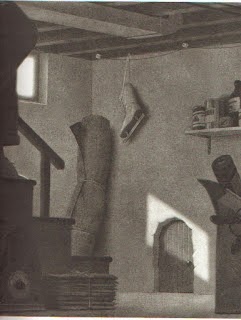
When I was in fifth grade, my class was taken to the school computer lab every week for typing lessons. Once we graduated from the keyboarding program we were assigned story prompts for the rest of the year. One week stands out in particular, because that week my teacher introduced us to a book called The Mysteries of Harris Burdick.

This book was magic. The author, Chris Van Allsburg, explained in a short introduction that a man named Harris Burdick had given fourteen drawings to an editor named Peter Wenders, in the hopes that Mr. Wenders would be interested in the books that went along with those pictures. Mr. Wenders asked Harris Burdick to come back the next day with the stories, but Harris Burdick disappeared…
We were told to pick a picture and write a story for it, and boy was I enchanted. That day the words flowed out of me like never before as I created a story about a basement under siege by tiny creatures.


The title of the picture is Uninvited Guests.

It was years before I realized that Harris Burdick wasn’t real. But the desire to write, to craft words to accompany the feelings and images in my head, that was real, and the imaginary Harris Burdick played a significant role in my love of writing that continues today, seventeen years later. I consider him my muse.


Kara Reynolds is a lapsed genetic counselor who spends her days corralling two small boys and daydreaming about characters in books. Her blog, The Reynolds Tribe (http://thereynoldstribe.blogspot.com), is updated sporadically with funny stories about her kids and musings on writing. Find her on Twitter: @reynoldstribe

Thursday, May 29, 2014

Is Angst Necessary?

People often view creative types as angsty people. We have that visual of a tortured artist, or a writer holed up in some attic turret with a bottle of booze and a soul full of torment. While I'm sure this is sometimes the case, I know many more writers who are peppy soccer moms who just happen to be awesome at writing stories that fairly drip with angst.

So where does all that angst come from? Don't creative people need angst?

Well, in my opinion at least, no, I don't think they absolutely need it. However, do I think many creative people have angst (at least more than the average person)? Yes. Do I need angst? I have no idea. :-D

I do tend to be more inspired by angst. Depression and sadness seem to draw the creativity out of me more than other emotions. (What this says about me I really don’t want to know) :-D The good news is, I don’t necessarily need the angst to be my own. I get very inspired by other people’s angst as well, like a really good, angsty song or movie. I guess I’d have to say, no, I don’t think creative people have to have angst in order to produce good work. But, I do think it helps.

Robert Penn Warren said:
The writer’s fundamental attempt is to understand the meaning of his own experiences. If he can’t break through those issues that concern him deeply, he’s not going to be very good.

I think this is what I use in my work. I wouldn’t describe it as “angst,” but I do dissect my experiences in order to serve up the most intense parts of them. And the more “angsty” emotions do tend to be the strongest, the ones that stick with me the most. For example, I was ecstatic at my wedding. It was a wonderful day. And then when my son was born, the love and joy I felt looking into his newborn eyes was beyond description. 

But the experiences that are the easiest to delve into now, are the depressing ones, the sad, heartbreaking, emotional ones. I have a hard time feeling that exact euphoria I felt at the best moments of my life. But I can feel the pain and anguish and rage and heat and desire and all consuming love that I felt at the worst or most intense moments in my life at a moment’s notice – I just have to dip into the right memory. 

What I truly think you need to produce good work is emotion. Any kind of emotion. Not angst, necessarily. But raw, unfiltered emotion. 

 Edna Ferber said:
I think that to write well and convincingly, one must be somewhat poisoned by emotion. Dislike, displeasure, resentment, fault-finding, imagination, passionate remonstrance, a sense of injustice – they all make fine fuel.

Notice that these are almost all “negative” emotions. I just think negative emotions are easier to tap into – and they are probably easier to relate to as well. Not everyone has felt that rush you get when you first fall in love. But everyone, at some point in their life, has been sad or hurt or scared. There is a line in Pretty Woman that I have always thought was so true…when Vivian is asked why she doesn’t believe the compliments she gets, and she answers, “The bad stuff is easier to believe.” I think this is true in a writer’s work as well. I think that goes along with the saying “Too good to be true.” The bad stuff is just easier to believe, to convey, to tap into. 

Do I think all creative people need to dress in black and sit around brooding with a shot glass in one hand and a cigarette in the other?…no! Of course not! In fact, my writer friends are some of the funniest, happiest people I know. But I do think a writer or artist has to have some kind of emotional background to draw from. 

So, what emotions drive me as a writer? This one is easy….all of them. 

If you read a scene in one of my books that is particularly depressing – well, I was probably feeling depressed that day. Or, more likely, I purposely delved into those memories or played a song that will trigger the emotions I need so that I can tap into them. And if you read an especially funny scene, I was probably in a really good mood that day. 

Can I write a funny scene if I’m mad or depressed? – yes. But I guarantee you it will be funnier if I was in a good mood when I wrote it. Same with the opposite end of the spectrum. I can write a fairly convincing tear-jerker no matter what kind of mood I’m in – but it really helps if I’m bummed when my fingers hit the keys.

So what do you think? Do creative people have to have angst in their lives in order to create emotionally touching art?

Monday, November 4, 2013

PiBoIdMo: How to Catch Picture Book Ideas with Sticky Paper

This month, I’m taking on another kind of writing challenge. In case you didn’t know, November is also time for Tara Lazar’s annual Picture Book Idea Month or PiBoIdMo. The challenge is to generate 30 picture book ideas in 30 days. You don’t have to turn any of the ideas into actual manuscripts or share your ideas with anyone. You simply go to Tara’s blog: and sign up.

She always has an amazing line-up of guest bloggers to share their picture book idea generating tips and tricks. (Have you ever wondered where Jane Yolen gets all of her picture book ideas? She’ll be on Tara’s blog November 13th to share!) Registration for PiBoIdMo runs until November 7th. By registering, you are eligible for really cool prizes, including agent critiques and feedback.

This is my third year participating in PiBoIdMo. Over time, it has turned into more than a month of creativity, but an online creative community through an active Facebook page.

Like NaNoWriMo, PiBoIdMo is a way to turn on the faucet of creativity without judging your ideas. It’s a time to go for it and see what pours out. It’s also a time to keep your eyes and ears open for ideas zinging around the universe and catching them on the sticky paper of your choosing. I sat down with a stack of index cards yesterday, my preferred PiBoIdMo sticky paper, and reflected on things I heard from my kids over the past week in preparation for Halloween. By the end of a 60 minute brainstorming session, I jotted down about eight ideas. Mind you some of them are absolutely, positively blech. But there were three in my pile that made me feel like I could turn them into something worthwhile in December.

So, if you are interested in writing picture books but aren’t really sure where or how to start, consider signing up for PiBoIdMo. Because getting inspired is always a good way to get started. If you write picture books, how do you capture ideas zinging around the universe? Is anyone doing PiBoIdMo and what do you think of it so far?

-- Kellie DuBay Gillis

Wednesday, August 24, 2011

The Imaginarium Of A Writer


When I was six I had a friend called Charlie. 

Charlie ate dinner with me. He sat on the swing beside me as we kicked our legs and tried to reach the sky. He comforted me when I had bad dreams. And, of course, he read books with me. Yep, Charlie was my closest friend. And the best thing about him was that only I could see him.

Charlie was my imaginary friend. And he was a mouse.

Why am I talking about Charlie? Because, in a weird way, Charlie was my first fully formed character. I knew what he looked like (brown fur with black whiskers). Where he lived (the skirting board under my bed). His family (mum, dad, twenty-five siblings) and his likes/dislikes (liked cheese, hated sprouts which, funny enough, so did I).

He had everything we associate with creating a character, but I never wrote about him. He existed for me alone. I guess when you are 6 you are selfish like that ;)

So I come to my point... Our WIPs are like the same. 

The idea comes to us. The little, whispering voice begging for their story to be told. And we write our first drafts. We share their journey. Their hopes and fears. We know their flaws better than anyone. We hold them close, sharing them with a chosen few until we send them on their way to an agent (and, hopefully, a world of readers who will love them like we do).

That spark of character building is always there as children. It is in the games we play. In the truths we bend so we don't get into trouble ("It wasn't me, it was....."). As adults we sometimes forget the innocence of childhood. The stories that flowed like water through us. 

The task as an aspiring author is to catch those sparks, craft them and share them. Because it's only by being read do characters really live.

'Stories were different, though: they came alive in the telling. Without a human voice to read them aloud, or a pair of wide eyes following them by torch light beneath a blanket, they had no real existence in the world.... Once someone started the read them, they could begin to change. They could take root in the imagination and transform the reader. Stories wanted to be read.'
The Book Of Lost Things, John Connolly.

And Charlie? One day Charlie left. I was sad but it was the right thing for him to do. He met a nice lady mouse, and they got married and had babies. He never calls, he never writes but, wherever he is, I hope he is happy.

Thursday, May 26, 2011

What Keeps You Going?

I came across this quote the other day and just loved it. It describes exactly how I feel toward my projects.

It is worth mentioning, for future reference, that the creative power which bubbles so pleasantly in beginning a new book quiets down after a time, and one goes on more steadily. Doubts creep in. Then one becomes resigned. Determination not to give in, and the sense of an impending shape keep one at it more than anything. 
— Virginia Woolf 

This is exactly how I feel at the start of a new project. It's like that giddy rush you feel when you first fall in love. I love my story, I can't get enough of it. Then, something maybe doesn't work exactly how I want it to. I have to work a little harder, move things around. My words don't seem as brilliant. The polish isn't as shiny. 
But, if I care about it enough (and heaven knows there are enough manuscripts I've shoved in a drawer and have never looked at again) then I keep at it, working at it until it's everything I wanted it to be.

The giddy rush comes back when I write the end and begin to edit. That also fades after a while as the work becomes more intense. And then it's done and a new giddy rush hits :)

And Ms. Woolf is right - it's that determination to not give in that keeps me going. If it wasn't for that, I'd never finish a book.

How about you? Do you feel that initial rush of first love that eventually dies down? What keeps you going?

Wednesday, December 22, 2010

Be Creative. Make Mistakes.

                "Creativity is allowing yourself to make mistakes. Art is knowing which ones to keep."
                                                                                                                          (Scott Adams)

One of the other creative things I do, other than writing, is drawing. There's something about a blank piece of paper that makes me smile. It can be what I want it to be. I can mould the image to reflect what's in my mind. When I studied art at school, the teacher told us never to be afraid to make mistakes. Mistakes can be erased, painted over. Heck, even artists like Vincent van Gogh used to paint over their canvases and start again.

But mistakes are also lessons. Without mistakes how do we know what works and what doesn't?

Look at Pointillism. Up close it's a mass of dots, but stand back and the image takes shape.


(Sunday Afternoon on the Island of La Grande Jatte, 1884-1886. Georges Seurat)

Art critics coined the term Pointillism to make fun of the technique. They thought it was a mistake. Now those paintings are some of the most visited works of art.

And writing is just like art.

We ready our canvas. Mix our words on the page. We delete to start over. We agonise over tiny sentences and words. We don't want to make a mistake. The mistake can ruin everything. Sometimes we just need to let the words flow. Creativity an writing is about discovery. Taking the story in places you never imagined.

So let creativity be your guide. Make mistakes. They can always be revised later. Who knows, one of them may end up being the most important dot in your word painting.

Sunday, December 5, 2010

Emotional Overload is a Beautiful Thing

So, last week I was pondering on whether or not creative people needed angst to create. And after a bit of rambling, I think what it boils down to is this - what you really need to produce good work (in my humble opinion) is emotion. Any kind of emotion. Not angst, necessarily. But raw, unfiltered emotion.

Edna Ferber said:

I think that to write well and convincingly, one must be somewhat poisoned by emotion. Dislike, displeasure, resentment, fault-finding, imagination, passionate remonstrance, a sense of injustice – they all make fine fuel.

Notice that these are almost all “negative” emotions. I think negative emotions are just easier to tap into – and they are probably easier to relate to as well. Not everyone has felt that rush you get when you first fall in love or the total rush of supreme happiness experienced when you've finally obtained a goal you've been working toward. But everyone, at some point in their lives, has been sad or hurt or scared.

Do I think all creative people need to dress in black and sit around brooding with a shot glass in one hand and a cigarette in the other?…no! Of course not! In fact, my writer friends are some of the funniest, happiest, goofiest people I know. We spend the vast majority of our time cracking each other up. But I do think a writer or artist has to have some kind of emotional background from which to draw.

So, what emotions drive me as a writer? This one is easy….all of them. If you read a scene in one of my books that is particularly depressing – well, I was probably feeling depressed that day. Or I heard a song that made me think of that one time where I was horribly hurt or heart broken and Ta-Da!!! Someone in my book is going to get shot (just kidding…well, sort of). And if you read an especially funny scene, I was probably in a really good mood that day.

Can I write a funny scene if I’m mad or depressed? – yes. But I guarantee you it will be funnier if I was in a good mood when I wrote it. Same with the opposite end of the spectrum. I can write a fairly convincing tear-jerker no matter what kind of mood I’m in – but it really helps if I’m bummed, or tapped into those bummed feelings, when my fingers hit the keys.

We'll talk about how I help myself get into the right writing mood next week :D

For now, I wanna know....what emotions drive you? Are the harsher, more angsty emotions easier for you to tap into, or are the humorous ones more your cup of tea? 

Oooo and here's a good question for you - does writing about a certain emotion create that emotion for you personally? Meaning, if you are sad when you sit down to write a funny scene, do you end up in a better mood by the time you are done? Or are your creative emotions completely separate from your personal emotions?

Sunday, November 28, 2010

Food for Thought...and Writing

So you know that whole stereotypical writer? Angsty, broody, dressed in black, eccentric, moody, often an alcoholic or chain-smoker (or both)? Same goes for artist, sculptor - anyone in the arts. People hear that I'm a writer and they'll look at me (a mostly normal soccer mom) and say "wow, cool, I never would have guessed." I can't really blame them. I still have that stereotype visual in my head even though I and most of my friends are writers who don't fit that mold.

I was asked once if I thought creative people needed angst to create. And you know what, it's an interesting question.

Do I think creative people need angst?…. No. Do I think many creative people have angst (at least more than the average person)? ….. Yes. Do I need angst? …. I have no idea.

Angst can be defined as “A feeling of anxiety or apprehension often accompanied by depression…[and]…going through deep emotional and possibly physical pain .” For you visual folk, this is how I see it:

Angst:


No Angst:


I do tend to be more inspired by angst. Depression and sadness seem to draw the creativity out of me more than other emotions. (What this says about me I really don’t want to know…not sure I want to) :D The good news is, I don’t necessarily need the angst to be my own. I get very inspired by other people’s angst as well, like a really good, angsty song or movie. I guess I’d have to say, no, I don’t think creative people have to have angst in order to produce good work. But, I do think it helps.

Robert Penn Warren said:

The writer’s fundamental attempt is to understand the meaning of his own experiences. If he can’t break through those issues that concern him deeply, he’s not going to be very good.

I think this is what I try to do in my work. I wouldn’t describe it as “angst,” but I do dissect my experiences in order to serve up the most intense parts of them. And the more “angsty” emotions do tend to be the strongest, the ones that stick with me the most. For example, I was ecstatic at my wedding. It was a wonderful day. And then when my son was born, the love and joy I felt looking into his newborn eyes was beyond description.

But the experiences that are the easiest to delve into now, are the depressing ones, the sad, heartbreaking, fearful, adrenaline-filled, emotional ones. Though I remember the "good times" clearly, I have a hard time feeling that exact euphoria I felt at the best moments of my life. But I can feel the pain and anguish and rage and heat and desire and all consuming love or hate that I felt at the worst or most intense moments in my life at a moment’s notice – I just have to dip into the right memory.

This post is getting tremendously long, so I'll go into the whole emotion aspect more next week, but for now, let me ask you...

Do you think creative people need angst to create? Do you need it?