Showing posts with label becoming a writer. Show all posts

Thursday, April 28, 2016

A Final Farewell...

It is with great sadness that I bid my final farewell to my Operation Awesome operatives. I am thankful to you all for your many contributions, and teaching me more than I could ever hope for.

In looking back over my past posts, I was reminded of one of my first, Sailing Through Fog: How Writers Can Chart Toward an Unseen Horizon. Yet again, I find myself in unfamiliar waters, navigating a new job and figuring out a new normal.

Fog Photo by Psytrom, courtesy of Photobucket

You'd think, two years after that post, I would have figured out all the bumps by now. But that's not how it works. You dodge a rock you think is there, only to run into a completely new rock on the other side. Then you have to re-chart again, because the reality you perceived wasn't there at all, and your certainty is dragged from your center until it becomes a delusion.

So you get knocked out of the boat maybe, and once you get back in, you're cold, wet, and irritated. But if you're in the right state of mind, you can start to see the new pattern so clearly that it turns into one that's familiar, and slowly, surely, you can sail forward again.

It's something we face time again, in writing, and outside of it. Something you tried didn't turn out the way you planned. Perhaps a book you wrote went off in a completely unexpected direction. Or your query flopped. Or a publishing relationship inexplicably went south. Or a marketing strategy you put a lot of work into tanked, and you're still not sure why.

All of these have one aspect in common: they all represent trials we have to go through in order to fully understand what we need to learn from them. And with that understanding, we're armed with a oar to do it better next time.

Sometimes we have to go through the same thing a lot of times before it finally registers. And that's okay. Even new mistakes are okay--because in them we can see where we've improved, what we've overcome, and what else we can learn.

So I leave all you wonderful readers in the hopes that you'll find as many new paths as possible, and when the river gets bumpy, remember we're are all sailing through this together, toward that unseen, misty horizon.

I'll let the Shakira song from the new Zootopia movie finalize my point:


Wednesday, June 10, 2015

Always Know Yourself Before...

During my trip to New York, I saw a lot of interesting sites, and had a great conference experience at Book Expo America.

Before visiting the city, I had a chance to go to Caffe Lena in Saratoga Springs, where the likes of Bob Dylan and other folk musicians have performed. That night, it was a unique blend of blues--sliding guitar, tuba, and trombone. But most fascinating was what I encountered in the bathroom:

"Always know yourself before making a decision that may change your life"
While the walls were covered in inspirational quotes, I picked this one above the others because it's so deceptively simple: "Always know yourself before making a decision that may change your life." Because better decisions are made when you have your own best interests in mind. And knowing what those interests are is key in determining whether a decision is a good fit.

As with anything, this can be applied to writing at all levels:

Crafting stage: When you are still in the process of editing your work, and getting it critiqued by others, make sure feedback resonates with the story you want to write. Don't assume that someone knows more than you, or that negative feedback means you have to change the story entirely.

How to Know Yourself: Think, reflect, and figure out which feedback resonates with you most. Be with it for awhile to see what sticks and what doesn't. That way, you can save having to revert to a previous draft when someone else's recommendations aren't working (though this isn't unheard of--I've had to do it myself).

Agented/publishing/selling stage: From what I understand, this can be a perilous stage because it involves a lot of waiting. And waiting can inevitably morph into unnecessarily questioning yourself. Or settling for a deal that might not be right for you in the long run in order to relieve immediate stress.

How to Know Yourself: Be sure of the direction you want your career to go. Make the decisions that honor that, even if it means waiting to see yourself in print. Because settling for something lesser means possibly having to undo it later on--and that isn't always an option.

What about you? In what ways do you know yourself? And how do these inform your decisions going forward? 

Monday, January 26, 2015

To MFA, or not to MFA? That is the question...

When people find out that I'm enrolled in an MFA program, they often ask me if it's an essential part of becoming a part of the writing profession. And while there are some who believe that an MFA is necessary, I'm in the camp that says it might not be.

Which sort of makes me look like this.
You might be asking why I'm in a program at all. Simple. I'm in a situation where my MFA fits my lifestyle and doesn't break my bank (my body, however, is a different matter, but we'll get to that in a bit). Besides, I feel like I need it to grow as a writer.

So here, in my experience so far, are my suggestions if you're considering an MFA program:

Like I said before, don't break your bank.

In my MFA program, I'm surrounded by writers who are battling huge debt, loans, broken-down cars, and other horrors. While I'm sure getting a writing degree has been the right choice for them, I wouldn't recommend it if you're not a situation where you have to break your bank to do so.

With my librarian job, I get a tuition discount, which basically adds up to about $100 or so a class, and I work in a job where my time is somewhat flexible. So if you're in this kind of position, and you're looking to grow, that's when an MFA might be the right thing for you. (But I also know many people who have been successful writers without one.)

Surround yourself with other writers, but keep writing on your own, too.

A lot of my classmates tell me how astonished they are with how much I write. Right now, I'm drafting a new project while working on an old one, because I'm making the time to do what I can, when I can.

Even some of my writing instructors are encouraging us to make time to write outside of class, which I'm thankful for. Some people are good at talking about writing (see the OA blogger typing to you right now), but my instructor mentioned this great book called, Do the Work, which encourages the doing rather than the talking.

So, write what what you can, when you can, no matter what your current situation might be.

Be open to learn new things, but only use the information that works for you. 

I'm lucky that I have instructors who are open (and sometimes even insistent) on plot-driven material. But this isn't always the case in MFA programs. A lot of times (perhaps more twenty years ago than now) literary writing is encouraged to be poetic more than anything else, and "commercial" fiction is sometimes looked down upon. I'm lucky that my program covers a lot of disciplines (fiction, nonfiction, poetry) and allows for flexibility in creativity. Just know that not all programs will emphasize this.

And so far, I've gotten some good guidance on how to help my writing grow. One instructor helped me see how I could make my characters more empathetic to others (and therefore more sympathetic to readers), and another encouraged me to "write with a heartbeat," because my prose tended to fall a bit flat. Both these suggestions have helped my writing immensely.

But if there's a guy either in your MFA class or critique group who wants you to change the plot because that's not how he would have written it, you can go ahead and tell him to suck his hot air.

Make sure you take care of yourself.

I'm mentioning this one last, but it's the most important, and one thing I've neglected lately. Ever since I've started my MFA program, whenever I had a week of vacation, or a bit of down time, I've always gotten sick. Even now, the scratchy throat and congested chest I have are so closely following my previous illness that I'm not sure if it's the same iteration of it, or something different. And while I did take the advice of my instructors to write in the morning, I didn't make the effort to get to bed at a decent hour and get enough sleep.

So here are some suggestions (especially while in a graduate program) that might help:

Get enough sleep.

Spend at least 20 minutes a day doing something that's completely unproductive.

Choose physical exercise that fits your lifestyle and routine.

Stop being so hard on yourself, you perfectionist, you.

That last one was mostly for me, but you get my point. Which brings me to my last one. Do whatever helps you grow the most as a writer, whether that means an MFA or not.

Monday, October 20, 2014

What's in Your Toolbox?

With November quickly approaching, I've seen lots of posts on how to prep for NaNo this year.

I won't be participating, since I'm still editing my current WIP (I'm almost 260 pages in), but all the NaNo stuff got me thinking about being prepared for novel writing and editing, and what I keep in my writer's toolbox year-round. So here it is:
And it's just about this messy.
Writing: The Drafting Stage/Craft Honing

NaNoWriMo really put me in touch with my drafting process back in 2011. With a spreadsheet to keep track of word count, and a separate spreadsheet with character sketches and chapter synopses, I always felt confident at this stage.

For those of you pantsers out there (I'm sure there are many of us), I highly recommend Rock Your Plot by Cathy Yeardley--I often build my outline around the elements she includes, such as inciting event, plot points, pinch points, etc.

I'm also increasing my focus on character development--since I feel weakest there. Mostly, it's getting to what your protagonist wants (goal) and why they want it (motivation). Explore who your characters are, and how they've been shaped by their experiences. Sometimes characters won't tell you these things until halfway through the novel (or even after the novel is written). This happened to me in my current WIP, when I finally realized her main goal was to fill the holes within herself.

At all writing stages, published or not, growing in craft is something we can all do. For this reason, craft stuff probably constitutes the biggest part of my toolbox.

Books:

Rock Your Plot by Cathy Yeardley
Bird by Bird by Anne Lamott
Characters & Viewpoint by Orson Scott Card
The Art of Character by David Corbitt

Blogs:

Fiction University
Writer Unboxed

Editing: The Revising Stage/Perfectionism and Fear Mongering

I'd admit, this is still an uphill battle for me. I just printed out pages of a revised chapter that I plan to look at tomorrow with fresh eyes, but even before I do, I know it will need a lot of work.

A lesson I learned the hard way was not to worry about line edits too early. Sometimes the perfectionist in me refuses, but when I ask her if she's being helpful, and she says no, I tell her to take a hike. And then I allow myself to be satisfied with my product, even though it might be messy and unfinished.

Another big and hard lesson in this process was learning that the best editor = space from my novel. Which means trunking my first draft for months, maybe a year. When I finally do revisit content, here are some things I try to consider:

First stage: Are the characters compelling people that readers want to hang out with for hundreds of pages? Is the plot engaging? Is there a strong hook to reel readers in? Writing 21st Century Fiction by Donald Maass is helpful in this stage, because it includes all kinds of useful exercises to ramp up narrative.

Second stage: Is everything consistent? Are there story flaws?

*Insert many stages of editing and trunking, including drafts to beta readers*

Last stage: Is everything consistent? Do the sentences read awkwardly?

I'm still honing this part of my toolbox, so if anyone wants to include something in the comments section, I'm all ears.

Books:

Writing 21st Century Fiction by Donald Maass
GMC: Goal, Motivation, Conflict by Debra Dixon
Self-editing for Fiction Writers by Renni Browne and David King

Blogs:

Fiction University (Mentioned above, but covers all writing stages)
A Novel Edit

Publishing: The Final Stage/Sending Your Stuff into the Great Beyond 

I've had a tendency to focus too much on this stage, so I'm only designating a small part of my toolbox to it. Still, it's good to know some basics, such as who your audience is, what genre your book fits in (including what genres are actually out there) and what age group your book will fall under (such as the nuanced differences between Young Adult and Middle Grade, standard word counts, etc.). You can keep an ear to what's trending, but don't marry yourself to it. And don't just write to the market, because it's constantly changing.

Books:

Writer's Market by Robert Lee Brewer (a new one of these comes out every year)

Blogs/Websites:

Absolute Write Water Cooler
Janet Reid, Literary Agent
Fiction University (Mentioned above, but covers all stages of the process)


Okay, your turn! What's in your toolbox?

Monday, July 28, 2014

The anchors that weigh us down...and how to break free of them

Anchors. We all have them. They can be both physical and mental. Some are so invisible that we don't realize how much they're holding us back. Or even that they're there at all, until they decide to put themselves front and and center. Sort of like this:


In cleaning out my office today, I was faced with an anchor that was both physical and mental--the hefty filing case filled with drafts of the first book I ever wrote. It took up almost the entire bottom half of my bookshelf. 

I love this book with my whole heart. I truly do. But seeing it there, heavy, and sagging, reminded me of how much it weighed down my writing career for a number of years. 

Like many beginning writers, I thought that book was going to be my be all and say all. That if I put the necessary work into it, someone would snatch it up eventually. And because I worked on it for so long, I didn't put much energy into anything else (including honing my craft). 

Of course I queried it too soon, and got a ton of rejections (and surprisingly, some partials). But I still clung to it, even after I realized the idea wasn't marketable, the story structure was too scattered, and most importantly, that the main character didn't jump off the page. 

And finally, last year--at long last, I commanded--"to the trunk with thee." It may come back out eventually, but I've set my energies in other directions. And I'm much happier for it.

I was also reminded of this recently on Janet Reid's blog, when someone asked whether bidding on a critique on their manuscript would hurt their chances with their "dream agent." (And while we're at it, yay Pens for Paws!). In the comments, I said, "Sometimes it's difficult for us writers to remember that the sun doesn't rise and set around one book. But making connections and fostering learning opportunities is always money well spent."

Anchors come in all shapes and sizes. Lingering self-doubt. Low self-perception. A marketing strategy that didn't work. A person from the past who causes you to regress into someone you aren't anymore. A panda bear gnawing your leg. A squirrel grabbing you by the nuts.

And yes, some anchors can be difficult to let go of. But if they hold us down long enough, we'll start to drown. (Not that anchors actually drown things, but they'll definitely keep us stuck in one place).

We have to drop them and figure out what the next course of action is. And remember the bright future that lays ahead. Writing that next book. Or trying a new marketing strategy. Or, if you've lost an agent (or editor), dusting yourself off and moving forward (and writing that next book). 

I posted this video on my blog a few years back, but I think it still applies: 


So now to you. What are your anchors, and how have you broken free of them?

Monday, June 16, 2014

The Creativity Issue and Harris Burdick: Guest Post by Kara Reynolds

About a year ago, I decided to dust off an old NaNoWriMo project and consider myself more seriously as a writer. To show his support, my husband gave me a subscription to Writer’s Digest magazine for Christmas. I get excited every time it shows up in my mailbox, and I got especially excited this month.


Yes, that is my excited face. Well, half of it.

The Creativity Issue. I have struggled with being creative throughout my life. Coming up with ideas for anything, be it a novel idea or the perfect Christmas present, has always been difficult for me. As someone who loves to write, this hurts particularly badly. So I loved the idea of an issue of my magazine dedicated to developing creativity. I particularly enjoyed the article “50 Writing Prompts for Every Part of Your Brain,” and plan on using them when I need inspiration.

There was also an excellent article on magical realism, but that’s another post for another day.
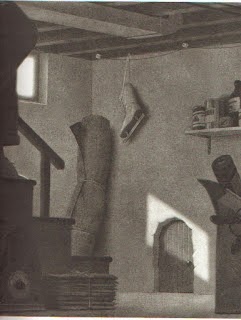
When I was in fifth grade, my class was taken to the school computer lab every week for typing lessons. Once we graduated from the keyboarding program we were assigned story prompts for the rest of the year. One week stands out in particular, because that week my teacher introduced us to a book called The Mysteries of Harris Burdick.

This book was magic. The author, Chris Van Allsburg, explained in a short introduction that a man named Harris Burdick had given fourteen drawings to an editor named Peter Wenders, in the hopes that Mr. Wenders would be interested in the books that went along with those pictures. Mr. Wenders asked Harris Burdick to come back the next day with the stories, but Harris Burdick disappeared…
We were told to pick a picture and write a story for it, and boy was I enchanted. That day the words flowed out of me like never before as I created a story about a basement under siege by tiny creatures.


The title of the picture is Uninvited Guests.

It was years before I realized that Harris Burdick wasn’t real. But the desire to write, to craft words to accompany the feelings and images in my head, that was real, and the imaginary Harris Burdick played a significant role in my love of writing that continues today, seventeen years later. I consider him my muse.


Kara Reynolds is a lapsed genetic counselor who spends her days corralling two small boys and daydreaming about characters in books. Her blog, The Reynolds Tribe (http://thereynoldstribe.blogspot.com), is updated sporadically with funny stories about her kids and musings on writing. Find her on Twitter: @reynoldstribe

Monday, April 21, 2014

Sailing Through Fog: How Writers Can Chart Toward an Unseen Horizon

Writing (and submitting, and selling, and promoting) can often feel like sailing through fog:

 photo 694968_zps97a5008f.jpg
Fog Photo by Psytrom, courtesy of Photobucket

It's pretty, but can you spot land on the distant horizon? Me neither. And the perils that lie ahead (other rocks, or, even worse, quicksand) are concealed, making the path more difficult. How can we make informed decisions when we can't even see properly?

Sometimes this happens on the novel level. Okay, I've plotted to the middle. Now what? I can't see my way through.

The same fog hits those of us querying or submitting manuscripts for critique too soon (something I've done more times than I'd like to admit). The book feels ready, doesn't it? We want to believe the rock is closer than it is, and then, crash. Cue rejection.

Or, for the published among us--trying to guess which audience your book will reach, and how to reach them. If this was clear sailing for everyone, all authors would have books flying off the shelves. But alas. Boat collides with rock.

Before we get too bruised, there's a better alternative. In her book Mystical Hope, Cynthia Bourgeault brought me the metaphor of sailing through fog in the first place. And offered this solution: "You find your way by being sensitively and sensuously connected to exactly where you are, by letting 'here' reach out and lead you...part of the local knowledge that all fishermen and natives use to steer by." (p. 49).

So it's not a matter of guessing your way ahead. It's about using what's immediately around you to chart your way. If I'd done that with my first novel, I would have realized it wasn't ready, and waited longer to submit it. Or, conversely, gotten the nerve to submit my more marketable novel to the WIP Contest instead of relying on the old, tired one just because it was complete.

On the novel level, this means looking at where your character is now...and why (not how) they got there. And using that to drive them forward.

As far as marketing and promotion go, use what avenues work for you instead of what everyone else is doing (or what's trending). Or, if you're agented but not yet published, this may mean trusting the course the river takes you, and adjusting accordingly.

Of course, hitting rocks is guaranteed. But we don't have to hit them all. Luckily, as writers, we can help one other navigate snags. It's why I love Operation Awesome, and the other writer communities I'm blessed to be a part of.

So, sail on. The horizon is there. Enjoy what surrounds you while you chart your way forward.


Wednesday, April 27, 2011

Begin Your Journey.

"The scariest moment is always just before you start. After that, things can only get better." 

There's nothing scarier than the blank page. It's an ocean of white, waiting for the words to spread their tentacles of ink across its surface. 

It's also a canvas of possibilities. A vast nothing where an entire world of discovery waits.

All we have to do is start. 

Don't worry about the perfect opening sentence. Don't sit and ponder if the adverb should be there or not. Just Write.

Words are like clay. We can mould them to be whatever we choose. If we don't like what we've created, we can always start again. 

But starting is the key.

A blank page will always be a blank page. 

Until you begin your journey with two words -- Chapter One.

How do you like to begin a new WIP? 

Friday, December 3, 2010

Finding Your Voice

Hi!


Sorry, was that too exuberant a greeting? I'm a little nervous. This is my first official post on the group blog, the first post written entirely by me and not about a contest or interview. Today, you finally get to hear my voice. Well, by hear I mean read, but you get that, right? Right. Okay, no more stalling, then.

When I first started devoting serious time to becoming (my romantic notion of) a writer, my biggest worry was that I had no voice.

Yeah, you read that right.

I'd read something online about Finding Your Voice and I worried I needed to develop my voice. It's actually kind of silly if you think about it, because just about everybody is born with a voice. You don't question it or think about it. You just speak and words come out in your own unique voice. Sure, you have to coo or babble when you're a baby (not to mention all that bawling). You have to listen to your parents and siblings speak, and you mimic them to some extent. But in the end, the only way to develop your voice is to practice speaking.

Writing is the same way, but I didn't know that. I thought I needed a special guide to teach me how to be myself.  This stems from a fear that's haunted me my whole life, and I'm probably not alone.


Is being myself good enough?


It turns out that the only way NOT to have a personal writing voice is to try too hard to be like somebody else. Don't do that.

While the guide I linked above has good ideas, like reading a lot of different books or practicing writing like your favorite authors, or writing to prompts--all this is effectively the baby listening to conversation before she tries to make words on her own, and then awkwardly copying words like "No" and "Don't" and "Stop that" (this might just be my babies).

Writing in someone else's style is fine, but don't try to be Meg Cabot. Yes, she is awesome. Yes, she is witty. Be awesome and witty in your own way.

How do I propose you do that?

Blog.

For writers, blogging is like a warm bubble bath. It's the fun and relaxation of writing without the cold shower of pass-or-fail judgment. Especially when you're first starting out. For a long time, I had 33 followers on my personal writing blog, and only about 8 hits a day from different viewers. Reaching more people is awesome, but starting small is good, too. I got into my own writing groove whenever I blogged, and even though I never turned my internal editor off (is that even possible?!), I did allow myself some indulgences you simply can't do in printed fiction...

:) SQUEE!! LOL. ;) ROFL b/c That is made of awesome. OMGoodness! :p

...and the result in my novels has been palpable: I actually have a personality. Letting my hair down on my blog has freed up that personality more than copying Shakespeare or Mark Twain ever could. Not that I SQUEE in my books (though a character might at some point). They are definitely different formats, unless you're writing one of those MG books in chat format, which I think has been done to death, people.

The greatest key to finding your writing voice is to be yourself. 

Let that snark, incurable optimism, or witty cynicism seep into your novel. That's what people will relate to. Learn from others, try out new ways of expressing your themes and your characters. But don't bend over backward trying to achieve the oh-so-marketable and ever-elusive VOICE agents are always talking about. When they say that, they're really saying THAT BOOK connected with them on a personal level. Across the publishing universe, voice is as subjective as romantic chemistry. You can't fake it.

Be yourself, let your voice shine through the printed page, and trust that someone, somewhere will like you.


p.s. If you're having trouble getting into the Christmas spirit, visit Lindsay's blog for some snowy goodness or Michelle's for Friday Funnies.

Sunday, October 17, 2010

Pleased to Meet You :) and A Contest!

Since today is my very first post (yay!) I thought I’d throw a little party to celebrate :D Check out the end of the post for details. But first things first….

Hi *waves* My name is Michelle. Nice to meet ya :D

I wanted to be a lot of different things “when I grew up” but looking back on it, being a writer was pretty inevitable. Books are my life and always have been. I’m perfectly happy spending long periods of time as a loner. I have a beyond overactive imagination. I love to get sucked into other worlds. I like to learn. I'm creative. I'm passionate. All of these things have been a part of what makes me ME since the day I was born. I think I've been a writer since the moment I took my first breath and maybe even before :) It's who I am. It's how I see the world. It's how I interact with people and with my environment.

Have you seen Beauty and the Beast (the Disney version)? I am soooo Belle. Seriously, it’s scary. I watched the movie with my daughter yesterday. Every time I watch this film, I’m reminded of the first time I saw it.

My whole family (parents, siblings, cousins, a couple friends) went to the theater. We filled up an entire middle row. I sat at the very end. The lights went down, the movie began, we saw the background story on the Beast….and then Belle wandered onto the screen, basket on her arm, nose in her book.

Every single one of the fifteen or so people in our group, in unison, leaned over and stared at me, laughing their heads off. And continued laughing through Belle’s enthusiastic bookstore visit.

Okay, so yeah, maybe you need a crow bar to get the book out of my hand…and maybe occasionally a trip to the bookstore (or office supply store, come to think of it) will make me go crazier than my five year old on caffeine, but hey, I am who I am. (My husband just did a full on snort at the word “occasionally.” So rude.) ;-)

My whole life I’ve had my nose stuck in a book. My mom used to find me sitting behind the couch with a stack of encyclopedias (which, fyi, are a lot more entertaining to read than one might think). I always, ALWAYS have a book. I never leave home without one :)

That insatiable love of reading turned into diaries filled with bad poetry and half written stories, and one day, several years ago, I typed the words THE END on a fully formed novel. And I was hooked.

What about you? Have you always been a writer, no matter what other professions you may have (or still do) worked in along the way? If not, what started the journey for you?

Contest Deets!

I'd love for all my new friends to meet my old friends, and according to my husband my bookshelves are in serious danger of collapsing, and we have no room for another one, sooooo, here's what I've come up with:

For every 5 new followers we get here at the Operation Awesome Blog, I will give away 1 book. Starting right now (with 153 followers), 7am PST going till 11:59pm on Sat the 24th. If we get more than 50 new followers, (because I don't know if I can bear to give away more than 10 books LOL), I'll throw in a $20 gift certificate to the online book retailer of your choice (B&N/Borders/Amazon).*

To Enter:

1. Be or become a follower at Operation Awesome.
2. Give me a shout out in the comments on this post or my post at my personal blog HERE.

That's it! :)

Winner will be announced next Sunday. Good luck!

*International entries are welcome. If an international contestant wins, I'll add $10 to the gift certificate instead of sending books.