Showing posts with label SNI. Show all posts

Sunday, September 30, 2012

Seeing Differently: Where Ideas Come From

Where do ideas come from? I'm getting ready for Picture Book Idea Month, which is about opening your mind to story ideas -- seeing the world as a story to be written. But to be a story, an idea isn't about just recording the world -- it's about seeing it differently and describing it in a way that's simultaneously fresh and recognizably true.

It's easy to see the difference in picture books. An anecdote is something cute or funny that you see your child do or that you remember from your own childhood. A story is that anecdote transformed -- bigger, neater, funnier, more universal, more specific, better. It's making that anecdote magical, even when you're writing contemporary realism.

Ideas for novels are more complicated. Sometimes they start as an original idea -- a blast of inspiration, even in a dream. Sometimes it's a twist on a trope. Sometimes it's a "what if" from looking at the ordinary world in a different way.

The story of DEADWOOD was inspired by one of those little "what ifs." I noticed how certain trees in the park were carved with messages and names, some of them really old. I didn't even know what kind of trees they were (beeches). I didn't know that the messages have an anthropological name (arborglyphs). But I wondered, "What if the messages were mystical? What if they were a channel for magic? What if the tree could use them to communicate?"

That idea isn't a story, and it certainly isn't a book. I need plot, character, setting, voice, dialogue, description -- but all those things came from seeing something ordinary and looking at it in a different way.

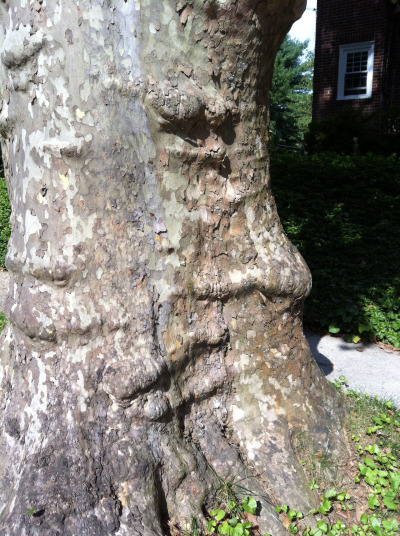
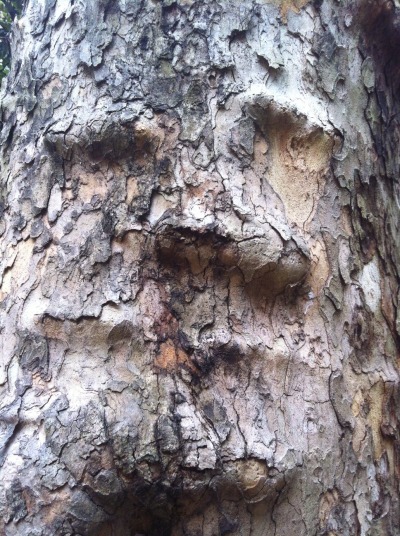
I'm sharing some photos from my tree blog as a fun example. I started taking pictures of arborglyphs, then I started noticing that a lot of trees (bumpy London planetrees especially) look a lot like people -- generally grumpy people. Here are a few of my favorites -- they might take a little imagination and squinting, but once I started looking, I started seeing them differently.

And that's what writers -- and photographers, and all kinds of artists -- do. The thing, person, or experience that washes over others can be a source of inspiration.
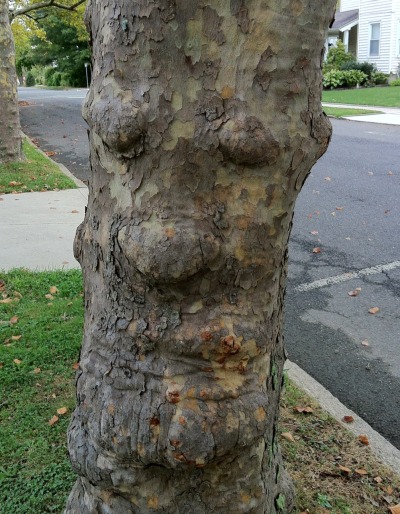
Contemplative tree, Belmar, Nj


Cartoon tree. Looks like Bart Simpson. Wynnewood, PA
Cubist tree. Eyes on same side of head. Wynnewood, PA


Skeptical tree. Philadelphia, PA


Sunday, July 29, 2012

Evaluating Ideas

I'm trying to decide which new novel to write, and it's a hard decision. Some writers only follow their muse -- pursuing their Shiny New Ideas wherever they go. My problem is that I can't decide which ideas are truly shiny and which are fool's gold. Which ones will fizzle out by page 50, which will languish in my trunk of broken dreams, which will sell?

I wish there were a better way to evaluate new ideas before writing a book. Lately I've watched some very talented writer friends query gorgeous novels that they'd carefully crafted over periods of years, only to meet utter thudding indifference at the query stage. If the pitch, premise, or query can't get an agent to request, the beauty of pages 11 through 400 does not matter. The novel is DOA. Yet agents and editors only consider completed novels -- the only way to get them to even consider the pitch is to write the whole dang thing.

Of course, established writers are able to test their ideas earlier, not only by running them past their agents, but by selling books on pitch or proposal. Of course, it seems a tremendous luxury to write a book that is sold, but that understates the pressure of writing a half dozen pitches before one hits with the acquisition team -- and then rushing to complete the contracted novel in six weeks.

So what should the rest of us do?

I've been thinking about a model for evaluating ideas used by Karl Ulrich, Vice Dean of Innovation at the Wharton School of the University of Pennsylvania. He teaches his courses on new product development in a tournament format. At the beginning of the course, students bring in their ideas. The class votes, knocking out the weak ideas at each stage and joining teams around the strongest projects. In the end, the most promising products emerge -- a cage match, if you will.

Ulrich hopes that the tournament teaches students that deciding not to pursue an idea should be considered a success, not a failure. It saves the resources that would have been spent on a doomed idea and redirects them towards a better one.

That's the principle behind sites like Authonomy, but those sites were devised more as a slushkiller to help publishers identify good stories, not for writers to find the most successful concepts in their own idea files. The site comes too late in the development cycle to help a writer gauge the appeal of his or her own ideas, and the judging system is questionable. And who wants to put their best ideas out in the public sphere before they've even written them?

One of the main problems in vetting ideas is that nobody really knows a book will sell until it does. Not even agents know, or they wouldn't have so many unsold client manuscripts gathering digital dust. Chasing trends only works if you're fast enough to catch them. Trying for high concept is no guarantee -- one of my friends had a manuscript rejected because it was "too commercial" to sell. Say again? We are still puzzling over that one.

So how do you identify which projects to work on? Do you think about the idea you're most passionate about, or do commercial considerations come into play?