Showing posts with label plotting. Show all posts

Thursday, August 29, 2024

Dear O'Abby: How do i make my ending more satisfying?

 Dear O'Abby,

I've recently finished my first novel and I took it to a local writing group to get some feedback on it.  I had six different people read it, and they all said they enjoyed it, but found the ending unsatisfying. None of them could put their finger on exactly why it wasn't satisfying, so I'm curious how one makes and ending feel right.

Do you have any kind of basic information that could help me re-shape the ending of my book?

Best wishes,

 Unfinished

Dear Unfinished,

That's the worst kind of feedback, isn't it?  That everyone feels the same thing about the ending, but no one can quite give you a specific reason why it's not working for them.

My suggestion would be to look closely at your characters.  Often when something feels unsatisfying it's because a character acts in a way that isn't typical of the way they've acted through the rest of the book.  That can be jarring, especially if they change out of the blue to facilitate the ending you want without there being much growth beforehand.  If you think this might be the case, go back through and see if there are places you can show your character growing or changing to become the person they need to be to make the ending satisfying.

Alternatively, it could be that the characters haven't earned the ending you've given them.  To be a satisfying ending, your characters need to have been through hell to get there.  If everything has just fallen into their laps and they've tiptoed through the tulips to get to the end, you may need to go back and throw some obstacles in their way.  It should feel impossible that these people can ever get whatever it is that they want or need, that there is no way they can possibly overcome everything thrown in their way.  Then, when they do attain that ending, it feels like they deserve whatever it is they earn from getting through.

Or it could very well be a combination of both these things.  I suggest you go through your MS with a finetoothed comb, focusing on both these things separately.  I can almost guarantee you will find ways in which to challenge your characters more, and in turn, show their growth as people who deserve the ending you've given them.

Hope that helps!


X O'Abby


Thursday, August 20, 2020

Dear O'Abby: Characterization

There is no Dear O'Abby question this week, but The White Rose took the time to comment on the post about writer's block last week, and she has some really valid points, so today's post is about characterization and how to use it to drive your story.

Another writer's block tactic for me is to review the very extensive characterizations I write for the protagonist, antagonist, and supporting characters of my stories. Quite often plot points, both major and minor, come out of these characterizations, as well as traits and odd tid-bits that make the characters more interesting and quirky, and act the way they do throughout the story. These traits can spur a new (and often exciting) direction for them and the story.

I've been a member of several writing critique groups for several years and it never fails to surprise me how many new writers don't spend the time getting to know their characters by writing comprehensive characterizations before they start writing! They need to do the work! Most have a story structure or outline they follow, but the "bones" are not enough. The "flesh" of the story comes from the characters' actions/reactions to what happens in the story, as well as the character of their natures that act as a stimulant/catalyst for what happens. - The White Rose

I don't think I can underestimate how important characterization is to your writing.  No matter what the story is you are telling, it is filtered through the characters who are experiencing it.  And often, when we get stuck somewhere in a story, it's because the character is doing something that isn't right for them.

Each character has to have something they want and something they need.  These should not be the same thing.  Conflict, which is so crucial to a story, arises when what the character wants is different to what she needs. And when one character's wants and needs oppose another character's.  As each character fights through the story to get what they want, other characters will get in their way because they too are fighting for what they want.  These wants and needs should be set up early in the book as these are what compel the characters to move through the story, interact and finally resolve whatever the central conflict might be.

Every decision your characters make will come from these wants and needs and the more in opposition they are, the more tension you will create.

While I don't think it's entirely necessary to write long, detailed biographies of each character before you start writing (but hey, I'm not an outliner either so do whatever works for you), I do think it's absolutely critical you know your characters well.  Even if you never put any of it on the page, your characters need to have a past that has informed who they are at the time the story takes place, a set of beliefs that define them.  This will drive the ways in which they react to the different plot elements you put in place to thwart them.

When you find yourself stuck at any point, go back to the last place your characters had to make a major decision or action and check that the way they responded fits with the personality and backstory you have created for that character.  Does it go against their moral code?  Is it beyond the physical capabilities you have outlined for that character?  While people do extraordinary things, particularly in times of distress, how they respond is almost always in line with their personalities and one of the fastest ways to break your story is for your character to do something that isn't.

Hope this was helpful!

X O'Abby


Monday, May 18, 2015

Pre-Writing a Novel, Making a Road Map

The next time I start a brand new project with new characters, I plan to follow these steps BEFORE I spend any time writing the actual story. At the beginning of my writerly life, I would have considered this a huge waste of time—when I already know (mostly) how the story will go in my head. But ultimately, for me, writing panster-style (and writing by consensus) created years of rewriting, reorganizing, and countless cleanups to make sure all the details were still true to what was kept (and that details or character comments didn’t pertain to something that got cut).

This recommended process (a writing assignment from my publisher) took me about two weeks and ended up being about 25k. I have referred to it often in the course of writing my series, because some plot threads span more than one book, some characters aren't fully revealed in a single book, and I can't forget who and what they are (lest I end up with loose threads and characters who vanish for no apparent reason.)

1. List every character who has a name and give them a face (a real picture from google images—no one but you will ever see this image, so no worries in regards to fame or legal rights)

2. Give each person a life—age, family status, why, who, where, how, what they want, goals/dreams/fears. What part do they play in the story? Where do they end up by the time the story is finished?

3. What are the plots? What are the sub-plots? Play all the plots out to the every end, including all major turning points, climax, and end (for every plot, like a synopsis!). This will give you a steady pace to follow, and keep you from giving away too much info too soon (if you know exactly how much is there in the first place).

4. Think of questions that could potentially rip your story apart, and figure out the answers before you start writing. (How does an entire community of shifters stay hidden? Why can’t Ariel write Eric a note to declare her love (after she’s lost her voice) when it’s clear she knows how to write? Who has access to the ‘magic’ and why?)

5. Connect all the dots. How does each character interact with the main character/s? Do they help or hinder? If they do neither, maybe they shouldn't be involved at all (if you’re doing this AFTER your story has been written, and you’re looking for ways to cut. If you love the character too much to cut, make him/her earn his way into the story by giving him a purpose that makes sense. Or save him/her for book 2, or another story entirely.) :-)

This is a great way to determine how much value a character or plot adds to your story. You don’t want or need extra wordage the reader could do without, or “talking heads” with no real cause.

Have a solid plan and know your characters’ personalities before you begin the writing, and you’ll save hours and hours (maybe months) of fixing timelines, filling plot-holes, and tweaking details for pace, believability, and dimension. With each character and plot, you should know exactly where they need to go and why. How they get there can still be a surprise in the writing, but the destination (along with the critical gas stations) should be mapped out before the journey begins.

*bonus tip! If your ideas gets tweaked along the way, do you best to keep this master document updated as you go. Because every time you come to roadblock in the writing, you'll have an accurate map to get you back on course.

If a *shiny new road has your wheels spinning faster, you can more accurately predict how much change one little detail might have on the overall story--if you can still get to the same destination on a different route.

*There's no harm in changing the destination before you get there, you just have to make sure all the details agree to change direction. If you've already written stuff that no longer applies...it's not the end of the world (just more work). Sometimes a different destination is well worth the effort. ;-)


Friday, November 14, 2014

NaNo and Slow Drafters

My name is Becky Mahoney, and I am a plotter.

I am a plotter to the extent that it makes drafting very, very slow. I like to get the wording very precise in my head before I lay it all out there. I didn't used to be this way, but I always say that learning how to revise properly kind of ruined me for drafting. Once I realized how good I could be, it was difficult to give myself permission to be terrible.

So having tried NaNoWriMo with very little success in the past, I always assumed it was just completely antithetical to the way I worked. Of course, I was always in the middle of a project when November rolled around, so I always tried to log 50k on that project with very little success. It's difficult enough to produce 50k in one month. But to produce 50k of good words? I'm sure it's been done, but I am nowhere near that amazing.

My participation this year was sort of a last-minute snap decision. All of my current projects were going slowly or stalling because I was stuck on the words, stuck on making them right in one go. I needed to stretch my drafting muscles. So I decided to do that with a completely blank slate. I chose a vague idea that had taken up residence in my brain over the last week of October, and I went for it with very little planning. Had I made this decision earlier, I might have made myself an outline ahead of time. But I dove in with only a few story beats mapped out in my head.

I am someone who, on a good day, is lucky to get to 500 words. 1000 is in the high end of my daily word count more often than not, and very rarely, I will write more, especially if I'm close to some watermark, like the end of a chapter (or the manuscript.) Today is November 14th, and I am sitting at 30,000 words.

They are, of course, not good words. Much of what I have is wheel-spinning, repeated conversations, clunky exposition, and loads and loads of telling. It is, in essence, a very long dry run for this project.

But I have a separate document going with all the ideas I'm having along the way: changes to the setting, various plot twists, logistical kinks to work out. I'm getting a chance to hash out voices and character dynamics without having to worry about hewing to my outline. And I'm getting a sense of just how much I can get done when I turn my internal editor off and just enjoy drafting.

I am a plotter. That much has not changed - actually, this experience has emphasized it for me. But NaNo is teaching me some excellent new tricks. And I look forward to using them.

I'll see you all at 50k!

Monday, November 3, 2014

Plot running astray?

The second draft of my novel has gone in so many unexpected directions, it feels more like a first draft, and I wish I could do NaNo WriMo with the rest of you wonderful people.

In my revisions, I built an ever-increasing word count that bordered on gluttonous, and it eventually ran my story into the ground. Kind of like this:


For days, I hemmed over how to jump start everything into gear. The answer came when I helped a student hone in on her research paper thesis. I told her a mantra from my own papers: "Stick to your thesis like glue."

I realized my novel's thesis was my synopsis and query, and I hadn't stuck to them at all. Notes and changes were spread across multiple documents, and there was a story thread that didn't need to be there. That's what was blocking my path.

Here's how I got myself untangled:

Step 1: Revised query and synopsis to reflect new story directions, and stuck to it like glue

Step 2: Condensed proposed story changes into a manageable to-do list

Step 3: Sliced out extra story threads that didn't belong

So far, I've been able to subtract 4,000 words, and I now have a clear path to the end:


I hope, whether you're doing NaNo WriMo, or if you're buried in revisions like I am, that you can stick to your query and synopsis (or outline, if that's your preference). Especially if you find your plot tangled or your story stalled. Letting go of what you don't need makes everything a ton easier.

Your turn: What are some ways you've tamed your unruly plots?


Friday, October 24, 2014

Pre-Writing for NaNoWriMo

Do you pre-write when you NaNo? The first time I did NaNoWriMo, I didn't do any pre-writing at all. It was strictly a stream of consciousness. What came out was somewhat, well, rambling, as streams of consciousness tend to be.

For a first draft, rambling isn't such a terrible thing. It only means that revision will be extremely important, and most likely time-consuming. Sure enough, it was. In fact, at the end of revision, I wasn't sure the story actually worked.

The next time I did NaNoWriMo, I came across a blog post about pre-writing, and was intrigued. The writer suggested I plot it all out in my head before writing, hitting all the major checkpoints of story architecture.


While there are many methods you can use to plot, my favorite is from Save the Cat. It's actually a book about screenwriting. You may be into screenwriting or you may not, but the structure of writing for film is extremely helpful to any fiction writer. It cuts all the darlings away to reveal the bones of the story, and the reason it does this is simply that the format of film is performing to the shortest attention spans in the world. Master this art of storytelling for film, and you'll be a master of the novel, as well.

Save the Cat has a chapter listing 15 'beats,' on The Blake Snyder Beat Sheet. A simple way to pre-write for NaNo would be to list these beats out on a piece of paper or a Word doc, and fill them in with your basic premise.

1. Opening Image
2. Theme Stated
3. Set-up
4. Catalyst
5. Debate
6. Break into Two
7. B Story
8. Fun and Games (I like to call this one The Musical Montage)
9. Midpoint
10. Bad Guys Close In
11. All Is Lost
12. Dark Night of the Soul
13. Break into Three
14. Finale
15. Final Image

For more incredibly helpful detail on these beats, buy Blake Snyder's book.

My NaNo project this year is a spiritual time travel story. What's yours?

Tuesday, April 15, 2014

Blood Moon

(Reuters/Marcos Brindicci)
If you're living in the United States and haven't figured out filed your taxes yet—you'd better get on that. Today's the day!

Did anything exciting happen during the big Blood Moon event last night? I set my alarm to see it, but the clouds sort of ruined any chance of visibility, so I went back to bed and used my imagination to create all sorts of paranormal mayhem. I mean...all those unsuspecting, vulnerable people gathering in parks in large numbers. At night. And not just any night with any ol' full moon, but the night of a BLOOD Moon! (Surely a Blood Moon has more potential for danger than a BLUE Moon.)

And I wonder how many babies were born (or conceived!) across the world during last night's eclipse, if they are now bonded by some (evil?) force that will become apparent on the night of the next Blood Moon. Actually, since there are four more Blood Moons this year, we'd better change the age to 16 or 18 — since Baby Blood Moon Zombies probably won't go over very well. Also, why do these things never happen when a kid turns 17?

It's no wonder I can't sleep.  :-)

All I can say is, in light of the Blood Moon, none of my pets turned "corrupt" like they do in the game Terraria, and I'm pretty darn happy about that. :-) Although, I haven't checked the rabbit and chickens yet this morning. :-)

If you missed seeing the Blood Moon last night, here's video and article at CNN: http://www.cnn.com/2014/04/15/tech/innovation/blood-moon/

Great information for writers!

Friday, August 9, 2013

Plotters and Pantsers alike - is it possible to go against your nature?

Happy Friday, OAers!

You all have seen the dozens of blog posts and discussions about plotters, aka compulsive planners and outliners, and pantsers, aka the improv masters of the writing world. I'm sure you've also seen the endless arguments for and against each. This is certainly not going to be one of those arguments, because in my humble opinion, those are silly.

But in general, I think it's safe to say that quite a few writers are more or less set in their ways regarding which one works for them. I, myself, am a total plotter. I have micro and macro outlines. Foreshadowing is my best friend. I even have foreshadowing charts. I love structure, even on the days when structure does not always love me back.

Since I have to wait a while before I can get back into my current project, and I didn't really want to start anything epic from my queue, I decided I'd pass the time with a fun little palate cleanser, and I decided I'd try pantsing it. That process always looked really fun, so why not give it a try?

I came up with the idea for the new story yesterday... and already I have a fairly significant chunk plotted out. Whoops.

So maybe I'm a bit set in my ways, but what about you guys? Was there ever a time where you 'went against your nature?' Or are you comfortable sticking with your own style?

Sunday, May 5, 2013

A Little Culture Goes a Long Way


Happy Cinco de Mayo! Which brings me to the question...

Do you have cultural events mingling with the events of your novel? I'm not suggesting your plot should be centered around cultural traditions, but that you consider using events (real or imagined) in the finer details that follow your existing plot.

Cultural events are the world-building results of a society. They add a sense of depth and realism for the reader, and the reader might even gain a new appreciation for something they didn't know (if your events are accurate). They can reveal a character's personality and upbringing, and the level of tolerance, understanding, and maturity of sidekick characters. They map the passage of time, season, and weather. They create a calendar deadline that can't be changed, even if your mc hasn't finished saving the world.

They can also instigate conflict and moral dilemmas. Would your mc pick a family tradition/gathering over a first-year anniversary? Does the significant other respect that decision? And on that note, did the mc even warn his date that there might be an issue when he brings her to a family event for the first time? Did he explain the expected customs so she could be prepared?

While your mc is actively saving the world, would his/her mother call to remind him/her that it's Mother's Day, and that a phone call would have been appreciated?

Does an unusual attempt at meal preparation reveal the fact that the in-laws are coming for Memorial Day weekend, and one spouse neglected to tell the other?

Does your mc care if the family doesn't approve of his/her friend for racial or religious reasons? It'd be kind of sad if the mc was just rebelling the family standards, and didn't take the long-term effects into consideration because the relationship wasn't supposed to last. (Character growth!)

Does your mc buy decorations/gifts at the dollar store the day of... or have they been prepping all year? Oh the stress if all that work was suddenly lost. How will they handle the holiday without the "things"... How would they handle a holiday they love in a society where that holiday isn't recognized?

Cultural events and holidays happen in all societies, no matter how much stress your character is trying to handle at the time. Don't let your plot get off track, but don't forget the calendar!

Monday, June 4, 2012

We Need To Talk About Kevin... And Kindness


A few days ago, I finally got the chance to watch We Need To Talk About Kevin, the film adaptation of  Lionel Shriver's novel. Confession: I haven't read the novel. When I first saw the trailer, I was unsettled without really knowing why. All I knew was that I had to see the movie.  

If you haven't read or seen We Need To Talk About Kevin, no worries. I won't spoil a single thing. 

Other than the fact that it devastated me.

Yesterday, Kelly blogged about the Victorians and their take on difficult topics in their work. We Need To Talk About Kevin deals with messy, messy things, too. But here's the thing: I wasn't super affected by the ugly parts. I rarely am, actually. Books, movies, TV, real life. I've grown accustomed to expect the ugly. 

What really affects me, what catches me off guard and devastates me in the strongest way, is kindness.

Heart is what gets me every time. People doing good things. That makes me cry.

We Need To Talk About Kevin shows glimpses of kindness, and they got to me. They push me to be a better person. The film's characterization and plotting push me to be a better writer. My advice to you? Find what wrecks you, and harness it into whatever your passion might be. I have a lot of passions, but one is certainly writing. I only hope I can pull off something as wreck-y to whoever reads my work. 


Now tell me: how do you incorporate what wrecks you into your work?? Have you read/seen We Need To Talk About Kevin? If so, what did you think? 

Monday, May 7, 2012

On Batman And Letting Go


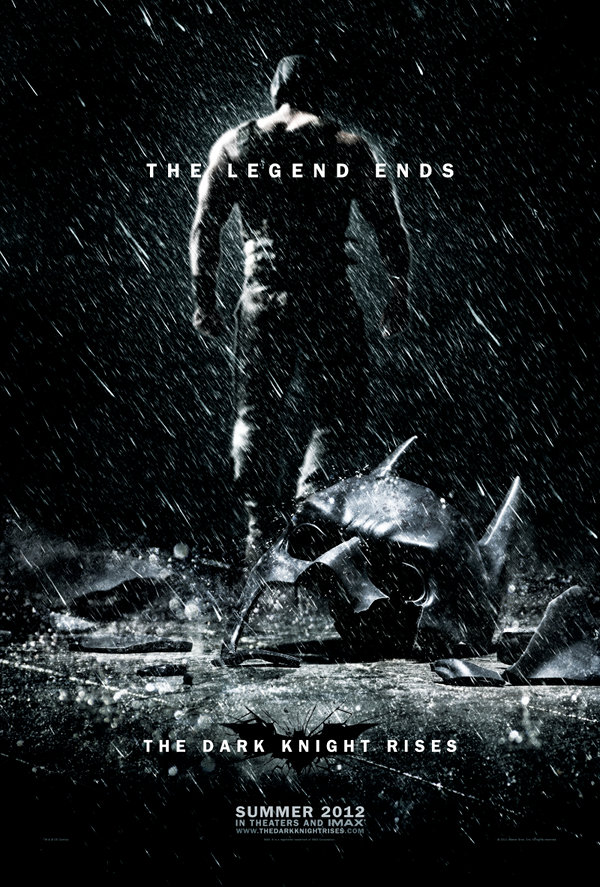
Confession: The first time I saw this poster for The Dark Knight Rises, I cried. I also cried the first time I saw the teaser trailer. And I also cried the first time I saw the two trailers after that one.

But back to that poster. You see how the words "The Legend Ends" sit at the top? Yep. Those did me in, folks. I read the stupid words and bawled.

Why?

Well, I'm a h-u-g-e Batman fan. Christopher Nolan, director/screenwriter extraordinaire, has re-envisioned my childhood superhero into someone I don't want to say goodbye to. Of course, I'm aware that even after Nolan's trilogy wraps up, more Batman films will be greenlit in the future. 

But Nolan won't direct or write them.

Christian Bale won't be Batman anymore, either. Some new dude will take over and re-envision the man/mythology all over again. 

That's one reason I don't want to let go.

The other? I suck at letting go of my favorite characters. Big time. I can convince myself that it's for the greater good and that it's not a real person I'm saying goodbye to, but in the end, those pesky tears always come back. Something tells me I'm never going to change. I'm destined to be a sort of character hoarder, unwilling to part ways with the fake people ruling my heart, and eventually burying myself underneath their awesomeness. 

*suffocates*

Which leads me to today's questions: how do you let go of your favorite characters? Which character proved the hardest to let go of for you? They can be from books/movies/TV shows you love, or they can be from your very own WIPs!!!


Also, for the Batman lovers out there, here's the latest trailer for The Dark Knight Rises: *sobs*


Tuesday, September 20, 2011

Climbing The Story Mountain

All stories require a tiny bit of plotting at some stage. It may be as simple as adjusting/rewriting the genius of chapter 3 after a fabulous idea strikes when writing chapter 15. It might even (as I like to do as I write) be as simple as sketching out the next chapter before you write it. 

Want a simple way to plan out your fabulous WIP without the drama? Here is a simple little plotting guide to help climb that story mountain:


What do you think?

Any plotters want to share some tips? Any of my fellow plantsers (plotter & pantser) want to share some handy hints?  

Monday, August 29, 2011

Hurricane Irene + Boredom = PLOTTING TIPS

So. Hurricane Irene. 

*glares*

You see, I live in Puerto Rico. And dear ol' Irene was not very kind to my country (for some reason, I am typing this while speaking like Borat. I assure you, Puerto Ricans do not speak like Borat. Just me). Anyway, Irene hit us this past weekend. She stayed with us for about three-ish days. On Sunday, while I was watching this:


...the power went out.


The water said goodbye the next day. On Wednesday, it returned. 


The power, on the other hand, came back on Thursday.


But without cable or an Internet connection.


I spent the majority of the week looking like this:


Things Amparo Was Plotting:


1) Irene's slow and painful death

2) Her WIP


When it comes to #2, I sort of had an epiphany... because of #1. You see, when it comes to character development, the toughest things for me to nail are the external triggers that allow said development to unfold. I know how my MC will change throughout the manuscript, but not always what causes that change. 

Which leads me to Irene and my Week In Cyber Suckage: if you take something away from your MC, giving it back in half pushes them to seek the missing piece. Also, if your MC gets everything he/she wants in one fell swoop, take something else away that means more than what they gained. This could be material or not. Totally up to you, and your story's needs. I think books are all about The Lack, and exploiting what your MC's lacking makes for awesome storytelling. 

So yeah. I guess Irene was good for something.

Now tell me: how did you spend time with Irene? Did she help you with your WIP? Have you used these tips in your writing?

Monday, June 27, 2011

Awesome Book Reviews: BEAUTY QUEENS by Libba Bray


From bestselling, Printz Award-winning author Libba Bray, the story of a plane of beauty pageant contestants that crashes on a desert island. 


Teen beauty queens. A "Lost"-like island. Mysteries and dangers. No access to email. And the spirit of fierce, feral competition that lives underground in girls, a savage brutality that can only be revealed by a journey into the heart of non-exfoliated darkness. Oh, the horror, the horror! Only funnier. With evening gowns. And a body count.


Review: Remember that time I said I wanted to make out with Elana Johnson's Possession?

Yeah. It happened again.


This was my first time reading a Libba Bray book. While I am still appalled at myself for not having read her other books, I'm glad Beauty Queens was my first. Bray has a knack for the funny. Scratch that--for the hilarious. Pageant girls stranded on a deserted island? Come on. You know you're laughing right now.


But Bray's novel isn't just about the hilarious. Yes, there are a few borderline psychotic, high-maintenance contestants who live and breathe sequins and sparkles. Some would kill for a flat iron. Or cry if they broke a nail. They are your standard beauty queen cliches. 


And it's precisely this that worked for me. Because not only does Bray acknowledge the cliches, she stomps on them and tosses them into the ocean. Adina, one of my favorite characters, is Miss New Hampshire. She has ulterior motives for being a contestant on the Miss Teen Dream pageant. I won't reveal said motives, but I will say that they spur debates between the rest of the girls. Mainly, they seek to answer this question: what does it mean to be a girl? Other contestants have their questions, too. Bray weaves them all together throughout the book, making you laugh and think at the same time. 


Beauty Queens shows an America turned corporation, where consumerism is king. At times, there are "commercial breaks" that feature ads for ridiculously named products, TV shows, and celebrities. There are also Fact Sheets that each contestant has filled, revealing funny yet poignant details about them. But sometimes those facts have to be censored--they clash with what a future Miss Teen Dream is all about. Or they might make The Corporation look a little less perfect. And we just can't let that happen, can we? 


I could go on and on, folks. My verdict? Don't listen to me. Go pick up Beauty Queens, which is in stores now, and see for yourself :)

Friday, December 17, 2010

Storyteller or Wordsmith?

Blacksmith removing rust with sand (or fairy dust, if you have any imagination)

Here's a thinker for you this Friday (Happy Friday, by the way, everyone!! Woot!):

Are you a storyteller or a wordsmith? 

I've noticed lately in my reading that some people truly excel at story, like Frank Baum of Wizard of Oz fame, or Rick Riordan of the Percy Jackson series; and others weave words like master artisans in the households of kings, like Libba Bray of Going Bovine and A Great and Terrible Beauty, or Gayle Forman of If I Stay, or my critique partners. ;) (Seriously, you guys are in for a real treat when any one of them breaks through the publishing bottleneck.)

Of course, it would be nice to have it all, but nobody starts out that way. That's why we call writing our craft.

So which part of our craft is your strong suit? Storytelling, with its plot structure, twists, and revelations? Or wordsmithing (how can that not be a real word?), with its heart-piercing phraseology and dew-from-heaven gloriousness?

It's an important question because the answer can tell you where you need to focus your practice. Me, for instance. I've got wordplay down to a hyphenated art. Okay not really, but I became a writer because people told me I write well, not because people said I come up with the most air-tight plots ever. So I fall in with the wordsmith lot. For me, this means my current focus has to be plot. And not just plot. Storytelling includes characterization and setting, so you can see I have my work cut out for me.

Knowing where my strengths lie as a writer gives me focus, but it also reminds me to allow myself a little failure in my weak areas. It's okay if my first draft is filled with plot holes. For me, revision is less about crafting perfect sentences and more about re-imagining the story... over and over again, until it all fits. And, of course, since this is my cross to bear I think storytelling is much harder than spinning beautiful phrases. Which is more difficult for you?

Now you know what to work on this weekend.

On that note, hop on over to my linky for the New Year's Revisions Blog Party. (You can totally cheat and write your revision goals before the 1st. I won't tell, if you don't.)

Psst! The OA blog circle is abuzz with excitement over Leah Clifford's new book, A TOUCH MORTAL. Michelle, Lindsay, and Amparo are all pimping it. The exciting news is that Leah will be HERE on the OA blog doing a Q&A about her upcoming book, her writing, whatever you think to ask, this SUNDAY!


Coming February 22, 2011


See you there!

Monday, September 27, 2010

How To Plot Your Awesome Novel


In case you haven’t heard, Kristal’s started an awesome 1k a day challenge. This challenge got me thinking about a bunch of stuff (like how I’m procrastinating… a lot… please don’t tell my crit partners…). But mainly, it made me ponder something I’ve recently become a fan of.


Outlining.

I know, I know—a 1k a day challenge is no place for pre-plotting. BUT I’m not here to tell you to map out everything beforehand. I’m here to share some uh-may-zing tips on what to keep in mind while you’re writing.

Confession: Heidi Willis is a genius. She blogged about what a novel’s plot should consist of, but in a way that even I understood it (yep, I’m sort of slow with the technical stuff…). Since it was such a great post, I decided to share it with all you pretty people.

Here’s how Heidi breaks down plot:

3 Act Method

Act I (25%) Set up characters, motivations, backstory. At the end of this section, a dramatic event propels the main character into conflict

Act II (50%) In the middle of this, the MC discovers a secret, by the end is the start of big confrontations with seemingly insurmountable obstacles. Conflict rises steeply.

Act III (25%) Obstacles are overcome, MC must make choices


Percentage Method

Stage 1 (10%) draw reader in, identification with hero

Turning Point (10%) new opportunity, new journey often followed by MC refusing to take the journey or by into the opportunity

Stage 2 (15%) hero reacts, formulates plan

Stage 3 (25%) hero is overcoming obstacles

***Turning Point (at the 50% mark) hero must commit, there is no turning back

Stage 4 (25%) goal is more visible, stakes are higher

***Turning Point (at 75% mark) Major setback, a do or die moment

Stage 5: (15%) Final push; conflict becomes overwhelming, MC must give everything; accellerated pace; MC determines his or her own fate.

Stage 6: Aftermath, what life are they living now


When Heidi plots, she uses 300 pages as her guideline. Thus the above percentages would be:
p 1 - 30
p 30 - 60
p 60 - 105
p 105 - 180 (turning point at p 150)
p 180 - 255 (turning point at p 225)
p 255 - 300


I don’t know about you, but I feel all smart after reading that :)

Here’s the link to Heidi’s amazing blog:

And here are some links to other plot-related posts around the blogosphere:
http://kidlit.com/2009/12/09/writing-a-hot-plot/ (by Kelly’s agent, Mary Kole)


Go get that 1k a day, everyone!