Wednesday, November 9, 2011

Fear of Failing

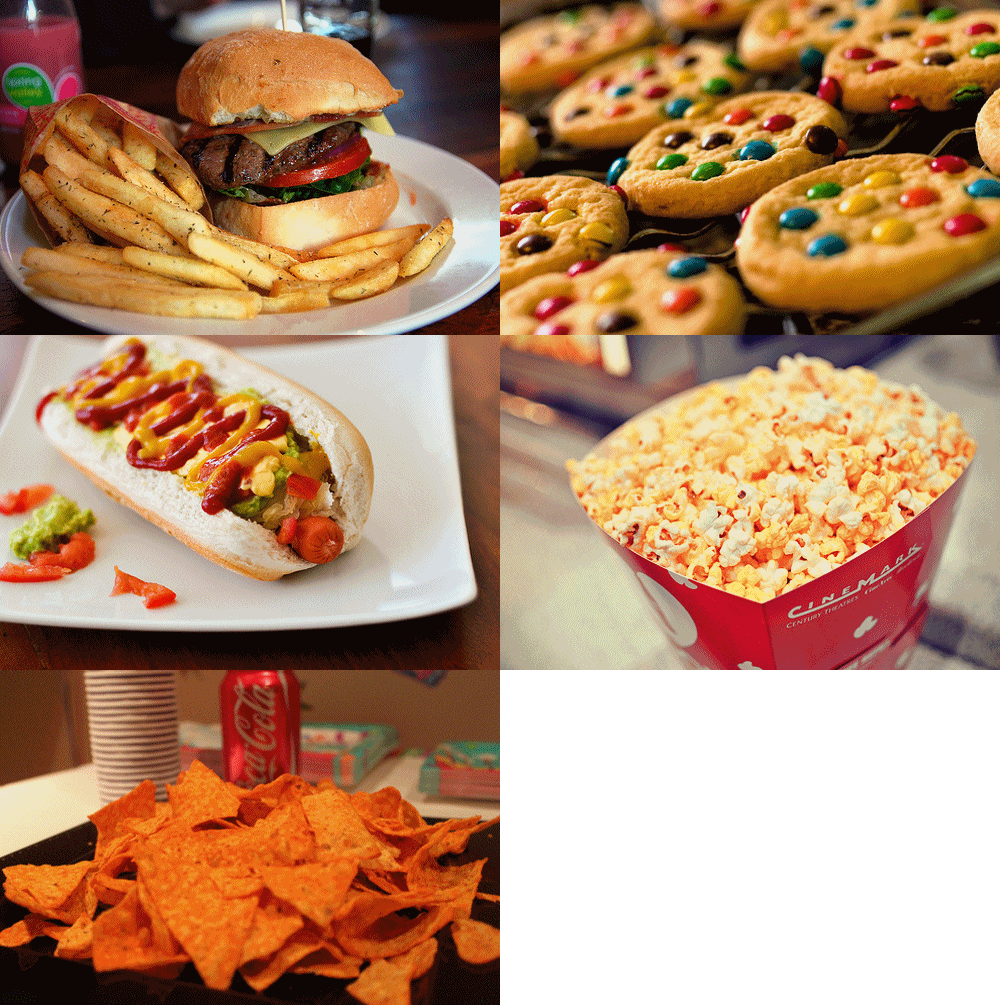
Writing is like a wonderful meal. The anticipation that comes with the starter of the idea. The wonderful main course of writing, creating that story into being. Then, finally, the delicious dessert of editing and polishing until full. But being a writer comes with a side-order of worry.

We worry about plot holes, adverbs, character development, purple prose, and the million other things that go along with writing.

But perhaps the thing that worries us the most is failure. That one word haunts us. Pulls at the edges of every fresh story idea. Every new WIP. Each draft of edits. Every query we send out.

But maybe we shouldn't fear failure. When I read this on Nova Ren Suma's blog, I knew I had to share it with you. Why? I'll let these wonderful words from Sara Zarr explain:


I’m inspired by failure.
Which is a good thing, because right now I’ve got a first draft of a new book in front of me, and it feels like a massive pile of FAIL. (I should note: this is my book.)
This, I know, is a somewhat distorted version of reality. Oh, there’s good work here, the bones of something. And, in places, muscle, flesh, blood.
But it’s far from a success. And that’s exactly where it should be right about now. I’ve been doing this and observing others doing this, or things like this, long enough to know that every book, every painting, every dance, every song, every screenplay, every movie, every craft project lives most of its life as a failure.
The creative process, and the creative life, is mostly full of moments between the idea and the being done, the spark and the blazing fire, the shimmering magic and the finished piece. We’re always living in the gap between our vision of what could be and what might be, and what is.
Even typing that paragraph kind of breaks my heart. I want the writing life to be made of more moments of capturing the vision, and fewer of feeling it slip through my fingers, uncatchable as time.
I need all the reminders I can get that I’m not alone in that gap, that this is the nature of the work, this is what it is: learning to live with a certain degree of failure. (I’m intentionally using the cringe-inducing, scary F word. You know how some social, ethnic, or religious groups have “taken back” certain words, claimed them, and made new meaning? That’s sort of what I’m doing here.)
So, I seek out any place where I can hear other creative people talk about their failures and their fears. Those places include documentaries, interviews, essays, articles, blog posts, and maybe even tweets from fellow writers who, in 140 characters or less, reveal their moments in the gap.
When I hear Bob Fosse say that every time he choreographed a new show, he didn’t know how to move dancers across the stage…
When Anne Lamott writes about the completely confounding process of writing her second novel…
When John Lasseter talks about being fired from Disney before going on to make Toy Story—which, by the way, was a disaster in its first version, as was Toy Story 2, and also p.s. Monsters, Inc. didn’t “find its center for a very long time” and then became the highest grossing animated feature at the time…
When I remember that Steve Jobs was kicked out of Apple… (Steve Jobs! Kicked out! OF APPLE.)
When I see artists Christo and Jeanne-Claude endure a quarter-century of obstacles before they were finally able to install The Gates…
When I read that the masters painted over their own work time and again when they felt their first attempts weren’t worth the canvas…
When I hear demo versions of just-okay songs that became gorgeous favorites…
I’m reminded:
Without risking failure, maybe even running headlong into it, there’s no chance for discovering something new and beautiful. Without wandering off the trail that the rest of the world is trudging on, we don’t know where we can go, what we can do, what’s out there beyond our current vision.
I’m reminded that the point of creating isn’t control.
The point isn’t saving yourself from embarrassment.
The point isn’t preserving an image of yourself dear to you, and/or dear to others, or earning out your advance or gritting your teeth as you check to see if your ranking, wherever, is ticking up.
The point isn’t avoiding failure.
We can’t. It’s inevitable. Those who finish what they start persevere through it, blow gently on those embers, tend to that first love, protect the shimmering magic, in hopes of…
…Insert your hopes here.
Maybe: To enflesh some truth—maybe beautiful truth or maybe not-so-beautiful truth—and the experience of living in this world, or a world in your imagination. To translate vision into whatever the medium of your craft is, for whatever your reasons are. To understand? To be understood? To ask questions well? To explore, maybe. To entertain, to show love, work out your demons. Or—gasp!—to have fun.
Whatever the answer is for you, there’s going to be a lot of failure along the way. In a way, “failure” is just another word for “the journey,” for not being there yet but on the way. It’s the road we walk on to get wherever it is we’re trying to go.
Today, I’m looking at my draft and its large and small failures, and I know: if everyone I admire and respect, everyone whose work has endured for more than five minutes, everyone who has come out with something beautiful, has struggled in this same, frightening gap, I must be on the right track.

Monday, November 7, 2011

New THE HUNGER GAMES Cast Photos: What Do You Think?

So. There's this movie coming out in March 2012. It's called The Hunger Games.


Maybe you've heard of it.


*winks*


Anyway, Vanity Fair magazine has released brand new pics with the cast! 


Le pics:


Now tell me: what do you think? Do they look like the Tributes you imagined? Are the pics getting you pumped up for the movie release?? (confession: Despite a few actors not looking like I thought they would, I. Cannot. Wait.)

Thursday, November 3, 2011

Keeping the Little Darlings Busy

So, I know not all writers have children. But for those of us who do, working on any sort of project, let alone something like Nano, can be a challenge. Here are a few ideas I've picked up over the years for keeping your kidlets (or significant others) busy while you are pounding the keyboard.

1. The Electronic Babysitter


Yeah, yeah, I know....Bad Mommy! But, I've found this one highly effective. Movies and video games can keep my little ones occupied for hours. And it doesn't have to be bad, mind-numbing drivel. There are lots of great, educational games and shows around. But just like the Borg, your kidlets will adapt quickly. You gotta keep throwing fresh, new material at them or they will develop immunity and it will no longer be effective.

2. Find the Coin


When I was growing up, my parents would play this game with us (we called it something different but it probably isn't PC anymore so...we'll just call it Find the Coin) :D I realize now it was a great way to give them a few kid-free moments, but at the time, I just thought it was a fun game. They would hide this huge silver coin my dad had somewhere in the house, and we'd have to go find it. I don't remember if we got a treat for finding it; I just remember how much fun it was to look. And I never suspected that my parents were just trying to keep us occupied for a while :D

3. Skittle Surprise


This one cracks me up and was suggested by my awesome friend Toni Wilson. I don't know that I'd ever do it but it's hilarious. Take your kids in the backyard, open a big bag of Skittles, and let them fly :D It'll take your kids hours to find them all :D

4. Pen Pals


My kids love to do projects with me. So sometimes we'll set up a whole Writer's Corner at the kitchen table. My kids will either get their toy laptops and play their games while I work, or they'll get out pencils and paper and create their own books. They love making up their own stories, drawing pictures to go with their ideas. And I love sharing something that such a big part of me with them :)

What are some things you do to keep your kids occupied when you need to work?

Wednesday, November 2, 2011

A Guide to Writer Traits

When drafting a new WIP there are certain things a writer will encounter. We can try to fight them. Pretend they won't happen to us, but the time will come when you are faced with these things:

Your appearance will suffer. You may/will be so engrossed in your WIP that your hair protests. Embrace it. Our presentation may suck, but the words you could write in the time it takes to brush your hair are what counts:


You've marked out your writing time. Everyone knows not to disturb you, but someone will interrupt you in the middle of THE MOST IMPORTANT scene to ask you a question. You'll need a speed answer to preserve your wordage flow:

image


Your computer will decide to shut down/freeze/go wonky at the most inconvenient moment. You will utter this phrase many, many times:


image

Or possibly want to do this:

image


A balanced meal takes time to prepare. Valuable writing time! Sometimes the major food groups will end up looking like this:


We all know that sometimes the brain needs a break. Never underestimate the value of procrastination time: 


A writer will find that everything else is exciting while procrastinating:


And don't forget the benefits of a power nap:

image


And then there is the ultimate writer trait to embrace. You can try to avoid it with carefully thought out writing plans/word count goals/time management, but the words are tricky. The words will hit you when you least expect it. Then comes the time when the words demand you write all night:


Happy writing! 

Tuesday, November 1, 2011

November Mystery Agent Contest!!!!

--- Contest CLOSED -- 
Thanks for participating!! Stay tuned for our Mystery Agent's winners. Happy Nano!

Update 11/1/11: Writing a
twitter pitch, aka a pitch in 140 characters including spaces, is extremely difficult. But most of you bent over backwards to do it! Kudos to those of you who did it right. Fifteen of you were over the limit, by anywhere from 7 to 180 characters over. This obviously isn't fair to those who followed Rule 5 down there. 


You've been disqualified and I'm reopening the contest for anybody who wants to submit or resubmit with the correct type of pitch.


Please check the length of your pitch to see if you're one who is being disqualified. Michelle also sent out emails (or tweets or a blog comment if you don't have an obvious email) to those who were disqualified. If you made a mistake and want to correct it, you're welcome to do so now! :) 


I promised our Mystery Agent 50 twitter pitches PLUS first 500 words, so I'd appreciate your help. Thank you!

It's true that NaNoWriMo begins today, but for those of you with a pitch-ready novel under your pillow, something even cooler is going on...

MYSTERY AGENT CONTEST!!


This month's Awesome M.A. has requested a twitter pitch PLUS first 500 words. This has never been done on OA before, so I'm excited to read the entries!


Requested genres include:
Picture book - YA/Teen:

commercial fiction
romance (contemporary and historical)
historical fiction
multi-cultural fiction
paranormal
sci-fi/fantasy in YA or romance only
dark novels
fairy-tale/legend spin-offs

The Rules:

1) Entries must be left in the comment section of today's post. (Please do not email us your entry.)

2) You must have a completed manuscript and be ready to send it upon request.

3) You can only pitch once per contest. So if you participated in any of our previous M.A. contests, no worries--you can submit your pitch today, too.

4) Please include TITLE and GENRE along with your pitch.

5) Your pitch should fit nicely in a twitter box. Please include the first 500 words of your completed manuscript following your twitter-length pitch.

Winner gets a full manuscript request from our Mystery Agent! Good luck!

And Happy NaNoWriMo!!

Monday, October 31, 2011

Past Tense vs. Present Tense: How To Choose Which Works Best

So. Many of you are gearing up for NaNoWriMo tomorrow, which I think is awesome. I, however, am sitting this NaNo out. I do have a WIP, and I'll continue to work on it throughout November, but I'm taking it a little slow. One reason for this is because I'm editing as I go.

Then there's my other reason: I couldn't decide which tense to write in. 

As such, today I'm going to discuss... wait for it... verb tenses!! *dances the Macarena* First, let me share what the Free Merriam-Webster dictionary has to say:

Past Tense
1) a verb tense expressing action or state in or as if in the past
2) a verb tense expressive of elapsed time.


Present Tense
the tense of a verb that expresses action or state in the present time and is used of what occurs or is true at the time of speaking and of what is habitual or characteristic or is always necessarily true, that is sometimes used to refer to action in the past, and that is sometimes used for future events.


The go-to book I always use when considering tense is The Hunger Games. Suzanne Collins chose present tense for her narrative. The story unfolds in real time, and since it's a gladiator-style fight to the death, choosing past tense would've automatically suggested that Katniss survives the competition.  For this book, present tense added lots and lots of tension--readers feel like whatever happens to Katniss is actually happening as they read, which makes them feel like they're right there with her, going through the same hardships. 

Past tense, however, seems to be the norm. Some writers/readers despise present tense and may believe it's nothing more than a trend. With past tense, I find that I can jump into the story without going, "Oh! It's in past tense." I'm so used to reading it that it doesn't jump out at me. Present tense does, though, since it's rarer for me. 

Now. How do you choose which works best for your WIP? 

Consider the following:
  • Who is the narrator? 
    • their goals/advantages/disadvantages
  • Where is the story set? 
    • time and place
  • What's the story about? 
    • if your story is in the mystery/horror/thriller/postapocalyptic genres, I think present tense will increase the tension and make readers turn pages faster.
    • if your story is in any other genre, though, it can still be present tense. You just have to make sure it's the right fit for your narrator and plot.
  • What kind of ending do you have in mind? 
    • does your narrator die/disappear without a trace?
    • is your world under threat of destruction, or is it moving along just fine?

Other than that, I only have one more thing to add: go with your gut. You can always switch between tenses as you write, or even after you've finished your first draft. As long as you feel comfortable, and it makes sense for your story, you're good to go.

Now tell me: which tense do you prefer? Which books do you think exemplify them best?

And remember! Tomorrow is our Mystery Agent contest!! Come back with your Twitter pitches and first 500 words!!

Saturday, October 29, 2011

Oliver Awesome's Book Corner with Sandra Ulbrich Almazan

I recently had the pleasure of reading Sandra's novella, Lyon's Legacy. SciFi isn't a genre I read much, though I do enjoy it, so I was very much looking forward to diving into her book. I wasn't disappointed. Here is the blurb:

Sometimes being a geneticist isn’t enough to understand your family....


When scientist-in-training Joanna Lyon learns her rich uncle plans to have their rock legend ancestor, Sean Lyon, cloned, she’s disgusted. Uncle Jack pushed her into music when she was younger, and she hated it. So it’s particularly galling that he wants her to travel through a wormhole to an alternate universe and sample Sean’s DNA. She only agrees to go so she can secretly sabotage the project. But meeting Sean forces her to re-examine her feelings about her family, including her estranged father. Can she protect the unborn clone from her uncle, and will she have to sacrifice her career and new-found love to do so?


What I liked: This book definitely contains a lot of science but it wasn't so bogged down in it that it lost me. Sometimes the technical aspects of SciFi books can get overwhelming, but this had just the right touch of "ooo that's kind of cool" without being so over-the-top technical that it's impossible for anyone without a PhD in Genetics to understand.

Jo is a great character, very real and relatable and I connected with her right off the bat. It was fun to watch her in a situation she didn't want to be in and to watch how it changed her. Her love interest, George, is just lovable and I liked that their romance was very present in the story without overtaking it. It was woven very well into the main storyline. This book just had a little bit of everything; science, time travel, romance, major character growth, a bad guy you want to smack upside the head, heartache, and hope.

I also liked that the story felt complete. Many novellas I've read do not. While this is Book 1 in a series, and there is definitely more to the story, this book does well standing on its own and doesn't feel like it was just cut off in the middle of the book in order to create a series as many novellas I've read do.

What I didn't like: The only thing I didn't really like (and this is very nitpicky) was that one of the characters called the woman who raised him Aunt Grandmother (or various versions of this). It got a little confusing. Every time I saw an instance of this, I found myself wanting to spend some detailed time with his family tree instead of paying attention to the story. However, this was a very minor part of the story and didn't affect my enjoyment of it.

Overall, I loved it :)

If you'd like to purchase a copy of Sandra's book (and I'd highly recommend you do) :) it is available through the links below. I will be posting an interview with Sandra on my blog tomorrow, so everyone be sure to head over!!

Amazon
Barnes & Noble
Smashwords
Sandra's Blog

Friday, October 28, 2011

Keeping it Real: Holidays in Fiction

Happy Halloween!

Ever noticed how a lot of YA books have a Prom or a Winter Formal or some such thing? It's immediately understood by readers to be a big event, a rite of passage, or at least a social ritual where certain expected things happen. If you want to be different, though, or if you write something other than YA, another easy way to get that reader identity wrapped up in your story is...


Holidays!

Personally, I love reading about holidays in books. For one thing, usually something plot-related happens during the holidays. In a paranormal book, holidays can be particularly exciting if there's some ancient ceremony that has to take place in order to save/destroy the world or bind all faeries to your will... or something.

In contemporary fiction, I love to read about how different people celebrate the holidays so differently. It immediately makes the characters more real to me, because traditions are part of everyone's life. Even if I've never celebrated Rosh Hashanah, I know it's a Jewish holiday and would love to see a character going through the tradition/meaning of it.

Holidays are something we all just understand. We know there are meaningful holidays and those that have lost meaning in our culture and are just for fun... like pinching on St. Patty's day if someone isn't wearing green. There are also holidays from the homeland which people in America may never have heard of... or maybe your father made up a holiday involving a Festivus pole. Your story will be completely unique.

Personal story time:  My mother didn't like the spookifyzation of Halloween and the growing danger of trick-or-treating. As a family, we developed our own tradition, which turned into a second Christmas. We called it Santa-Claus-Christmas or Halloween-Christmas. We dressed up, passed out candy canes to trick-or-treaters and told them "Merry Christmas!" 


You should have seen their faces. 


We watched Christmas classics like Miracle on 34th St. or It's a Wonderful Life. We popped popcorn and ate junk food (a rarity in my healthy household). And best of all, we got one gift each from "Santa." 


If I were a character in your book, you could have a heyday with something like this. How did I feel about doing something so different? Well, it was cool. It was something my weird, kooky family did that made us closer even as it made us different. As I got older (teen years), I started to want parties with friends instead of the traditional staying in with my family. But when I left home for college, I missed the family tradition. Halloween became a downer for me, kind of like New Year's Eve (which is the stupidest, shortest holiday in existence). I developed my own personal tradition of crappy things happening to me on Halloween. 


Now that I have kids, we've created our own traditions, including dressing up to a theme and decorating pumpkins. I'm not sure what traditions we'll have in the future or how our current ones will change, but the traditions of my past definitely affected my future traditions with my kids. Family time trumps the spookiness. 


I have a friend whose family has a traditional prank war on Halloween, which definitely fits the commercial meaning of the holiday and sounds fun, if a bit horrifying. Unleash your imagination. There are endless possibilities for holiday fun/chaos.

Whether your main character reveres and anticipates a holiday or almost completely forgets it, including holidays in your fiction can draw readers into your reality. For fantasy or paranormal, it's an anchoring element. Even if nothing else about your paranormal creature is familiar, if she blows out candles on her birthday, I can relate. I feel anchored.

Halloween is coming up, and I've seen some great spooky scenes in books and TV based around this holiday. Costume parties have provided a golden opportunity for the villain's infiltration, and haunted houses instantly create an atmosphere of confusion and chaos. 

Christmas presents are a prime time for characterization through gift-giving. Does he give her a pre-wrapped gift he bought on Christmas Eve? Or is his gift her favorite candy wrapped up in something she collects? Or maybe he's given her a family heirloom/talisman to protect her from the supernatural villain, and she just thinks he's being romantic. Yeah, I've been watching The Vampire Diaries on Netflix. 

Think of the traditions you've observed in your own life, or the ones you've heard about from co-workers during a one-up-this-awful-holiday-story session.


How do you celebrate the holidays? Or what's the best holiday story you've ever heard?


Let's create a mini-wiki for writers to draw from. :)

P.S. Mystery Agent contest launches November 1st. Be prepared with a twitter-length pitch PLUS the first 500 words of your completed MS. Entries will be capped at 50. Genres include: Picture book-YA/Teen: commercial fiction, romance (contemporary and historical), historical fiction, multi-cultural fiction, paranormal, sci-fi/fantasy in YA or romance only, dark novels and fairy-tale/legend spin-offs

Wednesday, October 26, 2011

NaNaNaNo


It's almost time for NaNoWriMo. We know the NaNo deal: Thirty days to write 50,000 words. 

I've read a few NaNo themed posts. There are some fabulous tips out there for how to approach it. And, if you don't want to NaNo, there are posts waiting. As for me? I don't hate the concept. I love the idea that NaNo pushes you to write. I like that the goal encourages making time write. But will I be doing NaNo? No.

Everything in me wants to say I'll do NaNo every year, but I always seem to be in the middle of a WIP when NaNo rolls round (or editing one). This year is no different (I'm in the writing stage). 

So I've got a few links for if you still aren't decided: 

Thinking of saying yes to NaNo? Elana Johnson talks about gearing up for NaNo. Ali Cross also has some reasons for NaNo-ing.

Thinking of saying No to NaNo? Check out the annual Dear John letter to NaNoWriMo by Maggie Stiefvater. 

What about you? Will you be NaNo-ing this year? Any tips for making the process easier. 

Tuesday, October 25, 2011

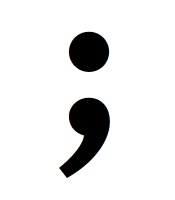
The Semicolon

I had a meeting with my local writing group the other night, and we had a discussion on the use of a semicolon. Now, back in the early days of writing, I had no idea how to use a semicolon. I figured it was just a strong comma. So thinking I was clever, I posted my opening pages to a critique forum. One guy told me that it might be good to proofread before posting for comments.

I thought I had.

I mentioned that I did indeed proofread. He commented that he thought not, considering I'd misused the semicolon 5 times on the first page. (And yes, I did use a lot of them in the early years). So at that point, I researched the proper usage of a semicolon. And considering that all the writers in my local writing group had no idea the proper usage (and one is a copy editor for a newspaper), I thought I'd post the rules of usage on here.

The most common use of a semicolon separates two complete sentences, closely related.  Two independent clauses. Two sentences that could stand on their own. So basically, if you can't replace it with a period, you can't use a semicolon. There are some other usages, that I will share, but that is the primary one that I see misused with a lot of writers. Here is a pretty good description, taken from Wikipedia.

And if you still don't believe me, here are a few more links to convince you.

http://theoatmeal.com/comics/semicolon
http://owl.english.purdue.edu/owl/resource/607/04/
http://writing.wisc.edu/Handbook/Semicolons.html
http://grammar.quickanddirtytips.com/semicolons.aspx


Usage

Semicolons are followed by a lower case letter, unless that letter is the first letter of a proper noun. Modern style guides recommend no space before them, and one space after. Modern style guides also typically recommend placing semicolons outside of ending quotation marks—although this was not always the case. For example, the first edition of the Chicago Manual of Style (1906) recommended placing the semicolon inside ending quotation marks.[5] Applications of the semicolon in English include:
  • Between items in a series or listing containing internal punctuation, especially parenthetic commas, where the semicolons function as serial commas:
    • She saw three men: Jamie, who came from New Zealand; John, the milkman's son; and George, a gaunt kind of man.
    • Several fast food restaurants can be found within the cities: London, England; Paris, France; Dublin, Ireland; and Madrid, Spain.
    • Examples of familiar sequences are: one, two, and three; a, b, and c; and first, second, and third.
    • (Fig. 8; see also plates in Harley 1941, 1950; Schwab 1947).
This is by far the most frequent use currently.[6]
  • Between closely related independent clauses not conjoined with a coordinating conjunction
    • I went to the basketball court; I was told it was closed for cleaning.
    • I told Kate she's running for the hills; I wonder if she knew I was joking.
    • Nothing is true; everything is permitted.
    • A man chooses; a slave obeys.
    • I told John that his shoe was untied; he looked.
  • Between independent clauses and semi clauses linked with a transitional phrase or a conjunctive adverb
    • Everyone knows he is guilty of committing the crime; of course, it will never be proven.[7]
    • It can occur in both melodic and harmonic lines; however, it is subject to certain restraints.
    • Of these patients, 6 were not enrolled; thus, the cohort was composed of 141 patients at baseline.
This is the least common use, and is mostly confined to academic texts.[8]
 

Monday, October 24, 2011

An Open Letter To Your Haters

Dear Writer Haters,

You are entitled to think writers are weird. 

You are entitled to think writers are boring. 

You are entitled to think writers have no knowledge of what goes on outside their heads.

You are entitled to think writers who write for teens and children are immature.

You are entitled to not read writers' stories.

But...

Writers are entitled to think you're weird.

Writers are entitled to think you're boring.

Writers are entitled to think you have no knowledge of what goes on outside your head.

Writers are entitled to think people who make fun of stories for teens and children are immature.

Writers are entitled to write whether you'll read their stories or not.

And remember...

Image here

Just sayin'.


Love,

A Writer :)

Friday, October 21, 2011

What Writers' Husbands Understand


1. When I say, "Just give me ten-twenty minutes. I'll be right in," it really means, "I'll be writing for the next several hours because I can't fight the muse and I'll probably need you to drag me to bed at some point."

2. When I say, "I just got feedback from my critique partners," he hears, "You know that movie we were going to watch tonight? Umm, can we postpone it for an hour so I can read what my critique partners thought about that last chapter?"

3. When I say, "I feel so close to the end. I just want to work on it until I can type THE END," he knows he'll come out later and find me playing The Sims3.

4. When I say, "One more round of revisions, and I think I'll be set," he knows I really mean, "I'm down to the last five rounds of revisions, but I may decide to rewrite it completely at the end of the month."

5. When I say, "I'm gonna start querying next week," he hears, "Buckle up, Buster!" and gets ready to join me on yet another writerly roller-coaster.

Here's a shout out to all the spouses of writers out there who continue to be supportive (for the most part) and help us maintain balance when we're crazy. And especially thanks to my husband, without whom I wouldn't even be giving my writing a shot. 

Thanks, Bill, for all the weekends you let me sleep in because you knew I had a writing hangover. Our kids appreciate it, too. :)

We all have our muses, but who are the people in your life who balance that out and keep you grounded in the joys of reality? Feel free to give them a shout-out in the comments!

Thursday, October 20, 2011

Finding Critique Groups

With my recent Blog Chain post being on critique groups, I’ve had them on the brain lately. So I thought I’d share some tips on how I found my critique groups and partners.

As with everything, there are many, many ways of going about this. But, this is what worked for me.

1. Google
You really can find just about everything on Google :) When I first set out to look for a group, I had no idea where to begin and lived in a remote area where finding another writer was going to be difficult, if not impossible (or so I thought...but that's another story) :D So I hit the internet. I googled for “online critique groups” and started scrolling.

Going about it this way is going to turn up a lot of results. So choose carefully. In my case, I found a group with an extensive screening process. I had to submit an application of sorts, with a bio and writing samples. I was reassured that this group was legitimate because they were obviously very careful about who they let in. Keep in mind, this was six years ago. Things have changed a bit...there are a lot more legit writer forums, etc out there where you can find crit groups, so googling might not be necessary. If you go this route, I'd definitely be sure to check on the members of groups you find, just to be sure everyone is a good potential crit partner.

I very much enjoyed my time with that group, and learned A LOT. I was a very green writer when I started with them; they showed me the ropes, the rules, helped me get my writing under control. Finding a good group is invaluable.

2. Writers Websites and Forums
This is probably the best way I can think of to find some good crit partners. When I first starting seriously writing, I joined as many writer websites as I could find. I wanted to learn as much as I could about the whole publishing world. I did okay at writing, but I wanted to be better. I found a ton of sites; only a handful were really good, valuable places. Through these sites, a met a few good writing friends. We exchanged some material, and I had my first few critique buddies.

Again, practice caution. Not all sites are there to help writers. Some just want to take advantage. But you can find some really excellent sites. I usually enjoy AbsoluteWrite. They have some excellent information available to writers and I met some really great people there.

But my all time favorite site is QueryTracker.net. I just can’t say enough good things about QT. I joined the site and forum when QT was just getting started, and I was lucky enough to become very close with the members of the site. These people have not only become my critique partners, but are close friends as well.

3. Local Writing Groups
This isn’t something I’ve tried myself as I have such a great online support group and live in a fairly small community. But in larger communities, you should be able to find writer’s groups. Your local library is a great place to start looking. Check the newspapers as well. Being able to meet with your crit partners in person can really be a great experience.

4. National Writers Groups
Organizations like Romance Writers of America, and the Society of Children’s Books Writers and Illustrators have many different chapters you can join. I know with RWA, there are chapters specialized in the different sub-genres of romance as well as chapters by location. These types of organizations are a great place to find critique groups or partners. Check out the forums…there is usually a thread devoted to people looking for crit buddies.

I truly believe no writer should be without at least one critique buddy. A fresh set of eyes is always a good idea :)

How did you find your crit partners?

Wednesday, October 19, 2011

What's In A Name?


Finding the perfect name for your MC can be tricky. You might spend 30, 000 words calling your character something, but realise the name doesn't fit. Then you are back to the drawing board (and using the Find/Replace feature a lot).

I'll admit that I don't spend a lot of time thinking of the perfect name (my characters have told me their names when they show up *phew*). But, sometimes, names need to be period specific. Or have a meaning.

And here are a few helpful links:

5 Tips for Naming Your Character.

Baby Name Generator 

What about you? How do you come up with names?

Monday, October 17, 2011

Scary Books: What's Your Fave?

So. It's October. That means Halloween is right around the corner. 

While some of you may be looking for the perfect costume for either yourselves or your loved ones, others are on the hunt for books that make them go like this:


Image here.


Personally, I love horror. 

But I also hate it. 

I hate how it gives me nightmares, and makes me double check my closet. I hate how I pause whenever I'm about to walk through a dark hallway in my own freakin' house. Yep. I'm a wimp. A big one.

Even so, I still carry on with my love of horror. Sadly, though, I feel like I haven't read enough in this genre. Which leads me to ask y'all for some suggestions for my TBR pile:


What's your favorite horror novel of all time?


Doesn't matter if it's MG/YA/adult, by the way. I'll take on anything as long as it's scary! :)

Friday, October 14, 2011

The Universal Psyche and the Stories We All Know


Have you ever had a fleeting idea for a story, gotten busy with something else, and then seen a suspiciously similar idea pop up somewhere else? On a TV show, movie, or even a published book?

It's eerie. How did they come up with such a similar idea to yours? *gasp* Is someone stalking you?

Every kid I know invented the concept of A Bug's Life before A Bug's Life began. They had to have stolen the idea from some six-year-old kid.

Or have you ever written something you thought was completely unique only to discover that Western Space Dystopian Steampunk was now the over-saturated trend in the marketplace? Darn that Firefly!


But even when there isn't a TV show or movie to revive an old concept, most writers I know have accidentally written something that fits within a trend. Here are some of the things I've seen sink into the universal psyche in the past few years:

  • vampires
  • werewolves
  • Victorian England steam punk with a touch of paranormal
  • ninjas
  • genies 
  • mermaids/water elementals
  • fairy tale retellings
  • dystopian society where some form of government controls everybody's minutiae 
  • school/orphanage for gifted or troubled kids
  • witches
  • superheroes
  • villains
That's just off the top of my head. 

What does it mean? Why do you, Writer A, cut off from Writer B across the sea, think of writing a story about a leprechaun samurai at almost the exact same time? It's not like you both watched a movie about leprechaun samurais recently! 

I submit that there is such a thing as a universal psyche that operates on a subliminal level. It offers up the stories we all grew up with and our minds twist them into our own kind of unique. In the creative process, many of us end up in a similar place. That's why there's never just one operating trend at a given time. It's not just vampires. It's vampires and fairies and ninjas. But the trends are still there. We're not copying each other (though some writers confess to writing to a trend), yet we're coming up with similar stories. 

The good news for those of you who are facepalming right now: No two stories are exactly the same! Your leprechaun samurai might be as tall as a light pole and preoccupied with treasure, while my leprechaun samurai operates in a microscopic world where demonic amoeba threaten humankind. 

The collective psyche is a good thing. Literature and other forms of entertainment are how we continue the generational discussion of life, death, principle, evil, hope, and fear. What Gail Carriger's over-souled vampires offered the world is different from what Stephenie Meyer's stone-faced veggie-vamps did. Both spurred thought and discussion deeper than the very brief description I just gave them.

So if you just found out your book is not the only novel about a grand duchess discovering her mother was a fairy bent on world domination, take heart. 

There's no way that other story about a grand duchess's scary fairy mom is anywhere close to yours. Just remember, when querying, to pick out that thing that makes your story truly unique - the thing nobody else thought of. That's what'll get you spotted.

Happy Writing! And Happy Weekend!

Thursday, October 13, 2011

Writers Block - by Jackson Pearce :)

A lot of you have probably seen this before, but I LOVE it LOL And it pretty much sums up my life at the moment so....enjoy :D

Wednesday, October 12, 2011

The Big Bang Theory Query

That moment you finally finish your MS:


And you send off the query:

image

When a new message shows up in your inbox:

image

Or the post drops through the door:


The face you make when someone asks you "If you've heard anything yet?"

image

And you have a "I hate waiting" moment:


Then you get a new idea:


And the waiting isn't so bad, right?:

Tuesday, October 11, 2011

The Ambiguous "Soon"

Like most of you, I've been around the rejection block a few times. And, like most of you again, I've waited long periods of time to hear from those rejections. Rejections from agents. Rejections from editors. Rejections from various writing contests. Rejections from publishers. You name it, I've probably been rejected by it. And I'm certain, that most of you can sympathize with me. Rejection is a normal process in the world of publishing.

So it's been seven months since I submitted to a publisher's open door submission. I've waited, and instead of a rejection, my manuscript has slowly ascended to the ranks of the chosen few. Out of nearly 1,000 submissions, mine is one of approximately 24 that made it to the editors desk. I feel great about that accomplishment! However, the waiting tends to drive me a little batty at times.

Sure, I know all the tricks. Write. Do something. But when the publisher posts twitter comments and posts about giving us an answer "very soon", I know-- from my experience--that soon means nothing in the world of publishing. That "soon" was posted over a month ago. And still I wait to know my fate.

A couple of months ago, I also submitted to a twitter contest for Random House UK, for a picture book. They asked if they could take my manuscript to a meeting. "Sure!" I replied. "Next week" has come and gone. A month ago they said that emails were going out "today". Well, "today" has long since come and gone.

(sigh)

It brings me to wonder, is there a secret language only known to editors? Do they have a code that "soon" actually means 3 months?  Or does "next week" actually mean give or take a month or two. I have yet to discover the hidden secrets in the editorial lingo. I have learned though, that one should never take an ambiguous "soon" as gold. Things happen. Meetings are pushed back. Things appear on their desks. And as one of many writers, we must learn patience (dang it). Makes me wonder if agents, editors, publishers, are teaching us to wait. Maybe we'll finally get used to it all when we get that contract. For if/when we do, we have to wait for our books too. :o)

Monday, October 10, 2011

Awesome Book Reviews: GETTING CAUGHT by Mandy Hubbard and Cyn Balog


Sometimes in war, there are no winners…

Peyton Brentwood is pretty, popular, and Harvard-bound. Or so she hopes. Her only distraction from AP classes and entrance exams is the prank war with her ex-best friend, Jess Hill. Peyton is used to getting what she wants, and she’s not about to let a loser like Jess gain the upper hand.

For Jess, the prank war is an outlet, a way to get revenge on the best friend who left her behind. As if Peyton has the guts to do what it takes to win. Please. There is no way in hell Jess is going to lose this one, even if she has to hit Peyton where it hurts.

These two girls are about to discover it’s best to keep your friends close… and your enemies closer.


Review: I loved this book. There. I said it. 

Peyton and Jess are two of the most three-dimensional characters I have ever seen in contemporary YA. Their voices just pop right out of the page. Peyton is all about The Plan: get into Harvard.  Jess, on the other hand, isn't as hell-bent on college as Peyton. She's the oddball who dyes her hair a different color in the blink of an eye, while Peyton is prim and proper. But despite their blatant differences, both girls have one thing in common: they're hurt. And they choose to hide that pain through mean-spirited pranks. 

Honestly, it was really hard to pick a side. Does Peyton deserve to win the prank war? Or does Jess? Sometimes, I did prefer one girl over the other. But it's not so simple. Because both girls are hurt, I could understand both perspectives. There's no clear victim and victimizer. Just a whole lot of gray area. This is what really made me fall for Hubbard and Balog's book--the characters genuinely felt like teen girls who used to be BFFs, but aren't anymore. The authors channel their characters' frustration and lack of communication effortlessly. And they wrote it in a way that feels appropriate for the target audience, but adult readers can appreciate the heart behind it, too. 

Also, THE PRANKS. Some were hilarious. Others had me going, "Please don't do it, please don't do it, PLEASE DON'T DO IT." Yeah. I may have gasped a few times... And even though some pranks are just plain evil, the book never strays into After School Special territory. Of course, readers will identify what's right and what's wrong with what Peyton and Jess are doing, but the story's about their struggles as ex-BFFs and high school students. 

All in all, Getting Caught is a book to be devoured in one sitting, but it'll stay with you long after you read that last (and ridiculously awesome) page. 

Don't forget to buy the Kindle edition of Getting Caught over at Amazon! And a HUGE thanks to the lovely Mandy Hubbard for letting me read it!