Showing posts with label writing communities. Show all posts

Thursday, September 22, 2022

Dear O'Abby: Where can I find a writing community?

 Dear O'Abby,

I've been writing on my own for several years now, and feel like I'm ready to share my work.  Probably not quite at the point of trying to get published, but I'd like some feedback from other writers before I dive into that particular pool.

I live in a remote area, so there is no real writing community nearby for me to join, so I was wondering if you might know of any online writing communities (other than this one) where I might find people who could help make my writing better.

Yours truly,

Friendless


Dear Friendless,

You are not alone!  There are several online writing communities I know of, and I'm sure some of our readers will be able to point out others I may not be aware of (readers, please leave links to your favorite writing community sites in the comments).

I have personally been a member of writing.com for many years and there are groups and forums for writers of all levels of experience across a wide range of genres and styles.

Another really useful community site is the Insecure Writers Support Group. They offer a lot of useful content themselves and have a monthly blog hop where writers can network.

NaNoWriMo is also a great community where you can connect with other writers while you are working on a project.  Initially set up to encourage people to write a novel in a month, there are now more opportunities to challenge yourself and connect with others throughout the year.

I don't personally have any experience with Writers Cafe, but it has been recommended to me in the past so might be worth a look.  So is Absolute Write.  I have not used this one for years except occasionally to read through the forums, but it was certainly THE writing site when I got started.

So there are a few options you might want to look at.  I also did a quick Google of writing community sites and found a few good lists you might want to explore in more detail here and here. 

Best of luck finding the one that will best suit you!

X O'Abby


Monday, August 24, 2015

Beta Readers

Do you ever look back on yourself from the early days of your writing journey and just think, "Aww... I didn't know a thing back then!"
I remember when I first decided that I would make a real effort towards getting my work published. I knew it would be important to have other people read my book and give me feedback, but I had no writer friends at the time. So I put out an open call on Facebook, and sent it off to a few friends, my little sister, and my grandmother. Grandma, who pretty much only reads mysteries, never made it past the first chapter of my New Adult contemporary.

This is my grandma. I will love her forever for introducing me to Agatha Christie. If you need a beta reader for a cozy mystery, she's your woman.

The feedback from most of my friends was "This is really great! It's like a real book!" You can imagine what that did for the ole ego.
So, like the overeager fool I was, I started querying. Fortunately, I also got involved in the writing community on Twitter, and discovered the importance of having both critique partners and beta readers.
A critique partner is exactly what it sounds like: a partner. Usually there is an exchange of work. Critique partners are people who write and are familiar with the publishing industry. You don't feel guilty about nagging them over and over about your first paragraph because they get it.
But what about a beta reader?
As the "beta" part implies, a beta reader is not your first pass reader. A beta reader should be reading the most polished version of your manuscript, one that has been edited several times and already been seen by your critique partners. Don't waste your beta readers on picking up typos (though I always tell mine to mark it if one jumps out at them). Have them read your manuscript as if it were a book they picked up off the shelf.
Find beta readers with expertise in the areas of your book that stretch you, and have them help you make those scenes more realistic. For example, my sister is in her fourth year of vet school, so she helped me immensely with the vet clinic scenes in the book I'm currently querying. The book I'm working on right now is set in the area of upstate NY where I went to elementary school. I don't know what it's like to live there as an adult. So when I'm done, I'll reach out to one of my friends from elementary school on Facebook and ask her to evaluate that aspect of the book. Beta readers are great tools for developing diversity in your work as well. Be bold! Write that character with a different race, sexual orientation, or socioeconomic status than your own! Then have a beta reader (or two!) from that group help you with accuracy and sensitivity.
Beta readers are a valuable tool in the editing process. When you receive feedback from one, thank them graciously. And don't forget to include them in the acknowledgements when you finally get published!

After I initially wrote this post, I read an article in the October 2015 issue of Writer's Digest on beta readers. It's by Amy Sue Nathan, and it really goes in-depth on the topic of finding and keeping beta readers. I'd really recommend it to anyone interested in learning more!

Monday, November 17, 2014

Affirmation is my Albatross

We all know that writing is a long waiting game, whether you're yet to be agented or published, on submission, or awaiting reviews for your published work.

In these stages, it's common to look for sources of affirmation. I'm lucky to have a group of people who support me when things get challenging, but sometimes, affirmation becomes my albatross. I get so consumed with the external--what people think, and confirmation that I'm doing all right--that it's easy to get desperate when affirmation doesn't come my way.

Unfortunately, this makes me look a bit like John Cleese in the beginning of this Monty Python YouTube clip (language NSFW).


And here are some other reasons why having affirmation as my albatross is a bad idea (the fact that John Cleese has his around his neck is probably no accident):

1. I look desperate. ("Alllbaatrosss!")

2. It's extremely unsatisfying. ("I haven't got any choc ices, I just have this albatross.")

3. Sometimes I get defensive. ("Don't you oppress me, mate!")

3. And at the end of it, I'm still left with a gigantic bird that weighs down my psyche. ("Of course you don't get f*#king wafers with it!")

So here's what I'm going to try. I'm going to look within, and find what matters in my bones, no matter whether the affirmation comes or not. Namely, I'm going to ask myself the following:

1. What are five things I've accomplished?

2. What am I most proud of?

3. What do I value most?

4. What keeps me going when things get tough?

Often, when I answer these, I find I'm further along than I thought. Plus, it helps me keep focused on the writing itself (a great source of internal affirmation). With these tools, I'm optimistic that I can eventually drop my albatross for good.

So what about you? What is your albatross? In what ways does external affirmation (or conversely, disavowal) affect your writing life?

Sunday, September 16, 2012

Writers Blogging About Other Things

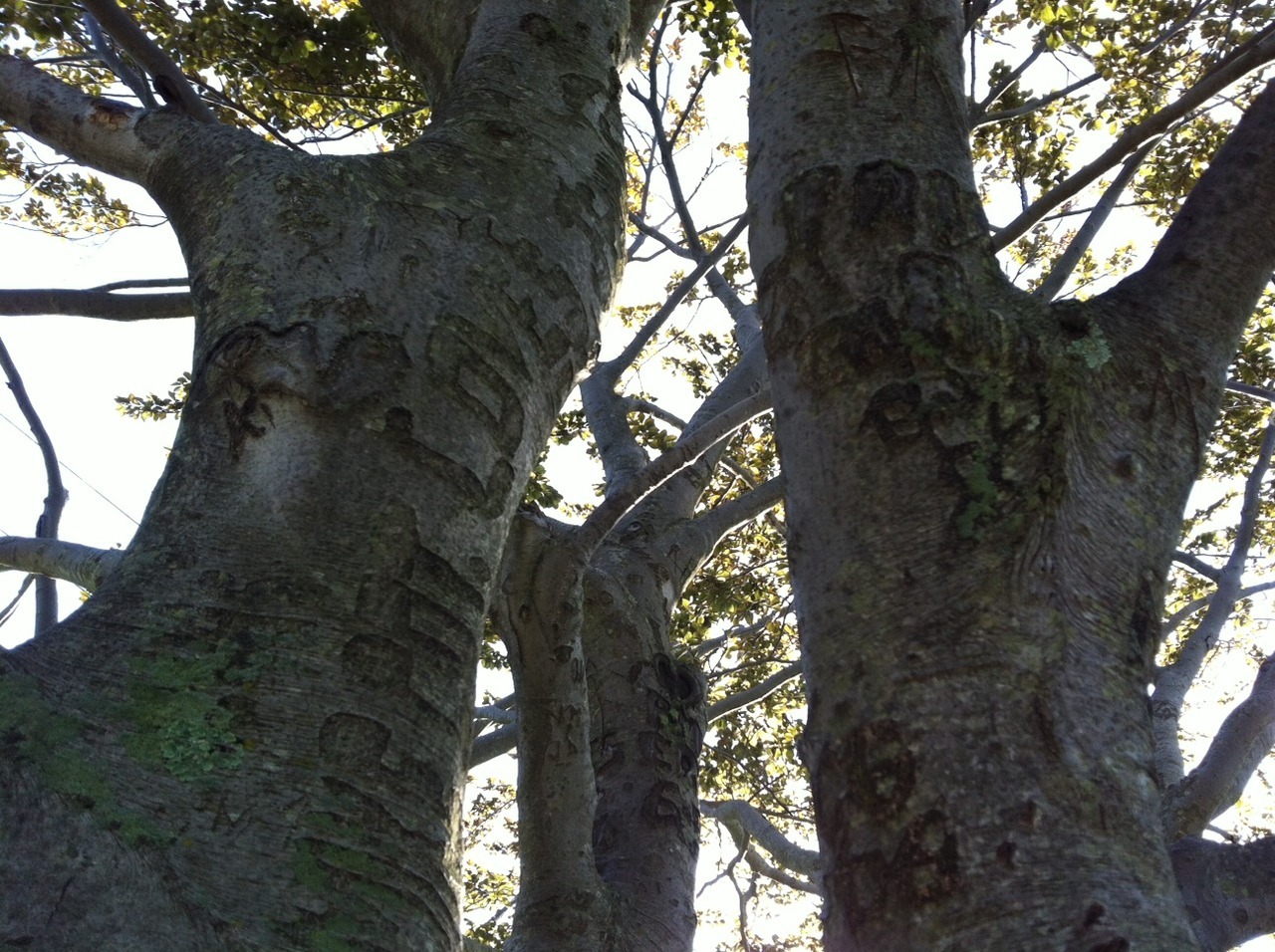
Photo of Arborglyphs from Tree and Twig, treeandtwig.tumblr.com
To blog or not to blog? That's a question a lot of writers ask, but another question to ask is what to blog about. Blogging about the writing process or books we love is a natural extension of our bookish tendencies, but is it the best way to reach readers?

As in all things, it depends. Many writer and book blogs have strong followings, particularly in YA, and I've found the online community of writers to be a fabulous source of knowledge, community, and support. But why not reach beyond that community to create content related to your book?

I follow a few wonderful, informative blogs that are rarely about writing at all.

Marissa Doyle, author of YA historical fantasy romances BETRAYING SEASON, BEWITCHING SEASON, and the new COURTSHIP AND CURSES (all published by Henry Holt Books for Young Readers), writes the blog Nineteenteen with fellow author Regina Scott about life for a teen in the nineteenth century. It's an invaluable resource for fashions, manners, and customs for a writer or reader of historical fiction.

Dee Garretson, who writes middle-grade adventures WOLF STORM and WILDFIRE RUN (HarperCollins), also does double-duty as a writer of adult historical fiction. On her blog, she writes about topics related to her books -- facts about presidents or Camp David (the setting for WILDFIRE RUN) and other topical tie-ins to her genres. She also maintains kidsadventurebooks.com, with resources for other MG adventure stories.

Benjamin Martin, author of YA fantasy SAMURAI AWAKENING (coming from Tuttle Publishing in October) blogs at More Things Japanese about Japanese culture, food, politics, and more. His novel, first in a series, is about an American teen who discovers Jitsugen Samurai powers in modern Japan.

I asked them both a few questions about their writing experiences.

How did you decide to create content-based blogs? 


Marissa: I started Nineteenteen along with friend and fellow writer Regina Scott (who writes Regency romance) as a place where we could talk about the interesting little history tidbits we were always turning up when doing research for our books but didn't fit into our WIPs.  After all, you can only cram so many cool history factoids into a work of fiction.
Dee: Out of necessity. I couldn't think of enough posts about writing, plus I knew there were so many writing blogs out there, anything I posted would most likely be lost in the noise. I was also hoping to attract potential readers who are not interested in the writing process.

Benjamin: I had come to Japan teach English and learn more about the history and culture I had learned about at the University of Arizona. I hadn't planned to start writing, but felt there were too many unique experiences to keep to myself. I had a budding interest in photography and food as well so the three new delights came together in the blog. My first post was in 2010, but I only did a few each month. I moved the blog to its own domain and wrote five posts a day for four months starting January of 2012, and it has jumped from 800 views to nearly 30k just this year. For now, MTJ is the non-fiction cousin to Samurai Awakening.
What do you personally get out of it? Is it more fun or more work than writing about writing?
Marissa: Part of why I write historical fiction is because I want to show readers just how fascinating history is--so writing a history blog is just an extension of my sooper sekrit mission to spread history geekiness across the planet.  It's both fun and work--we're just entering our sixth year of blogging, and it's getting harder to find topics to write about than it used to be...and yes, it takes a couple of hours to write each post because it usually involves some research.  But honestly, I wouldn't find it much fun to blog about my writing...I find this much more satisfying personally because I feel I'm offering something useful (at least a little bit) to the world, rather than blog posts about me me me.  Besides, I'm kind of like a centipede when it comes to writing.  You know how you're not supposed to ask a centipede how it walks, because that'll just confuse it and it won't be able to?  Well, that's me.
Dee: It's far more fun than writing about writing. I like odd facts and random bits of information. One of my favorite posts was about all the actors who have played Sherlock Holmes on television and in the movies. I'm both a big fan of Sherlock Holmes and an avid movie watcher, so when I thought of the idea, it seemed a good choice for one of my blogs which I put up for my historical mystery.
Benjamin: I'm not a writing expert. I had never written anything longer than a business plan until I sat down to start working on Samurai Awakening. There are all kinds of writing blogs, but anything I ended up writing (on writing) at the point where I started More Things Japanese would have been of little value to anyone. Why not share what I had learned living on an island with a population of 550 people instead? Personally, it’s a way to give back for the amazing opportunity to live in Japan. I feel strongly about the need to promote cross-cultural understanding and learning, plus it’s just good practice. 
Two years later there are things I could probably share about my experiences writing, but they wouldn't fit. I'll probably get them into bytes at some point, just not on MTJ. 

What kind of practical marketing outcomes have you seen -- exposure, content, sales, etc.?
Marissa: Honestly, I don't know.  We average between 6,000 and 8,000 hits per month, which I suppose isn't bad for a blog that is hardly advertised.  I think, though, that it must be giving us some exposure as people google topics we've blogged about and run across us.  We've also had some well-known historical romance authors ask to guest blog with us...requests we've regretfully had to turn down as we're strict about sticking to a G/PG rating, in light of our target audience.  So someone must have heard of us. 
Dee: I wish I could measure sales, but I haven't been able to tell if any of my posts are making an impact. I have seen from Statcounter that some people who come to one of my blogs because of its content on presidents, do click on information about my middle grade books, so I'm very pleased about that. Both my blogs and my websites have my book covers prominently placed in the sidebar, so people can't help but become more aware of them.

Benjamin: Since my blog is about Japan, and since it’s a way to give back, I don't do any advertising on my sites (I have three now). Just as there are a lot of writing blogs, there are a lot of great Japan blogs too. I try to keep mine original by producing unique posts about what I know, rather than trying to chase a fad. I do link between my sights though. I get a lot of search traffic for people looking for information about Japan. I try to create posts that answer real questions, without being too encyclopedic or too personal. I do include links on the blog to my book, so it is a great for people interested in Japan to find out about Samurai Awakening.
Since SA is out in October it will be some time before we know just how well its going, but it has been fun connecting with other bloggers, and of course new readers.

Inspired, I started a blog called Tree and Twig with photos and links about trees. I'm not an expert, but I've researched the topic for DEADWOOD, my MG novel about a cursed tree, and I might as well share what I've learned for readers, educators, and librarians.

But mostly posting about trees is fun and easy (and I'm pretty silly about it because I especially like trees that look like people if you use your imagination a lot), and it generates an entry point for searches -- people looking for photos of trees or tree carvings might stumble upon the site. They might not turn into readers, but most of them are people who don't dwell in writerly corners of the Internet and would otherwise never have heard of me at all.

So will my tree blog work to reach readers? It's too early to say, but at least it has me paying more attention when I walk around the neighborhood. And it's fun for me, so I might as well keep doing it.

Do you blog about anything besides writing and books? Do you know of other good blogs by writers who blog about other things? Post them here!

Monday, August 13, 2012

WriteOnCon Fanboy: An Interview With Ryan Lochte

After hearing about WriteOnCon, a free online writing conference kicking off tomorrow, Olympic medalist/ swimmer Ryan Lochte invited correspondent Amparo Ortiz to London for an exclusive interview. 


Amparo: "Thank you so much for having me, Ryan. How are you today?"

Ryan: "First of all, let me say a quick hi to my fans."


Photobucket


Amparo: *waits for Ryan to stop*

Ryan: 

Photobucket


Amparo: "Um, Ryan? Sorry to interrupt, but-"

Ryan: "Wait, I missed a spot."

Photobucket


Amparo: *lunges at Ryan* *sits him down* "Okay. Now that you got that out of the way, let's discuss a topic near and dear to your heart."

Ryan: *nods* "My grill."


Amparo: *closes eyes* "No, no. Not that. I was referring to what you invited me here for."

Ryan: *nods* "To show you my abs." *starts to lift shirt*

Amparo: *opens eyes* "NO! Ryan! Keep it together! We're here to discuss WriteOnCon, remember?"

Ryan: *lets go of shirt* "Oh, jeah! Sorry. I distract myself all the time."

Amparo: *cringes at the substitution of 'y' for a 'j' in the word 'yeah'* "So. WriteOnCon. I understand you're a secret fanboy."

Ryan: "Jeah. WriteOnCon is, like, the best. I love it 'cause it's about writers giving back to other writers. It's free, too, and you know me, Amparo. If it's free, I'm, like, totally there."

Amparo: "Yes, I can see why something free would appeal to you. But I'm sure our readers at Operation Awesome want to know: why is Ryan Lochte so invested in the writing community?"

Ryan: "Well, it's pretty simple. I wear these sick glasses..."


"...and they make me look, like, really smart and stuff. Then one day, I realized writers wear glasses, too, you know."

Amparo: *blinks* "Not all of them wear-"

Ryan: "And they look really cool with them on. Then another day, I realized that not only do writers wear glasses and look cool, but they also, like, spend a long time writing."

Amparo: "Yes, that's why they're called writers, Ryan."

Ryan: "Exactly! So then some other day after that, I realized writers wear glasses, look cool wearing them, they write a lot, and they sweat, you know. Like, not like I sweat 'cause I swim all day and stuff. But writers? They work really, really hard. As an athlete, all I know is hard work.  But I also only know what success is like if I get a medal, or beat my best time. Those writers who attend WriteOnCon? They taste success in all sorts of ways: finding the courage to post their work in a public forum, striking a connection with a potential critique partner, learning valuable tips about their craft, getting positive feedback on their query/first 5 pages/synopsis, and requests from ninja agents/editors. WriteOnCon is more than a free online conference. It's a slice of success after all that hard work. Sure, there's more hard work after the conference is over, but at least writers can have some fun before going back to sweating." 

Amparo: *drops jaw* "Wow, Ryan. That was really deep and lovely and-"

Ryan: "OH MY GOD I HAVEN'T SHOWN YOU MY SICK DANCE MOVES YET"


Photobucket


Amparo: *runs away forever*


*I'd like to thank Ryan Lochte for his time, despite him chasing after me in his Speedo while singing the Bad Boys theme song with his grill on. I am currently accepting donations for therapy. 

**Don't forget: WriteOnCon starts TOMORROW! Make Ryan Lochte happy and check it out. 


***This exclusive interview is a figment of my vivid, oftentimes disturbed imagination. No Ryan Lochtes were interviewed or harmed during the making of this post. :)

Monday, January 9, 2012

Open Thread: Authors vs. Their Work

So. I've been thinking a lot about authors and their online platforms these past couple of days. Specifically, the kind of reputation an author has with those who follow their blogs, Twitter, Facebook and Tumblr accounts (whether they're hilarious/informative/inspirational/etc). In some cases, we might even buy an author's book because we like their online platform, even if the author writes in a genre we don't typically read (confession: I am SUPER guilty of this and am in no way ashamed of it).

But I'm curious about something else: what happens when things go south? Let's say you discover an author through the blogosphere/Internet, like their perspective on writing/life, and fall head over heels  for their books. What if the author does something that disappoints you? Not as a reader, but as a person (i.e. their attitude toward something you take seriously isn't respectful or tactful). 

This leads to today's open thread question: does an author's reputation come into play when you're choosing between reading their work or not? Or does content trump reputation?


I'm really looking forward to your thoughts!

Thursday, October 20, 2011

Finding Critique Groups

With my recent Blog Chain post being on critique groups, I’ve had them on the brain lately. So I thought I’d share some tips on how I found my critique groups and partners.

As with everything, there are many, many ways of going about this. But, this is what worked for me.

1. Google
You really can find just about everything on Google :) When I first set out to look for a group, I had no idea where to begin and lived in a remote area where finding another writer was going to be difficult, if not impossible (or so I thought...but that's another story) :D So I hit the internet. I googled for “online critique groups” and started scrolling.

Going about it this way is going to turn up a lot of results. So choose carefully. In my case, I found a group with an extensive screening process. I had to submit an application of sorts, with a bio and writing samples. I was reassured that this group was legitimate because they were obviously very careful about who they let in. Keep in mind, this was six years ago. Things have changed a bit...there are a lot more legit writer forums, etc out there where you can find crit groups, so googling might not be necessary. If you go this route, I'd definitely be sure to check on the members of groups you find, just to be sure everyone is a good potential crit partner.

I very much enjoyed my time with that group, and learned A LOT. I was a very green writer when I started with them; they showed me the ropes, the rules, helped me get my writing under control. Finding a good group is invaluable.

2. Writers Websites and Forums
This is probably the best way I can think of to find some good crit partners. When I first starting seriously writing, I joined as many writer websites as I could find. I wanted to learn as much as I could about the whole publishing world. I did okay at writing, but I wanted to be better. I found a ton of sites; only a handful were really good, valuable places. Through these sites, a met a few good writing friends. We exchanged some material, and I had my first few critique buddies.

Again, practice caution. Not all sites are there to help writers. Some just want to take advantage. But you can find some really excellent sites. I usually enjoy AbsoluteWrite. They have some excellent information available to writers and I met some really great people there.

But my all time favorite site is QueryTracker.net. I just can’t say enough good things about QT. I joined the site and forum when QT was just getting started, and I was lucky enough to become very close with the members of the site. These people have not only become my critique partners, but are close friends as well.

3. Local Writing Groups
This isn’t something I’ve tried myself as I have such a great online support group and live in a fairly small community. But in larger communities, you should be able to find writer’s groups. Your local library is a great place to start looking. Check the newspapers as well. Being able to meet with your crit partners in person can really be a great experience.

4. National Writers Groups
Organizations like Romance Writers of America, and the Society of Children’s Books Writers and Illustrators have many different chapters you can join. I know with RWA, there are chapters specialized in the different sub-genres of romance as well as chapters by location. These types of organizations are a great place to find critique groups or partners. Check out the forums…there is usually a thread devoted to people looking for crit buddies.

I truly believe no writer should be without at least one critique buddy. A fresh set of eyes is always a good idea :)

How did you find your crit partners?