I've started on my sequel to Crow's Rest (its working title is No Man's Land) and a couple chapters in I realized I was having trouble finding the tone of the book. In the past, I haven't worried about that too much in the drafting stage, but with this book the tone is going to direct several plot-forks in my outline. (Plot-forks are too real things! Don't make me show you my literary license)
I was thinking about how when I would come back to the Crow's Rest draft after an absence, two songs helped get my brain in gear for writing (Firethief by Karine Polwart, and the song I wrote for the book which will appear in the book trailer). But No Man's Land didn't have a song just yet, so there wasn't a tool I could use to drop me into the story.
To fix that, I spent some time rewriting lyrics to an old English folk song, variously called A Blacksmith or Blacksmith Courted Me. Now I have song lyrics that are particularly relevant to the story and plot, plus singing it puts me in the frame of mind to continue in the Crow's Rest world.
Do you ever use music in this way? It's a little more specific than a playlist, but I'm sure they'd be considered close relatives!

Monday, August 4, 2014


Sunday, August 3, 2014
Setting is more than just scenery
Setting isn't the coolest aspect of writing. Maybe because many of us associate it with a long passages of scenic description or town history and backstory that we associate with 19th century novels -- you know, the sort of thing we call infodump and edit out immediately.
But a realistic or contemporary novel can have a specific sense of place. "World-building" is associated with fantasy, but every novel builds its own world, whether it's one that's familiar or foreign, a meticulous recreation or the author's invention.
When I wrote Deadwood, I wanted to create a specificity of place -- the outer Philadelphia neighborhoods of Mount Airy and Andorra, the inner suburbs of the Mainline and Delaware County, the leafy urban parks where I've spent. I decided to do this because it's too common to think of some places as non-places -- places without regional character, places where nothing happens. But there are stories everywhere if you find them or write them.
Setting is specificity of place, accent, culture, geography, history, and architecture. In Deadwood, aspects of setting were almost a character -- Deadwood Park, the geographical and emotional center of the story. I had a very clear map in my head about where everything was. I didn't draw it out, but next time, maybe I will.
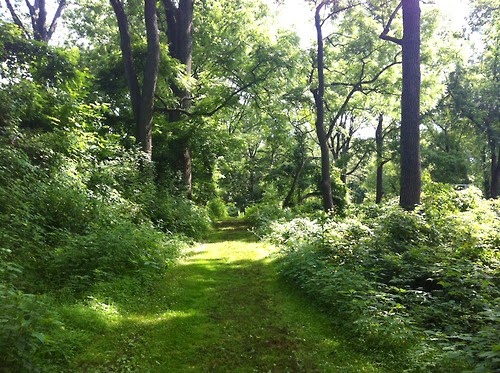 Brynwood Valley Park is based on few places: Wynnewood Valley Park in Wynnewood, Powder Mill Park, Haverford Heritage Trail, and Cobbs Creek in Haverford Township, and Wissahickon Valley Park and Carpenter’s Woods in Philadelphia.
 I love gatehouses, and I based Jenna Blitzer’s house on a couple near me. Most of them are right near the main roads, but the estate that they guarded are gone – knocked down for development.
 I based the high school/municipal complex on the layout of Upper Dublin, where I went to high school. The district rebuilt the school a few years ago, but I was describing the old layout. I walked around the new school about a month ago, and it was such a strange feeling. I felt like I could see the ghost of the old school in the new one.
 The geography of Hannah’s neighborhood is based on Manayunk, a neighborhood in Philadelphia with rowhouses and twins on super steep streets. Manayunk was originally a milltown, like Lower Brynwood.
Does a sense of place matter in the stories you write? Do you try to be universal or specfic when it comes to regionality? Do you prefer to write the exotic or the everyday?
And for another perspective, read this excellent guest post by PK Herzo:
Settings that Pop
About Kell Andrews: Kell Andrews writes picture books and middle grade novels. Deadwood, her middle-grade contemporary fantasy about a cursed tree, is out now from Spencer Hill Middle Grade.
But a realistic or contemporary novel can have a specific sense of place. "World-building" is associated with fantasy, but every novel builds its own world, whether it's one that's familiar or foreign, a meticulous recreation or the author's invention.
When I wrote Deadwood, I wanted to create a specificity of place -- the outer Philadelphia neighborhoods of Mount Airy and Andorra, the inner suburbs of the Mainline and Delaware County, the leafy urban parks where I've spent. I decided to do this because it's too common to think of some places as non-places -- places without regional character, places where nothing happens. But there are stories everywhere if you find them or write them.
Setting is specificity of place, accent, culture, geography, history, and architecture. In Deadwood, aspects of setting were almost a character -- Deadwood Park, the geographical and emotional center of the story. I had a very clear map in my head about where everything was. I didn't draw it out, but next time, maybe I will.
Top 5 places in Deadwood that are based on places in real life.
Does a sense of place matter in the stories you write? Do you try to be universal or specfic when it comes to regionality? Do you prefer to write the exotic or the everyday?
And for another perspective, read this excellent guest post by PK Herzo:
Settings that Pop
About Kell Andrews: Kell Andrews writes picture books and middle grade novels. Deadwood, her middle-grade contemporary fantasy about a cursed tree, is out now from Spencer Hill Middle Grade.
Saturday, August 2, 2014
RIVER OF BONES THE MOVIE
Hello Everyone! hope you are enjoying your Saturday.
In order to write a script that is marketable, it is critical to have a solid theme, and a good understanding of the content. You have to be able to engage your readers through visual themes within your work product.
You will want to not only gain the interest of a director or producer but investors as well. Investors are professionals that finance the film project. Unless its a very low budget movie you will need qualified investors that can support a multi-million dollar project. Most film investors are seasoned professionals. They have a good idea of what will sell to consumers.
Every film must have a prospectus. A prospectus will give your investor an idea of how they may profit from a film. It's a document that will describe the risks and benefits. It also explains how the production company works, its board members and operational expenses involved.
Below is the cool R.V. I get to relax in while they are filming River of Bones. Items such as this are also included in a film prospectus--and other fun things as well!
HAVE A GREAT WEEKEND EVERYONE!
Friday, August 1, 2014
August MA pitch critiques!
Welcome to the NEW format of our Mystery agent critique portion of our contest. We hope this will be easier for everyone to see the entries and comment. The 32 entries (some didn't turn in their pitches) will be open for your amazing feedback all week!
Our rules are simple:
You can also visit the entries in the tab under the OA blog banner: MA Critiques.
August 2014 MA Entries
Our rules are simple:
- Be helpful.
- Be relevant.
- Be kind.
You can also visit the entries in the tab under the OA blog banner: MA Critiques.
Just a little more info about the forum:
- You DO NOT have to register to comment.
- To comment on a pitch, just click Reply on the main post in the thread. It will bring up a comment box where you can enter your name and comment.
- To return to the full list,click August 2014 MA Entries in the top left corner of the forum.
And we'd love to know what you think about the new format. Let us know here in the comments. Any feedback would be awesome! Thanks!
August 2014 MA Entries
Monday, July 28, 2014
The anchors that weigh us down...and how to break free of them
Anchors. We all have them. They can be both physical and mental. Some are so invisible that we don't realize how much they're holding us back. Or even that they're there at all, until they decide to put themselves front and and center. Sort of like this:

And yes, some anchors can be difficult to let go of. But if they hold us down long enough, we'll start to drown. (Not that anchors actually drown things, but they'll definitely keep us stuck in one place).
We have to drop them and figure out what the next course of action is. And remember the bright future that lays ahead. Writing that next book. Or trying a new marketing strategy. Or, if you've lost an agent (or editor), dusting yourself off and moving forward (and writing that next book).
So now to you. What are your anchors, and how have you broken free of them?
In cleaning out my office today, I was faced with an anchor that was both physical and mental--the hefty filing case filled with drafts of the first book I ever wrote. It took up almost the entire bottom half of my bookshelf.
I love this book with my whole heart. I truly do. But seeing it there, heavy, and sagging, reminded me of how much it weighed down my writing career for a number of years.
Like many beginning writers, I thought that book was going to be my be all and say all. That if I put the necessary work into it, someone would snatch it up eventually. And because I worked on it for so long, I didn't put much energy into anything else (including honing my craft).
Of course I queried it too soon, and got a ton of rejections (and surprisingly, some partials). But I still clung to it, even after I realized the idea wasn't marketable, the story structure was too scattered, and most importantly, that the main character didn't jump off the page.
And finally, last year--at long last, I commanded--"to the trunk with thee." It may come back out eventually, but I've set my energies in other directions. And I'm much happier for it.
I was also reminded of this recently on Janet Reid's blog, when someone asked whether bidding on a critique on their manuscript would hurt their chances with their "dream agent." (And while we're at it, yay Pens for Paws!). In the comments, I said, "Sometimes it's difficult for us writers to remember that the sun doesn't rise and set around one book. But making connections and fostering learning opportunities is always money well spent."
Anchors come in all shapes and sizes. Lingering self-doubt. Low self-perception. A marketing strategy that didn't work. A person from the past who causes you to regress into someone you aren't anymore. A panda bear gnawing your leg. A squirrel grabbing you by the nuts.
And yes, some anchors can be difficult to let go of. But if they hold us down long enough, we'll start to drown. (Not that anchors actually drown things, but they'll definitely keep us stuck in one place).
We have to drop them and figure out what the next course of action is. And remember the bright future that lays ahead. Writing that next book. Or trying a new marketing strategy. Or, if you've lost an agent (or editor), dusting yourself off and moving forward (and writing that next book).
I posted this video on my blog a few years back, but I think it still applies:
So now to you. What are your anchors, and how have you broken free of them?
Saturday, July 26, 2014
We've Selected Our 50 Entrants for the August Mystery Agent Contest!

Check the list and see if you're one of the lucky 50 folks* who get to pitch our August Mystery Agent!
If your name's on the list, you'll need to email us your pitch--50 words or less--for your completed and polished middle grade or young adult manuscript. Send it to operationawesome6 (at) gmail (dotcom) by July 30. In the past, we've emailed stragglers to get their pitches in on time, but with 50 entries we're not going to be able to do that this time, so make sure you follow the guidelines and meet the July 30 deadline!
Please format your pitch like this in the email:
Name:
Email or twitter:
Genre:
Title:
Pitch:
Good luck to all!
a Rafflecopter giveaway
*(There are 49 here, btw, because we had a mixup with our last contest and that person has a guaranteed slot in this one)
Friday, July 25, 2014
What's Your Story About? Exploring Theme in Fiction
That’s the question we get any time we tell someone we’re
writing a (insert your form here – story, novella, book, space opera…) And
that’s the question we’re told to have a ready answer to, just in case we bump
into our dream agent in line for a McMuffin on the way to work, or in the
elevator at a writing conference. It’s the log line, the pitch, the meat of the
matter. But what is this critical nugget really? If the piece we’re writing has
a shot at capturing the hearts and minds of an audience, it’s the theme.
When someone asks what your story is about, how do you
answer? Do you give a brief summary of the action?
For example, “my story is about this poor girl who is
harassed by her evil stepsisters until her fairy godmother comes and turns her
into a princess so she can go to the ball and meet her prince and live happily
ever after.”
That is, after all, what Cinderella is about. Isn’t it?
Maybe not.
Try this: “my story is about the belief that by putting
goodness and love out into the world, goodness and love will be returned to us.
It’s an exploration of the golden rule, set in the world of princes and fairy
godmothers.”
Which one do you want to read?
The first tells us what the story is about in terms of
action. The second, though, tells us what the theme of the story is.
The Importance of Theme
Let’s look at the idea of theme for a moment. Have you ever
finished a book and put it down, asking yourself what the point was? Maybe
there was great action, and a rollicking plot, but at the end you’re left
feeling like it was hollow somehow. That, writers, is the absence of theme.
All stories should have a theme – from literary (where
sometimes the themes seem to take over all action and bring the plot a
standstill) to genre (where occasionally theme suffers for the sake of the
plot.) It was easy to identify a theme in fables or parables – the theme was
the moral or teaching. But in fiction, we don’t always seek to teach.
Think about it this way – the theme of your work is the
concept that links the story to the audience. It’s what makes the story
universal. It’s what elevates it from a good story to a story that will keep
readers thinking long after they’ve put the book down.
As I’ve written more, I’ve learned to build theme into my
work somewhat organically. I’ve even discovered that I have themes where I
didn’t intentionally place them. But the best work, I think, develops when a
writer has a theme in mind as they craft the story, allowing it to work in and
out of the words, wrapping itself intricately through the scenes and chapters
and adding an extra layer of complexity to the story.
How do you approach theme? Do you build it in intentionally,
or have you discovered your themes after the fact? Can you think of any books
you’ve read recently that have done a nice job with building on a theme?
Thursday, July 24, 2014
Behind the Contest - A Few Pointers from A Contest Judge by SC Writer (guest post)
First up, my credentials, so you know I'm not just pulling this out of thin air. I've co-hosted "Query Kombat" twice and "Nightmare on Query Street," hosted "The Writer's Tank" and twice hosted "Become an Agent," and I was a slush reader in "In With the New." So, yes, I've went through...dang, nearing a thousand queries and first 250 words.
When going through the slush to pick entries for the contest, we usually have a hashtag that we slush-readers use on Twitter. On this hashtag (different for each contest) we tweet our thoughts as we go through the slush, but I've never done a blog post on the subject.
1. It is SO, SO, SO subjective.
Maybe you need to be a slush-reader to truly understand this, but picking entries (and, to an extent, requesting material) is so subjective. We're not trying to make you feel better by saying this, we're not babying you: IT IS THE TRUTH. Very rarely do I ever feel 'satisfied' when I make my final picks. Most of the time I'm torn apart because there were so many others I wanted to pick but because of the limit on entries, I couldn't.
The same is true for agents. They can, technically, request a ton of material, but that means they'll fall behind on their own clients' work. No human can read five manuscripts a day. Agents must be picky for their clients' sake and their own sake.
2. In picking entries, it came down to "I MUST MUST MUST have this entry on my team."
This is related to point #1. Ultimately, especially with "In With the New" where I could pick only 4 entries from a slush of 191, I picked the entries that I just had to have on my team. Subjectivity played a huge deal.
This must be true for agents as well, and I've seen many echo the same sentiment: they must be dying to request. You've got to force them to request. Otherwise, if they find any reason to pass, they will. Of course, different agents act differently, but I've heard this sentiment many times and as a contest host, I do the same thing.
3. Follow submission guidelines. Please.
I automatically passed on an entry that forgot its header of Title, Word Count, Genre. I didn't even read the entry. I passed on one that had 200 sample words instead of the required 250.
Do yourself a favor and follow agent guidelines. They're there for a reason, and it's annoying and frustrating when submissions don't follow guidelines. It doesn't help you, either; it's an automatic pass.
4. Don't try submitting to agents that don't rep your genre UNLESS they specifically say something to the lines of, "I'm not sure what I want, I picked up manuscripts that totally surprised me, so feel free to query if you think I'm a good match."
I passed on every picture book in "In With the New" because, simply, I didn't know how to judge it. I didn't know what were "good" or "bad" picture books, so after trying once and giving up, I didn't read the PB entries. Same went for many Middle Grade entries. I'm getting better at MG books but still, at many times I ask my co-host, Michelle (who writes MG), to take a look at the entries that I think may be good.
If an agent has a list of genres they are looking for and yours isn't on it or even NEAR the genres they're looking for (if you have a contemporary and they're asking for commercial, be cautious, but go ahead and query), DON'T QUERY THEM! There's a reason they have a list. Also, don't ever start the query by saying, "I know you don't represent literary, but..." because, as I've seen on Twitter, some agents auto reject that.
5. Angry rejected writers put a stain on the entire process.
I've had a few writers who grew angry at one another for their critique suggestions. This didn't only happen once, it happens many, many times. I hear about it, and it gets ugly. The writers who do take the suggestions gracefully, even gratefully, are far FAR more in number than the angry writers. I'd love to say that I think about the graceful writers more, but a small stain in a white carpet catches everyone's eyes. I love the graceful writers, they're the reason I host contests after all, but I'll always remember angry writers. (I love the nice writers most, though. They make me happy. So don't think I hate hosting contests - I don't! I love love love doing it because of the nice writers.)
Agents don't like sending rejections. No one does. But it's a part of the process. Deal with it. If you ever even think about replying to a rejection, unless it's a "Thank you so much for your time!" and that's it, don't even send it. Never reply to rejections. Not with excuses, not with (even polite) requests to look at the submission again. Don't ask for suggestions to improve, either. If the agent wanted to send a personalized rejection, they would have.
6 (and most important). IT'S SO SO SO SOOOOOO SUBJECTIVE!!!!!!!
Repeat that in your head until you believe it. Think about a book someone loves but you hate. Think about your best friend's favorite book. Is it the same as yours? If not, are you seriously going to get upset about it? Obviously not. Don't get mad at agents who reject you. Their tastes are not the same as yours, your critique partners, or anyone else.
 SC is the host of the 'The Writer's Tank' and 'Becoming an Agent' on his blog, and he is the co-host of 'Query Kombat' and 'Nightmare on Query Street.' He's a YA and Adult writer and loves YA, Adult, and especially literary...basically any good writing. He's a HUGE Harry Potter and Les Misérables fan (mainly the book but the musical too). Dumbledore is his favorite character in the whole world. Jean Valjean is a close second.
When going through the slush to pick entries for the contest, we usually have a hashtag that we slush-readers use on Twitter. On this hashtag (different for each contest) we tweet our thoughts as we go through the slush, but I've never done a blog post on the subject.
1. It is SO, SO, SO subjective.
Maybe you need to be a slush-reader to truly understand this, but picking entries (and, to an extent, requesting material) is so subjective. We're not trying to make you feel better by saying this, we're not babying you: IT IS THE TRUTH. Very rarely do I ever feel 'satisfied' when I make my final picks. Most of the time I'm torn apart because there were so many others I wanted to pick but because of the limit on entries, I couldn't.
The same is true for agents. They can, technically, request a ton of material, but that means they'll fall behind on their own clients' work. No human can read five manuscripts a day. Agents must be picky for their clients' sake and their own sake.
2. In picking entries, it came down to "I MUST MUST MUST have this entry on my team."
This is related to point #1. Ultimately, especially with "In With the New" where I could pick only 4 entries from a slush of 191, I picked the entries that I just had to have on my team. Subjectivity played a huge deal.
This must be true for agents as well, and I've seen many echo the same sentiment: they must be dying to request. You've got to force them to request. Otherwise, if they find any reason to pass, they will. Of course, different agents act differently, but I've heard this sentiment many times and as a contest host, I do the same thing.
3. Follow submission guidelines. Please.
I automatically passed on an entry that forgot its header of Title, Word Count, Genre. I didn't even read the entry. I passed on one that had 200 sample words instead of the required 250.
Do yourself a favor and follow agent guidelines. They're there for a reason, and it's annoying and frustrating when submissions don't follow guidelines. It doesn't help you, either; it's an automatic pass.
4. Don't try submitting to agents that don't rep your genre UNLESS they specifically say something to the lines of, "I'm not sure what I want, I picked up manuscripts that totally surprised me, so feel free to query if you think I'm a good match."
I passed on every picture book in "In With the New" because, simply, I didn't know how to judge it. I didn't know what were "good" or "bad" picture books, so after trying once and giving up, I didn't read the PB entries. Same went for many Middle Grade entries. I'm getting better at MG books but still, at many times I ask my co-host, Michelle (who writes MG), to take a look at the entries that I think may be good.
If an agent has a list of genres they are looking for and yours isn't on it or even NEAR the genres they're looking for (if you have a contemporary and they're asking for commercial, be cautious, but go ahead and query), DON'T QUERY THEM! There's a reason they have a list. Also, don't ever start the query by saying, "I know you don't represent literary, but..." because, as I've seen on Twitter, some agents auto reject that.
5. Angry rejected writers put a stain on the entire process.
I've had a few writers who grew angry at one another for their critique suggestions. This didn't only happen once, it happens many, many times. I hear about it, and it gets ugly. The writers who do take the suggestions gracefully, even gratefully, are far FAR more in number than the angry writers. I'd love to say that I think about the graceful writers more, but a small stain in a white carpet catches everyone's eyes. I love the graceful writers, they're the reason I host contests after all, but I'll always remember angry writers. (I love the nice writers most, though. They make me happy. So don't think I hate hosting contests - I don't! I love love love doing it because of the nice writers.)
Agents don't like sending rejections. No one does. But it's a part of the process. Deal with it. If you ever even think about replying to a rejection, unless it's a "Thank you so much for your time!" and that's it, don't even send it. Never reply to rejections. Not with excuses, not with (even polite) requests to look at the submission again. Don't ask for suggestions to improve, either. If the agent wanted to send a personalized rejection, they would have.
6 (and most important). IT'S SO SO SO SOOOOOO SUBJECTIVE!!!!!!!
Repeat that in your head until you believe it. Think about a book someone loves but you hate. Think about your best friend's favorite book. Is it the same as yours? If not, are you seriously going to get upset about it? Obviously not. Don't get mad at agents who reject you. Their tastes are not the same as yours, your critique partners, or anyone else.

(There's a long story behind his icon. Don't ask.)
and visit/ follow his blog for news on more contests and writing tips!
I hope my points helped!! Any questions? I'd love to answer them in the comments.
I hope my points helped!! Any questions? I'd love to answer them in the comments.
Wednesday, July 23, 2014
Guest Post: Submission Tips From An Editorial Intern
I won't rattle on today because, as you may have guessed from the the title, we have a guest post with the fabulous Jennifer Blackwood.
Thank
you for having me on Operation Awesome today! My name is Jennifer Blackwood,
and I am lucky enough to be an editorial intern. I’ll point out a few things I look for when a
submission crosses my desk.
Voice-
This is the first thing I look for in a
submission. It is what keeps me going throughout the story—or makes me stop
after 50 pages. It’s what sets your story apart from others. I will faithfully
read a story with an overdone trope with a stellar voice as opposed to a unique
story with a weak voice.
Source: https://33.media.tumblr.com/38c831c67a7734c059395a9df5bf3b9c/tumblr_n3hl7tP5AR1s98th6o2_250.gif
Some things to look for before you submit:
*Passive voice (using “to be” verbs). There
are definitely times where using a “to be” verb is warranted, but make sure it
isn’t every sentence!
*Telling- especially emotions. It’s very
easy to fall back on, but super easy to fix! Helpful hint: Utilize the “find”
button in your document to look for any emotion words (Angry, frustrated,
happy, etc.) Instead of using these, show the reader with dialogue, facial
expressions, reactions, etc. By doing this, you will draw the reader into the
story (and hopefully make it farther in the submissions process!)
*If you have dual point of view, make sure
your characters have two distinguishable voices. I often see submissions where
the two main characters sound like the same person. Make sure they have their
own distinct mannerisms, opinions, dialogue, and thought-processes.
Dialogue- Dialogue should move your story forward. Oftentimes, in submissions,
I see really stiff dialogue that does nothing for the characters. Make sure
that each character has their own unique way of speaking. If you took away the
dialogue tags, you should be able to tell who is talking just by their style.
A good example of this is Derek from the
movie Zoolander. Everything that comes out of his mouth is unmistakably Derek. J

Source:https://31.media.tumblr.com/998db7eef1a10cfca67bca556ce175af/tumblr_mnccwhKNCQ1rkuidwo1_500.gif
Mechanics- Your submission does not have to be perfect. Commas are the bane
of a writer’s existence, I totally get that. I can forgive that. What I can’t
forgive is twenty typos per page. Before you send in a submission, make sure to
spellcheck. Have a critique partner read over it. It’s a safe bet that your
submission won’t make it past the interns if you submit a rough draft riddled
with typos and grammatical errors.
Overall
story- I have read dozens of submissions and it
strikes me as odd that 90% of what I read in the submission pile is THE SAME
STORY. Sometimes I do a double take because I think haven’t I just read this? I love me some good, solid tropes (older
brother’s best friend, anyone?!?!) but make sure you bring something to the
table that makes your story stand out. Tropes I am seeing a lot of: Virgins,
rape, bad boys turning good, teens discovering they are
werewolves/lycan/fae/anything supernatural on their birthday. I’m all for these
tropes if done in a stellar voice with a unique twist!
Introspection- There is a time and a place for your characters to get deep and
philosophical.

The beginning is not a place to bog down
the reader with a ton of introspection. Like wasabi on sushi, a little bit of
introspection goes a long way. With that said, you shouldn’t leave readers in
the dark about what’s going on with the main character, but ten paragraphs of
introspection probably isn’t a good idea for the first few pages.
Professionalism- It is really important to be professional in your query. There are
a handful of queries/submissions that stick out in my mind—and usually if they
stick out, it means they did something really good or REALLY BAD. Usually the
latter of the two. I’ve seen submissions with title pages saying it was a rough
draft, others saying I was lucky to be reading it. Some said that if it didn’t
get picked up, they planned to self-publish in the next month or so…

These probably aren’t things you want to
say when you are submitting to a publisher. Or anyone you are querying, for
that matter.
Anyhoo, that’s just a little peek inside
the mind of an editorial intern. Thank you for having me on the blog, Operation
Awesome!

Jennifer Blackwood is an English teacher and New Adult author. She lives in Oregon with her husband, son, and poorly behaved black lab puppy. When she isn’t writing or teaching, she’s binging on Veronica Mars episodes and white cheddar popcorn. Blackwood writes about gray area issues with steamy tension and sizzling romance. But don't worry—her tortured heroes always get their happily ever after they deserve. She is represented by the fabulous Courtney Miller-Callihan from Greenburger Associates. Her debut novel, UNETHICAL, comes out later this year with Entangled Embrace.
Website: www.jenniferblackwood.com
Subscribe to:
Posts (Atom)