Monday, February 13, 2017

Book Marketing Experiment #782: Wattpad

For me, book marketing has been one experiment after another. I hear of or think of a new idea, then give it a try. Some things have worked. Some haven't, but I'm always willing to try something new.

For the past year, I've been thinking about and researching Wattpad. I've heard of people having success there, but I've been in this business long enough to know that for every wildly successful author out there, there are about 10,000 others who haven't achieved the same results.

I had a few of misgivings about Wattpad.
  1. There are thousands and thousands of stories available which means it's yet another platform where competition is fierce.
  2. It's free. I work very hard on writing and editing my novels, and I feel my time has value. No one would give away a house they built themselves, and we're talking about a similar number of hours invested.
  3. If the novel didn't do well, I ran the risk of never getting it traditionally published because it would be available online for free, which technically means it was previously published.
However, I have this manuscript that I wrote during the 72-Hour Novel Contest (yes, you have 72 hours to write an entire novel). The Typhon Project is a YA Sci-fi apocalyptic read that is complete at 35,000 words, qualifying it as a novella, not a novel. I loved the story, so I'd considered weaving in some subplots to beef it up but, after a lot of thought, came to the conclusion that the story was best served at its present length. 

As I considered trying out Wattpad, I thought of The Typhon Project, a manuscript that I would probably never pursue traditional publication for because of its length. I wanted to share that story and since it was just going to languish on my computer anyway, I decided that Wattpad might be an excellent way for me to get it in front of readers, especially since the platform is hugely popular with teen audiences. 

So, I designed a cover and posted the first couple chapters. I've committed to posting a chapter per week until it is complete. This experiment is well underway, and I'm excited to see how it turns out. If you're curious, you can find it here: The Typhon Project

Since I'm still learning this new platform, I'd love tips from the OA community. If you have any tips or best practices to share with a Wattpad newbie, please post them in the comments below. Thanks!

****************

Melinda Friesen specializes in writing teen fiction. Her first novel, Enslavement, has been nominated for a Sunburst Award as well as a Saskatchewan Young Readers Choice Snow Willow Award.


Flash Fiction Contest Winner #27

Reading some sweet haiku definitely put me in the mood for Valentine's Day! Thank you to the entrants, we always appreciate your creative participation on the blog. And a big congrats to Dani C. for crafting our winning conversation heart poem!

Recipe 4 love
Spice it up, my honey bun
You & me, let’s kiss


Friday, February 10, 2017

Flash Fiction Contest #27


Valentine's Day is almost here! I hope everyone gets something sweet from someone special, and speaking of sweet, how about some romantic poetry?

For this #OAFlash fiction contest, please submit a 3 line haiku using conversation hearts. I'm including some pictures of conversation hearts, in case you need some help w/the phrases. You can also come up with your own, as long as they are conversation heart-like. =)

Deadline is at noon on Sunday, with the winner announced later that afternoon.


Thursday, February 9, 2017

Synopsis Critique #1 - Women's Fiction

We're getting started with our first synopsis critique this week! The author of UNREASONABLE DOUBTS, a 91,000-word Women's Fiction, submitted this synopsis. My in-line comments are [blue and in brackets], and I'll include a summary at the end. Feel free to comment below!

If you want your synopsis critiqued on this website, fill out the form here, or email your 1-2 page synopsis to me at operationawesome6@gmail.com, and I'll post one critique per week (NOTE: I'll email my critique to the author as soon as I'm done, so the author won't have to wait to see his/her synopsis on the site). Thanks for participating!


Synopsis

LIANA COHEN is an idealistic young attorney in the appeals bureau of the NYC Public Defender’s office with a problem: after representing dozens of guilty people, she’s lost hope that the clients actually deserve her help. [I'd break up this sentence for easier reading. I suggest (1) '...NYC Public Defender's Office. She has a problem: after representing..." Or (2) leave out 'with a problem' and just use "After representing..." as its own sentence. The reader will understand it's a problem.] Accused of letting her cynicism infect the more junior attorneys, her boss threatens to fire her if she can’t get back on mission. Her uncertainties have spilled over into her personal life. Liana is seriously involved with JAKOB WEISS, a mid-level associate at a white-shoe law firm. They love each other, but Liana is tired of playing second fiddle to Jakob’s outsized career ambitions – nearing 30, she wants to get married. [This is a great first paragraph. Introduces us to the main character, her world, and her 'normal.']
In this state of emotional upheaval [what you described above about Liana's personal and professional lives is problematic for sure, but I'm not sure it amounts to emotional upheaval. Upheaval connotes a sudden change for the character, and in the first paragraph, you're giving us the status quo, not the change. 'Emotional turmoil' could work.] , Liana is assigned to represent 24-year-old DANNY SHEA, who has been convicted of raping an 18-year-old girl on July 4th on a rooftop in Brooklyn. Shea testifies that he and the girl, whom he knew casually, got a little high, slow danced while watching the fireworks, and then made love. According to Shea, the girl freaked out when her younger brother interrupted their consensual encounter. The victim’s story matched Shea’s in all regards, except that she claimed Shea had forced himself on her. Liana finds Shea intelligent and magnetic, a young Brad Pitt look-alike. Most importantly, she believes he may be innocent of the crime. [I would reverse these first two sentences. If she believes he's innocent, I'd be on board with her finding him attractive. But if we're told first she finds him attractive, I'd worry that's why she's trying to believe he's innocent. From what we know so far of Liana (she's idealistic but jaded, believing her clients are mostly guilty), her belief in his innocence seems paramount here] Liana discovers reversible error in his case when the jury is exposed to inadmissible DNA evidence suggesting that Shea has raped a second woman in the past. [On the same token, why does Liana suspect he's innocent? If there's evidence he's done the same thing in the past, it's worth dropping another sentence here to explain why she doesn't think he did it this time.] Liana visits Danny in prison, out of curiosity and less honorable motives. When she finds the physical attraction overwhelming – just the touch of his hand on hers -- she cuts the visit short. Liana‘s close friend at work, Deb, complains of stomach problems and a loss of appetite; a number of weeks later, she is diagnosed with ovarian cancer. Their friendship becomes both more demanding and closer as Deb’s health fails, culminating in Deb’s request that Liana to [delete 'to'] help her overwhelmed parents arrange her funeral when the time comes. Deb warns Liana not to let herself get bamboozled by Danny and lose sight of her love for Jakob. [I think you can delete this paragraph. Deb doesn't show up much in the rest of the synopsis, and the friendship (and Deb's subsequent death) doesn't seem to have much impact on the main plot. Of course, if you're also writing a longer synopsis, you should flesh out Deb's subplot and tie it into the main plot as much as possible.] On a trip over Thanksgiving weekend to Newport with Jakob, meant to rekindle [rekindle what? Their relationship? Their love? Need an object here] after a strained summer, he explains to Liana the work stress that he has been under. Liana floats the idea of getting married, and he tells her he doesn’t feel either of them is ready. On New Year’s Day, Liana announces to her two closest girlfriends that if Jakob doesn’t propose by her 30th birthday in May, she will move on, an ultimatum that she never shares with Jakob. [All of this is good detail for the subplot (which I think you do need here) about Liana's relationship. But we haven't heard anything about the main plot - her representation of an accused rapist - for a few paragraphs. Add a sentence or two here tying Liana's romantic subplot into the main plot - what's been going on with Shea and his case over these several months?] Valentine’s Day, and Liana prepares a romantic meal. [Make this a complete sentence: On Valentine's Day, Liana prepares a romantic meal.] When Jakob forgets their date, she brings the repast to the office, and finds Jakob holed up in a conference room drinking wine with a pretty paralegal. She forgives him, but they are both thrown. [Did he do anything requiring her forgiveness? Is he having an affair with the paralegal? Did Liana catch them kissing? Maybe they talk it through and decide to forget about the incident?] Liana wins Danny Shea’s case on appeal. In a weird procedural twist, the prosecutor declines to re-prosecute [wouldn't it be double jeopardy if he did re-prosecute? If not, disregard this comment], and Danny [sometimes above, you refer to him as 'Shea.' Either is fine, but keep consistent (first name or last name) throughout] is set free. Over coffee, they discuss his past, and Danny tells Liana that he wants her to be part of his life. [How does Liana respond?] Liana is a fanatic Mets fan. When Jakob doesn’t clear his calendar for Mets Opening Day, and Liana’s widowed mom is going to the Yankees opener with a man she’s met, Liana, devastated, invites the next person she encounters, who happens to be Danny. [How did they encounter each other? Have they been seeing each other?] At the game, she is enjoying his company, when they are featured on the kiss cam, and she succumbs to his passionate kiss, captured on the Jumbotron before Liana breaks free. She leaves in a huff. [Why is she angry about this? Because he kissed her or because it went public and she's still technically with Jakob?] Liana has developed a friendship with a local rabbi, JORDAN NACHT. When Rabbi Nacht, also a Mets fan, sees Liana on the kiss cam, he invites her in for a chat. They discuss marriage, fate, and the need for couples to bring out the best in each other. Liana asks him to tell her how to pray for Deb. [This paragraph also seems unnecessary, especially if you delete the subplot about Deb from the rest of the synopsis. Again, for a longer synopsis, you can add more detail about this subplot. Either way, no need to name the rabbi, since he doesn't appear at any point in the synopsis other than this paragraph. You can just refer to him as 'the rabbi.'] On Liana’s 30th birthday, she suggests to Jakob they take a break from the relationship. Instead of objecting, he tells her that he loves her, but he won’t be strong-armed into getting married. A couple of days later, Deb dies. [If deleting the Deb subplot, you can delete this sentence. But I would add a little more here about what's been going on with Shea between the baseball game and Liana's birthday. Are they still communicating? Seeing each other? Did winning his case have any impact on Liana's feelings about her job?] After the funeral, Liana gets drunk. Danny arrives unbidden at her apartment and she confides her troubles in him. They begin to be intimate, until, in a lucid moment, she tells him she wants to stop. He pulls himself together and leaves, warning her to lock the door behind him. It is unclear whether he has given her a date rape drug, but she collapses. [So was he planning to rape her? Is that why he told her to lock the door - so if he came back, he wouldn't be able to get to her? How does Liana feel about this? Add a little more detail here - this is a really important turn of events, so it should be emphasized.] The next day, Liana finds out Danny has been arrested on a new sexual assault case after leaving her apartment. [Then Liana was (presumably) wrong about his innocence. Emphasize this, and add a little more about how she feels and copes with it. She's lost a potential romantic interest and her judgment about him was wrong. Either of these things alone would be disheartening, but both of them together would be crushing. Show us how this turn of events impacts Liana.] Liana has crossed too many lines at work, and quits. [What lines has she crossed? Above, we're told she's a bad influence on the more junior attorneys, but it's not clear she's done anything else questionable.] Danny is convicted of a lesser charge and gets the maximum of 90 days; Liana knows he is still out there, waiting. [Waiting for her? Waiting to sexually assault someone else? How does Liana know?] Liana is depressed – unemployed and unattached. She desperately wants to win back Jakob’s trust but doesn’t know how. Her mother’s boyfriend unwittingly gives her the idea of introducing Jakob to a potential client that he could bring into the firm. Liana secretly prepares materials for Jakob, and sets up a meeting for him and the CEO. With this effort Liana proves to Jakob that she is committed to him. He gives her an “eternity” necklace and proclaims his love, but stops short of proposing, saying they both need to recover from this experience. [You wrap up the subplot of Liana/Jakob nicely (though I am curious whether Jakob ever found out about the kiss-cam), but is there any more that needs to be said about the main plot (Danny)? If Danny is out there, waiting, there should be some resolution to how Liana deals with that. And is there any resolution to Liana's career problems? Or did she want to solve her problems with Jakob before figuring out her next career move?] EPILOGUE: Two years later, after they have moved in together, Jakob has made partner and Liana has embarked on a new do-gooder job. At [a] Mets game, Jakob proposes on the Jumbotron. [Nice ending. Though if you don't have resolution to Danny's plot in the preceding paragraph, it would be good to include a detail or two about where he's ended up and whether he's tried to approach Liana again.]


Overall, this is a well-written synopsis that follows the rules. Most of my comments have to do with the need to emphasize the main plot throughout (including relating subplots to the main plot whenever possible), making sure to include character motivations and reactions where they're needed, and ensuring all the character arcs are followed through to the end. It reads well, and with some fairly minor adjustments, you'll be good to go. Great job, and best of luck with this manuscript!


Wednesday, February 8, 2017

Meet Chinedu Enechi in this Debut Author Spotlight

Debut Author Spotlight from @JLenniDorner on @OpAwesome6

Ifechidere by Chinedu Enechi


1- What is your favorite philosophy book?

“Self -Constitution” by Christine Korsgaard.

2- Can you share a story from your life that shows who you are as a person and why you are a writer?

My mom fell ill in 1998 and her business crumbled as a result. We had to survive on only my dad’s salary. Even then, the major part of my dad's salary was used for hospital bills, so there was little or nothing left for feeding and other housekeeping needs. The worst part was that no doctor could diagnose what was wrong with her. In Africa, where science fails and doctors say they can't do anything else, we try unorthodox methods but even that didn't work for my mom and things got worse. Things became so difficult that we started missing classes at school. Sometimes, my dad would have to skip work or even the days he went to work, he always had to rush back to check on her. Because of my mom's health problems, I determined to speak to people through my writing. My mom's life story and my family generally, motivate me to write. Though my mom is gone, I feel like I can continue to honor her and her legacy through my writing.

3- What ignited your passion for writing?

Life generally, Nature, people’s experience and mine too.

4- I read that you're working on a story dealing with the culture of gender age differences in marriage. Is gender equality an important issue for you and why?

Yes, it is. I detest inequality and the problems it causes. I love when everyone is treated the same, given equal opportunities and treated fairly.

5- Would you share pictures with us of the environment you grew up in?


6- What are some of your short and long term writing goals?

My short-term goal is to write things that will help someone out of an affliction they may be undergoing at the moment they're reading my book. Then long term, I will love my stories to always be remembered by people who have been helped as a result. Even when I am gone, I want to be remembered through my writing, and I want my future children and grandchildren to reap the fruit of my labor financially and socially.

7- The University of Nigeria's logo states "to restore the dignity of man." Do you feel your studies at Nsukka have empowered you to aid in that noble mission?

Sure, it really was of immense help. In fact, I wrote “Ifechidere” when I was in school. Being in Nsukka was of huge value to my writing.

8- Would you share a recipe with us?


Ingredients:
Method: Boil some water, meat and fish to which you add a small quantity of oil. When it boiled, you add the pounded coco-yam mixed with red oil. Grind some pepper with ogiri, Maggi, and allow to boil till you notice the pounded coco-yam had started melting. Add the oha leaf and okazi leaf and salt to taste. Wait till the oha leaf and okazi leaf are softer by then the coco-yam would have dissolved. Your soup is now done!

9- Who is currently your biggest fan? What does that person love most (or "ship") about your debut novel?

My biggest fan is Ike Gift Ifunanya and he loves my storylines.

10- What emotions do you hope your book will evoke for the reader, and is there a particular scene you hope will resonate with readers?

The reader will feel sympathetic towards Ifechidere, especially when they read about her ordeals at the hands of her foster parents. They might also feel sorry for Steve because of some things that happened to him.

11- What most helped you to improve your writing craft?

Both praise and criticism. Praise helps me to continue my good work in meeting my fans expectations and demands while criticism helps me to tighten any loose ends.

12- What is the most memorable trait of one of your characters?

Ozioma’s forgiveness of Onukwube.

* 13- #DiversityBingo2017 Which squares does your book cover on the card?

Romance [*interviewer note: Covers the Book by and Author of Color square]

14- Which character has your favorite Personality Contradiction?

Steve.

15- As a reader, what most motivates you to buy a new book to read?

The synopsis and the cover page.

16- How will you measure your publishing performance?

I am happy that publishing happened and I believe that things will continue to progress.

17- What is your favorite movie?

Tyler Perry's “Why Did I Get Married?”

18- What was the deciding factor in your publication route?

Small press because I wanted to be carried along in the publication and marketing of the book.

19- What discussion topic would you would like the readers of this interview to remark on in the comments?

How my past impacts on, but doesn't negatively affect my present or my future.

20- Anything else you would care to share about your book (an excerpt or blurb) and yourself (short bio, social media)?

“Ifechidere” is based on a real life story; my mother's real life story, actually. Also, the issues surrounding and caused by the osu caste system are real, even today; it happened to a friend of mine.

Chinedu Enechi is an African writer who enjoys telling Africa stories, that raise questions about ethics in a bid to pave ways for reformation of some societal ills – especially as they relate to different forms and expressions of domestic violence. He is a graduate of Philosophy from the University of Nigeria Nsukka and an MA student of Political and Social Philosophy at the Nnamdi Azikiwe University in Awka, Nigeria.

Facebook: Chinedu Enechi
Twitter: @ChineduEnechi
Amazon Author Account: www.amazon.com/author/chineduenechi
Smashwords

Tuesday, February 7, 2017

Tuesday Museday feels lived in

Have you ever heard the term "it feels lived-in" used to describe a movie or TV setting? For example, in Star Wars, lots of the sets are scuffed and worn--it makes each place look like it's existed forever. In Crazy Ex-Girlfriend, Paula's kitchen countertops are covered in junk, like Paula and her family really live there and we just get glimpses into their lives.

You can do the same with your writing. Little traditions can make your characters' lives seem more real to the watcher (er, reader). When writing descriptions, remember that people aren't perfectly neat--describe their unique messes! Anything you can do to make your fictional world feel like it exists outside of your story will help your readers to sink deep into your work.

What techniques do you use to make your worlds (contemporary or otherwise!) feel lived-in?

Do you need an extra set of eyes on your query letter? I'm offering up some critiques! If you're interested, let me know in the comments! I'll select a few people to win critiques.

Friday, February 3, 2017

Author Crushes


Have you ever had a crush on a certain author? You love their work, you enjoy how they present themselves online, and follow avidly on Twitter, Instagram, etc., so as to get glimpses of their magical, intriguing lives.* You dissect their books, hoping to find what makes them so darn good.

I've got a few author crushes, and I'm not afraid to admit it. I use these crushes to help give me encouragement when I'm feeling down. They were once unagented/unbook-dealed** writers once upon a time, too. But they worked hard & believed and here they are today. That can be me--and you, as well.

No matter what path you choose for yourself and your work (self-publishing or traditional), it can be good to find yourself a crush. And what better time to do so than in the month of February! I do advise that you don't send them valentines or chocolates though. That could get weird... ;)


*I'm sure their lives aren't any more magical or intriguing than most. Except for when they're on the red carpet if they're so lucky for their book to be adapted to the silver screen. That seems pretty magical.

**Totally correct English! (cough)

Thursday, February 2, 2017

Tackling the Dreaded Synopsis - Part Two, and Call for Submissions!

Last week, we covered the basics of synopsis writing. This week, as promised, we're going to get into the mechanics, using an example from a book most of us are very familiar with. Now take a deep breath, limber up your typing fingers, and let's get synopsizing! And keep in mind, if you'd like your synopsis critiqued on this site, the submission instructions are below.

Where do I start? Do you use an outline? If so, start there! Flesh out each scene from your outline's descriptions, focusing on the main plot, into no more than a paragraph each. Many scenes will require only a sentence, some paragraphs will summarize more than one scene, and some scenes won't require summary at all (focused on a subplot, character description, etc.). Once you have all the relevant scenes fleshed out, start connecting the dots: make sure going from Scene A to Scene B, all the way to Scene Z, makes sense in the context of your central plot. Then revise the language until it flows well.

If you don't have an outline, make a list of scenes from your manuscript, in order. Summarize each scene (you don't have to do this in great detail, just enough so you can explain what happens in your central plot in each scene). Then connect the dots and revise the language.

Some pointers
  • Use third person, present tense, active voice, regardless of what you used in the manuscript.
    • This isn't required, but it helps orient the reader if you put each character name in ALL CAPS the first time you use it. This makes the name stand out to the reader.
    • ... but no more than 4-5 named characters in the synopsis. For everyone else who isn't as integral to the main plot as those 4 or 5 characters, describe them by their relationship to the main character or the plot. For example, in a synopsis for Harry Potter and the Sorcerer's Stone (the book we'll be working with below), the only named main characters should be Harry, Ron, Hermione, Voldemort, and Quirrell. There are obviously many other important characters in these books, but for the purposes of this book, everyone else can be described rather than named (Harry's aunt, the headmaster of Hogwarts, etc.). 
    • Start at the beginning. Weave in a brief description of the setting, the time period, and any other details necessary to orient the reader, and then get right into the main character and his/her 'ordinary world,' in order to lead into the inciting incident in the next paragraph.
    • Lead right into the inciting incident. What happens to propel your main character into action? You should get into this as soon as possible after describing your main character's 'ordinary world.' What changes?
    • Follow the Hero's Journey (explanations here) or Save the Cat (here) or any other plotting structure you used for your manuscript, and run through every important point that gets your hero from the ordinary world, to the inciting incident, to deciding to act, to trying and failing, to trying and succeeding, to ultimate victory/failure.
    • Give away the ending and all plot twists!
    An example

    Here's the synopsis (by an anonymous poster) from the Wikipedia page for Harry Potter & Sorcerer's Stone. This summary wasn't written to accompany a manuscript submitted to an agent, but let's pretend it was. I'm going to include my comments in bold/brackets throughout. Then, I'm going to rewrite this synopsis so it conforms more closely to the guidelines we've discussed (focusing on the main plot, limiting the number of named characters, etc.):

    Original Synopsis with Comments:
    The most evil and powerful dark wizard in history, Lord Voldemort, murdered married couple James and Lily Potter but mysteriously disappeared after failing to kill their infant son, Harry. [THIS IS BACKSTORY. WEAVE THROUGHOUT THE SYNOPSIS, BUT DON'T LEAD WITH IT] While the wizarding world celebrates Voldemort's apparent downfall, Professor Dumbledore, Professor McGonagall and half-giant Rubeus Hagrid place the one-year-old orphan in the care of his surly and cold Muggle uncle and aunt, Vernon and Petunia Dursley and their spoilt and bullying son, Dudley. [TOO MANY NAMES AND TOO MANY DETAILS ON BACKSTORY BEFORE GETTING INTO HARRY'S STORY. ]
    For ten years, living at number Four Privet Drive, Harry is treated by the Dursleys more like a servant than a member of the family and is forced to live in a cupboard under the stairs. [THIS IS WHERE THE STORY REALLY STARTS. MAKE THIS THE FIRST PARAGRAPH, WITH SOME DETAILS FROM THE OPENING PARAGRAPH SPRINKLED IN] Shortly before his eleventh birthday, a series of letters addressed to Harry arrive, but Uncle Vernon Dursley destroys them before Harry can read them, leading to an influx of more and more letters. To evade the pursuit of these letters, Vernon first takes the family to a hotel, but when the letters arrive there too, he hires a boat out to a hut on a small island. [THIS IS TOO MUCH DETAIL FOR A SCENE THAT CAN BE OMITTED OR SUCCINCTLY SUMMARIZED TO GET TO THE INCITING INCIDENT, WHICH IS HARRY RECEIVING HIS HOGWART'S LETTER]
    It is Harry's eleventh birthday and at midnight, Hagrid bursts through the door to deliver the letter and to tell Harry what the Dursleys have kept from him: Harry is a wizard and has been accepted into Hogwarts School of Witchcraft and Wizardry. [THIS IS THE INCITING INCIDENT, AND SHOULD BE PRESENTED EARLIER] Hagrid takes Harry to a hidden London street called Diagon Alley, where he is surprised to discover how famous he is among the witches and wizards, who refer to him as "the boy who lived." He also finds that his parents' inheritance is waiting for him at Gringotts Wizarding Bank. [TOO MANY DETAILS, WE DON'T NEED ALL THESE NAMES. WE SHOULD BE ON OUR WAY TO HOGWARTS BY NOW] Guided by Hagrid, he buys the equipment he will need for his first year at Hogwarts and as a birthday gift Harry receives a pet owl from Hagrid (which he names "Hedwig").
    A month later, Harry leaves the Dursleys' home to catch the Hogwarts Express from King's Cross railway station. There he meets the Weasley family, who show him how to pass through the magic wall to Platform 9¾ [LITTLE DETAILS LIKE THESE ADD A LOT OF COLOR. PLATFORM 9 3/4 GIVES THE READER AN INDICATION OF THE KIND OF MAGICAL WORLD WE'RE IN. KEEP DETAILS LIKE THESE, BUT KEEP THEM SMALL], where the train that will take them to Hogwarts is waiting. While on the train, Harry meets two fellow first years, Ron Weasley, who immediately becomes his friend, and Hermione Granger, with whom the ice is a bit slower to break. Harry also makes an enemy of yet another first-year, Draco Malfoy. Draco offers to advise Harry, but Harry dislikes Draco for his arrogance and prejudice and rejects his offer of "friendship". [DRACO ISN'T IMPORTANT ENOUGH IN THIS FIRST BOOK TO EVEN INTRODUCE]
    At Hogwarts, the first-years are assigned by the magical Sorting Hat to houses that best suit their personalities. While Harry is being sorted, the Hat suggests that he be placed into Slytherin which is known to house potential dark witches and wizards, but when Harry objects, the Hat sends him to Gryffindor. Ron and Hermione are also sorted into Gryffindor. Draco is sorted into Slytherin, like his whole family before him. [KEEP THIS MORE VAGUE. IF ANYTHING SHOULD BE KEPT HERE, THE ONLY IMPORTANT DETAIL IS HARRY AND HIS FRIENDS ARE SORTED INTO THE SAME HOUSE, WHICH AIDS IN THEIR GROWING FRIENDSHIP AND LOYALTY TO EACH OTHER]
    Harry starts classes at Hogwarts School, with lessons including Transfiguration with Head of Gryffindor, Minerva McGonagall, Herbology with Head of Hufflepuff, Pomona Sprout, Charms with Head of Ravenclaw Filius Flitwick, and Defence Against the Dark Arts with Quirinus Quirrell. [NONE OF THIS DETAIL IS NECESSARY, THOUGH QUIRRELL SHOULD BE INTRODUCED] Harry's least favourite class is Potions, taught by Severus Snape, the vindictive Head of Slytherin who seems to loathe Harry. Harry, Ron, and Hermione become far more interested by extracurricular matters within and outside of the school, particularly after they discover that a huge three-headed dog is standing guard over a trap door in a forbidden corridor. They also become suspicious of Snape's behaviour and become convinced that he is looking for ways to get past the trapdoor. [WAY TOO MUCH DETAIL. CUT DOWN TO ONE SENTENCE]
    Harry discovers an innate talent for flying on broomsticks and is appointed as Seeker on his House’s Quidditch team, a wizards's sport played in the air. His first game goes well until his broomstick wobbles in mid-air and almost throws him off. [SUBPLOT. NOT DIRECTLY RELEVANT TO THE MAIN PLOT, EXCEPT FOR THE NEXT SENTENCE, BUT CAN BE CUT WAY DOWN] Ron and Hermione suspect foul play from Snape, whom they saw behaving oddly. For Christmas, Harry receives an invisibility cloak from an anonymous source and begins exploring the school at night and investigating the hidden object further. He discovers the Mirror of Erised, in which the viewer sees his deepest desires becoming true. [IRRELEVANT SUBPLOTS]
    Thanks to an indiscretion from Hagrid, Harry and his friends work out that the object kept at the school is a Philosopher's Stone, made by an old friend of Dumbledore named Nicolas Flamel. Harry is also informed by a centaur he meets in the forest that a plot to steal the Philosopher’s Stone is being orchestrated by none other than Voldemort himself, who would use it to be restored to his body and come back to power. When Dumbledore is lured from Hogwarts under false pretences, Harry and his friends fear that the theft is imminent and descend through the trapdoor themselves. [THIS IS A GOOD PARAGRAPH. PRESENTS THE STAKES WELL AND EXPLAINS WHY HARRY AND HIS FRIENDS WOULD PUT THEMSELVES IN DANGER]
    They encounter a series of obstacles, each of which requires unique skills possessed by one of the three, and one of which requires Ron to sacrifice himself in a life-sized game of wizard's chess. In the final room, Harry, now alone, finds Quirrell, who admits that he had tried to kill Harry at his Quidditch match against Slytherin. He also admits that he let a troll into Hogwarts. Snape had been trying to protect Harry all along rather than to kill him, and his suspicious behaviour came from his own suspicions about Quirrell. [I WOULD LEAVE OUT THE SUBPLOT ABOUT SNAPE UNLESS YOU'RE WRITING A LONGER SYNOPSIS. FOR 1-2 PAGES, IT CAN GO]
    Quirrell is one of Voldemort's followers, and is now partly possessed by him: Voldemort's face has sprouted on the back of his own head, hidden by his turban. Voldemort needs Harry's help to get past the final obstacle: the Mirror of Erised, but when Quirrell tries to grab the Stone from Harry his contact proves lethal for Quirrell. [A LITTLE MORE DESCRIPTION HERE SINCE THIS IS THE CLIMAX OF THE BOOK] Harry passes out and awakes in the school hospital, where Dumbledore explains to him that he survived because his mother sacrificed her life to protect him, and this left a powerful protective charm on him. Voldemort left Quirrell to die and is likely to return by some other means. The Stone has now been destroyed. The school year ends at the final feast, during which Gryffindor wins the House Cup. Harry returns to the Dursleys' for the summer holiday but does not tell them that under-age wizards are forbidden to use magic outside of Hogwarts. [THIS IS A CONFUSING ENDING. END WITH A SENTENCE THAT'S RELEVANT TO THE PLOT, NOT SOMETHING THAT LEADS INTO FUTURE BOOKS]

    Rewritten Synopsis

    Ten-year-old HARRY POTTER lives with his aunt, uncle, and cousin, who treat him more like a servant than a family member, and force him to sleep in the cupboard under the stairs. Harry can't remember his parents, who died when he was an infant. He mostly keeps to himself, avoiding his cousin's bullying and his uncle's unpredictable wrath. But when strange things start happening around Harry, including his sudden ability to converse with a snake, and an influx of letters addressed to him flood the house, Harry realizes he's part of something bigger than the only world he's known.

    Then, on Harry's eleventh birthday, a huge, good-natured man shows up with another copy of the letter, despite Harry's uncle's attempts to destroy all of them. It's Harry's acceptance letter to the Hogwarts School of Witchcraft and Wizardry. The man explains that Harry is a wizard, and in fact, his wizard parents were murdered by the most evil and powerful dark wizard in history, LORD VOLDEMORT, who disappeared after failing to also kill Harry as a baby. Harry is shocked to learn he is famous among the inhabitants of the wizarding world, who refer to him as 'the boy who lived.'

    Soon afterward, Harry leaves his aunt and uncle's house to attend Hogwarts. On the train, he meets RON WEASLEY, the fun-loving youngest son of an established wizarding family, and HERMIONE GRANGER, a brainy know-it-all who is the only witch in her family. When they arrive at Hogwarts, Harry, Ron, and Hermione are all sorted into Gryffindor House, the House associated with bravery and loyalty.

    Soon after starting his lessons at Hogwarts, which include subjects such as Transfiguration, Potions, Charms, and Defense Against the Dark Arts, Harry and his friends discover a huge, three-headed dog standing guard over a trap door in a forbidden corridor. None of their professors will tell them why the dog is there or what it's guarding, but that doesn't stop Harry and his friends from sneaking around the school at night, having a horrifying run-in with a troll, or using Harry's newly-acquired invisibility cloak to spy on their classmates and professors.

    Eventually, Harry and his friends learn the hidden object is an ancient artifact called the Sorcerer's Stone, which gives the bearer eternal life, and in turn, near-limitless power. Harry soon realizes the plot to steal the Stone is being orchestrated by the disembodied Lord Voldemort himself, who plans to use it to return to his body and resume his evil reign. But Lord Voldemort must be using someone on the Hogwarts grounds to acquire the Stone for him. Harry and his friends initially suspect their dour Potions professor, who has a history of associating with Voldemort and despises Harry for unknown reasons, of being his helper.

    Then, the headmaster is lured from Hogwarts under false pretenses. Left unprotected, Harry and his friends fear the theft of the Stone is imminent and descend through the trapdoor themselves to guard it. They encounter a series of obstacles, each of which requires unique skills possessed by one of the three: Hermione must solve a difficult puzzle, Ron sacrifices himself in a life-sized game of Wizard's Chess, and Harry must use his newly-discovered flying talent to retrieve the key to the final door. 

    Behind that door is not the Potions professor after all. It is PROFESSOR QUIRRELL, the Defense Against the Dark Arts professor. He admits he is one of Voldemort's followers and is now partly possessed by him. In fact, Voldemort's face has melded with the back of his own head, and has been hidden all year by Quirrell's omnipresent turban. Voldemort needs Harry to get through the final obstacle and retrieve the Stone for him. Harry is able to get the stone, but when Quirrell tries to grab it from Harry, the physical contact proves disastrous for both Voldemort and Quirrell. Because Harry's mother died to save Harry, she left a powerful protective charm on him and Voldemort cannot touch him, even through someone else's body. Voldemort vanishes, Quirrell is injured but no longer possessed, and the Stone is destroyed.

    The school year ends with a feast, during which Harry and his friends are honored for their roles in saving the Sorcerer's Stone. Harry returns to his aunt and uncle's house for summer vacation. This time, though, Harry goes with the knowledge that he is a wizard and his real life is at Hogwarts with his friends. And no one, not even his awful family, can take that from him.

    Here are some great resources on synopsis writing:

    And now, here's your chance to have your synopsis critiqued on this website! Fill out the form here, or email your 1-2 page synopsis to me at operationawesome6@gmail.com, and I'll post one critique per week. Thanks for participating!

    Wednesday, February 1, 2017

    Meet Kayla Rae Whitaker in this Debut Author Spotlight

    Debut Author Spotlight from @JLenniDorner on @OpAwesome6


    1- Welcome! Can I get you a Kentucky Bourbon or a cosmopolitan cocktail?

    As much as I would love either, I have to decline on the alcohol. Better stick with 2% milk and Ovaltine. The most metal of beverages.

    2- Did you set out with the intention of writing a book that passes the Bechdel Test, or did it just happen that way?

    Bechdel Test 1. Have at least two [named] women in it, 2. Who talk to each other 3. About something besides a man

    I wanted to write something about women making art - for themselves, for each other - so I suppose it was one part intention and one part necessary accident. One of the toughest implicit (and often explicit) barriers to women making anything is the issue of agency, the sense that you are the authority of your own body of work. The Bechdel test is, essentially, about that sense of agency. I’m happy to have made something that passes the test.

    3- Can you share a story from your life that shows who you are as a person and why you are a writer?

    Since childhood, I have habitually talked to myself, telling myself stories. I remember doing it as a kid and hearing family members comment on it outside the room: “Sissy’s talking to herself again.” “Yeah, she does that.” I didn’t know it then, but it was the beginning of narrative construction: of world building. That was the beginning of writing, for me. I went to a reading once and heard a young novelist talking about doing the same thing, and it was a revelation moment for me: “Oh God, me too. I do that, too.”

    4- What ignited your passion for writing?

    Probably the hours of reading I put away as a child. I was a fat, awkward kid who was rotten at sports and rotten at school but who loved to read, and read like her life depended on it. Stories have always been a refuge for me, a way of figuring out a world that was oftentimes scary and isolating. It was only a matter of time, I suppose, until I started trying to transfer those stories to paper.

    5- Do you have a fun story to share with us that illustrates a time when a benefit of being a published author came to light for you?

    The Animators by Kayal Rae Whitaker
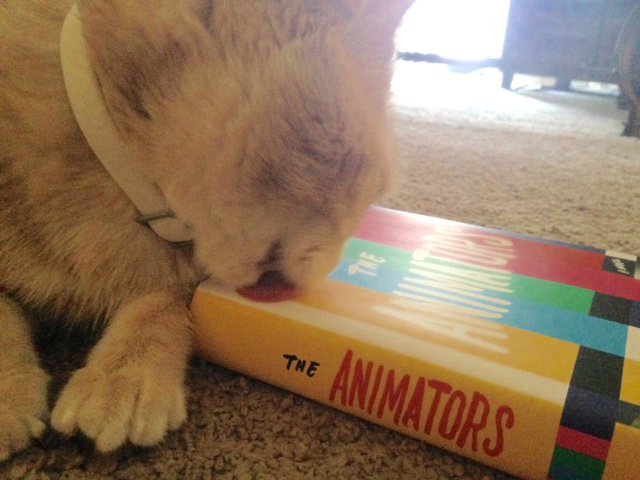
    Seeing my book in print for the first time was lovely and surreal. That was the most striking blessing – to receive the hardcover of The Animators in the mail, just last week. I will never forget opening that package and seeing the actual, gorgeous object. Of course, I put it down on our coffee table and my cat immediately set about trying to eat it, which was when the moment ended.
    The Animators by Kayal Rae Whitaker


    6- What's the best way to celebrate Valentine's Day?

    Slasher movies and takeout. I think last Valentine’s, we watched Rosemary’s Baby and ate Chinese food.

    7- Who is currently your biggest fan? What does that person love most (or "ship") about your debut novel?

    My husband. He’s fond of the fact that I used the term “waspers,” at one point, instead of “wasps,” which is a real Kentucky thing. Mel also makes reference to feeding marshmallows to the alligators during her childhood in Florida, which is something my husband used to do during his childhood (a detail used with his permission, of course). He got a kick out of seeing those details surface in the fiction. It probably doesn’t hurt that the book is dedicated to him.

    8- Can you share a picture of NY and one of KY?

    Kentucky image
    Kentucky “dog walk” photo on the KY/TN border, from 1993.

     NYC BK image
    NYC photograph, from Bensonhurst, Burger King, 2013.


    9- What emotions do you hope your book will evoke for the reader, and is there a particular scene you hope will resonate with readers?

    Renewed faith, I hope, in the beauty of which we are capable, not only through persistence and vision and work, but in terms of what we are capable of doing for one another in the name of friendship. It’s rare for someone else to really see you and to say, with certainty, “I see you as you are. I recognize your struggle.” That Sharon and Mel can do that for one another is rare and redeeming. There is one scene that comes to mind in which Sharon is hospitalized and Mel, to keep her company, tells her this ridiculous story from her childhood about learning how to spell obscenities with her Lite Brite – all while clipping Sharon’s toenails. That image is, in many ways, the book’s core.

    10- What is the most memorable trait or visual oddity of one of your characters?

    For Sharon and Mel – it would be the calluses on their hands. They’re career cartoonists. Their calluses rival those of professional guitar players and manual laborers. You could bounce needles off the callus pads on their thumbs: no puncture, no blood. Their life’s work is written all over their hands.

    11- #DiversityBingo2017 Which squares does your book cover on the card?

    We definitely have a main character with an underrepresented body – though the fact that a size 14 is underrepresented is beyond ridiculous. Main character Sharon experiences a stroke at age 32 in the book, and so deals with chronic pain throughout. Both Sharon and Mel struggle with hidden mental health disabilities, particularly depression and PTSD. Mel and Sharon moved through school early enough in the late eighties/early nineties to miss the benefit of neurodiversity recognition, to their disadvantage, perhaps. Though the book is not in Mel’s voice, she is an obvious candidate for an ADHD diagnosis.

    12- Which character has your favorite Personality Contradiction?

    Sharon is depressed as hell. Her misanthropy, at times, stuns me, and I invented her. But she is funny, man. Really funny. I suppose that’s not an entirely uncommon combination – humor as indicative of a somewhat dark internal life.

    13- As a reader, what most motivates you to buy a new book to read?

    My failproof method – and it’s easiest to do this in an actual bookstore – is to pick the book up and read the first ten to twenty pages. That usually gives me what I need to know. The last couple of books I bought because I liked the first ten were The Red Car, by Marcy Dermansky, and The Life and Death of Sophie Stark, by Anna North.

    14- What was the deciding factor in your publication route?

    I’m happy we live in a time when publishing allows for three or four routes instead of just one. I knew from the beginning that I did not want to sell my book unagented. I knew I needed an expert. For the record, my agent, who is wonderful, found my manuscript in the slush pile – so take heart, writers, the slush pile works. That decided my publishing path. I’ve loved being at Random House. I’ve gotten to work with an amazing group of people who love my book as much as I do. I feel extremely fortunate.

    15- What's your favorite charity or charitable cause?

    Planned Parenthood. When you declare war on women’s health, you declare war on women, plain and simple. PP needs all the support they can get. The cause of equitable health care access needs all the support it can get.
    Planned Parenthood services performed stat image from churchmilitant.com


    16- What discussion topic would you like the readers of this interview to remark on in the comments?

    That of women and agency. Women are still conditioned, from girlhood, to assume a passive stance in their own lives, to live as the ones told rather than the ones telling. I would go as far as to say that for a woman to develop a project of any kind is to move against her conditioning as female. The concept of women as authorities over their own work, claiming the narratives they have created without interference, is an important one, and one that relates to the claim women should have over the rest of their lives: politically, socially, personally. I hope we’re progressing. I hope we’re moving beyond teaching women silence.

    17- Anything else you would care to share about your book and yourself?

    Because this is such a visual book, I’ve become really fond of using Instagram (https://www.instagram.com/kaylaraewhitaker) and Tumblr (https://www.tumblr.com/blog/vaughtandkissescartoonreel) to start up the Vaught and Kisses Cartoon Reel, filled with our favorite animated shorts. This is unusual, because I typically find social media difficult and scary (Facebook, in particular, gives me the shakes). I feel like an actual Millennial now!

    Tuesday, January 31, 2017

    January Reading Roundup

    Here's what I read this month:

     I don't read a lot of literary fiction, and I don't remember why I picked this book out, but I'm glad I did. I wanted to keep reading because I was so engrossed in the characters and how their lives were affected by Lydia's death. And the ending surprised me, which is something I require from literary fiction.
     One of Jodi Picoult's sensitivity readers pointed out on Twitter that this is not a book teaching black people about their own experience--it's a book that will hopefully help white people wake up to some of their own privileges. It frequently made me uncomfortable, and I'm glad it did.
     Leandra recommended this series to me some time last year, and I've finally gotten around to it. I love the premise of ghost-hunting teenagers, but I guessed the big reveal long before it was actually revealed, which disappointed me. I can't tell if this book is supposed to be middle grade or young adult, but since I'm neither of those target audiences I decided to let it go and enjoy it regardless.
     Book 2 in the Birth of Saints series. I like that the fantasy world isn't your typical ripoff of medieval Europe, and I'm excited to see where the characters go next!
     My sister got this for me for Christmas. The design is gorgeous, both inside and out. I liked it, and just like with HP & the Cursed Child, I wished it was a complete book instead of just a screenplay. I liked Newt Scamander, but felt like the American characters were a caricature of what J.K. Rowling thinks Americans are like. It reminded me of the episode of Doctor Who with Martha and the tenth Doctor that's set in 1920s NYC.
    I enjoyed Nicola Yoon's debut, but I LOVED this one. I loved the way the story was told just as much as the story itself. You should definitely recommend this one to the teens in your life.


    Reading this after Carrie Fisher's death last month made it even more sad. I liked getting some behind the scenes detail about filming Star Wars, but it's mostly about her affair with Harrison Ford and how it made her feel like junk.


    I thought this was a contemporary novel, and then about 20 chapters in it became paranormal. Nothing against paranormal, but the "bait and switch" feeling annoyed me. I enjoyed the book, but wish the description wasn't misleading.


     The thing about Historical Romance that I love is that the flooded market demands that each book have a unique premise or conceit. The conceit in this book is ridiculous, yet compelling. I will probably end up reading the whole series to find out what happens to all those silly Stud Club tokens.


    See above.
    In related news, I don't think I will ever read 3 historical romances in a row again, because by the third book I was skipping over the sex scenes because I could not handle another one.
    I cried a lot while reading this book. It was a poignant reminder that you never know what people are struggling with, and you should always try to leave people better than you found them. It makes me want to read Strayed's memoir, WILD.


    What books did you read and love this month?

    Monday, January 30, 2017

    How to Make Podcasts Part of Your Book Marketing Strategy

    A hearty welcome to guest blogger, Josh Pantalleresco of Just Joshing, a literary podcast. He's here to tell you how to make the most of this great book marketing resource.


     Just Joshing
    Podcasts are a great resource for authors. These days, promotion is a necessary evil all writers must engage in. As amazing as your book may be, you need to let people know about it. Interviews are a great way to let your fans or potential fans know who you are and what you offer, and maybe make them care about it at the very end.

    After all, you want people to care about your book. Each one of you reading this has worked your butt off constructing a book.  It deserves to find an audience—the right audience—reading it.

    So if you are looking for press and promotion, try to keep a few of these things in mind when you do seek podcasts to promote it.

    The first question you should ask yourself is what kind of book did you complete? One of the key things about promotion today is that general promotion is no longer an efficient form of advertising. Don't get me wrong, there's no such thing as a bad kind of promotion. That said, I'd argue that identifying the niche of your book is one of the most crucial things you need to do to is identify your niche. Are you a steampunk romance? Or are you a cyberpunk world war two alternative history story? Believe it or not, there are places that promote each.

    Podcasts are no different. There are horror podcasts, science fiction podcasts, graphic novel podcasts, and so on and so forth. They love their niches and talk about them all the time. If you are in that niche, chances are they will gush at what you've done.

    My podcast (the twice a week literary podcast Just Joshing, which airs Tuesdays and Fridays) is a little bit more general. But if you look real closely at my guest list, most of my guests do some kind of science fiction, fantasy, young adult, or horror. I do diverge from this from time to time, but that is what I'm looking for by and large. So if you are unsure what audience the podcast is trying to reach, check out their guest list. Do they do the kind of thing you are doing? The more they do it, the better the chances that podcast would be interested in you.

    The last thing you should do before you go on a podcast of any kind is listen to it. After all, you need to know what kind of interview do they do. In my podcast, Just Joshing, I do a casual interview.  I rather have an interesting conversation, over the general question and answer session. I feel a podcast is best for a conversation and that's how I do my show.


    Beyond that, I leave it up to you. Find your niche; I cannot stress that enough. It seems like such a common sense approach, but the truth is, a lot of creators fail to realize who they are in the literary world. Figure it out, and then go forth and find that audience. Once you find that niche, make sure you come across as genuine and comfortable. Beyond that, be yourself. More so than the book, people will connect with you if you come across as someone honest and sincere with your audience—which you've hopefully achieved with the interview. And if you're lucky, you've found more readers that are into what you do. And isn't that the goal?

    Have any questions for Josh? Please post them in the comments.

    *****************

    Joshua Pantalleresco writes stuff, and podcasts too. His podcast, Just Jo
    shing, airs Tuesdays and Fridays at http://jpantalleresco.podomatic.com or on itunes at https://itunes.apple.com/ca/podcast/just-joshing-podcast/id1199328015 .
    His books The Watcher and Stormdancer are published by Mirror World Books and are available at http://www.mirrorworldpublishing.com, Amazon or at bookstores. His next book The Cloud Diver will be released this spring. Learn more at http://jpantalleresco.wordpress.com.

    Friday, January 27, 2017

    Flash Fiction Contest #26


    Have you ever been told a tall tale and you know it? Little kids are famous for it, spinning out yarns that it's hard to listen to with a straight face.

    Show us your tallest tales-- reasons why you were late or why you didn't get X done. The wilder and taller, the better!!

    The deadline for entry is noon Sun 1/29, with the winner announced later in the afternoon. Rules can be found here. As always, have fun!

    Thursday, January 26, 2017

    Tackling the Dreaded Synopsis - Part One

    Here's an increasingly common scenario. An agent has had your partial or full manuscript for several weeks, and you finally get a long-awaited email from her. Your heart pounding, you open the email. "Can you please send me a synopsis?" she asks.

    Or you just found out about a contest you know you want to enter. The contest judges will be deciding which entries move on to the agent round based on a query letter, the first page/chapter of the manuscript... and a synopsis. The entry deadline is tomorrow. Your query letter and the manuscript itself are word-perfect, edited, beta-read, and revised. But can you write a great synopsis in 24 hours?

    In this post, we'll discuss what a synopsis is (and isn't), how synopses are used by agents and authors, and the basic requirements for writing a good one.

    Next week, we'll go through the mechanics of synopsis writing, and I'll post an example of a synopsis that works.

    After that, I'll be critiquing your synopses - we'll add a form to next week's post so you can submit!

    What is a synopsis? A synopsis is a summary of your manuscript's plot. It details the entire main plot arc (including the ending) and also mentions the most important subplots and characters. It doesn't include many character or setting details, and also doesn't include dialogue, metaphors, or detailed descriptions. Think of it as the blueprint for a house. You don't need to show the tablecloths and chandeliers, but you'd better make sure the dimensions of all the rooms are accurately represented.

    Why does everyone hate writing synopses so much? Because it's hard! You've spent months (maybe years) writing your book, weighing every word, stressing over character arcs, settings, and plot points. Now you have to condense tens of thousands of words into a couple of pages? It's definitely daunting, but it's doable.

    How is it different from a query letter? I like to think of a query letter as 'teasing your story' and the synopsis as 'telling your story.' It may not sound like a huge difference, but think about it: With the query, you want to say just enough to entice an agent, to excite her so much about your story that she just has to request pages. You don't want to give away the ending in a query - you want to end on an uncertain note, a cliffhanger, with the action or decision your main character will have to choose. You want to hook the agent, but you don't want to reel her in. On the other hand, with the synopsis, you're reeling her in by telling the entire story.

    Why do agents and contest judges want synopses? An agent might be reading your full manuscript, but also have 100 other fulls to read. If she starts reading and knows right away she likes your voice, your writing, your characters, and the concept, she may request a synopsis so she can get a 'cheat sheet' for the plot without having to read the entire manuscript. It's a way for her to confirm the plot isn't going to go off the rails in the middle or end of the manuscript, and that you can sustain momentum throughout the book. Same with contest judges - they often have hundreds of entries to pore over. A synopsis helps cut way down on reading time.

    How long does it have to be? The most common requests seem to be 'no more than two pages' and 'no more than five pages.' I've always started by writing a five-page synopsis, and then cut it down to two pages. The opposite works just as well. Once you've got both, you're ready to go, and can comply with a request for either a short or long synopsis.

    What formatting should I use? Use the same font/size as your manuscript (12-point Times New Roman, etc.). For the five-page synopsis, double-space and indent paragraphs. For the two-page synopsis, you can single space and add a space between paragraphs instead of indenting.

    What parts of my manuscript do I need to cover? All of it! Well, okay, that's not exactly true. You need to set the scene, introduce your main character, and run through the entire main plot. All of the significant events (and characters) from the main plot need to be included. Subplots and secondary characters can be included if they are directly relevant to the main plot. And you MUST give away the ending.

    How many characters can I name? Rule of thumb is no more than 5. More than that, and it starts getting difficult for the reader to keep track. For all other characters, you can refer to them using their relationship to the main character (for example, John's brother, Mary's teacher, etc.).

    Do I need comps, word count, genre, a bio, etc.? Nope. Save those for the query.

    Does the writing have to be stellar? Why not? This is another opportunity to show the agent or contest judge that you've got the chops. Write your synopsis like you're answering the question, "What happens in your story?" You want that answer to be colorful, intriguing, and complete, and for it to showcase your writing abilities.

    My book has a great twist at the end. I can't possibly give it away? Too bad. If an agent has requested a synopsis, then he wants to know how the plot of your book progresses, and that necessarily includes the ending.

    When should I write my synopsis? I usually write my synopsis when I'm about halfway through the first draft of my manuscript (note: I do create broad outlines before I start writing, so if you're a pantser, you might prefer to wait until the first draft is done). Writing a synopsis while I'm writing the book lets me know whether the plot is working. Is there a clear through-line for the main plot? What's missing to connect Points A, B, and C? Does a character appear in the first chapter of the book and then isn't heard from again until the 50% mark? A synopsis helps you see the forest for the trees - you can make sure your main plot is working while you're writing the draft. Besides, after you're done editing the manuscript and sweating over the query letter, it's nice to know you've already got a draft synopsis waiting in the wings!

    Got questions about the 'Tackling the Dreaded Synopsis' series? Feel free to ask, or start a discussion, in the comments. And tune in next week for more on the mechanics of synopsis writing, a sample synopsis of a novel 99% of you will be familiar with, and the official call for submissions!